

The nuclear partition function of the diatomic molecule. In the general case (AB
molecule), it is equal to:
F n ¼ 2I A þ 1
ð
Þ2I B þ 1
ð
Þ=r;
ð2:2:26Þ
where I i are the the nuclei’s spins, r is the order of the axis of symmetry (see above);
r = 1 (heteronuclear diatomic molecules); for homonuclear molecules, it is equal to
2, because the two positions of the molecule when replacing nuclei are equivalent. It
is clear that in the case of a homonuclear molecule, such as I 2 , F n = (2I + 1)
2 /2. The
author deliberately omits here the details associated with different statistics (Fermi–
Dirac and Bose–Einstein), which obey homonuclear molecules with different
nuclear spins. (the degeneracy of the ortho-isomer is equal to (I + 1) (2I + 1), and
para (2I + 1)). When summing over all rotational levels, one gets (2I + 1)
2
/2.
Polyatomic molecules.
The rotational partition function is equal to [3], p. 386
F r ¼
8p
2 8p
3
I A I B I C
ð
Þ
1=2 kT
ð Þ
3=2
rh 3
;
ð2:2:27Þ
I A ; I B ; I C are the principal moments of inertia.
The vibrational partition function is
F v ¼
Y
j
½1 À expð hx j =kTÞ
À1
ð2:2:28Þ
x j are the normal vibration frequencies.
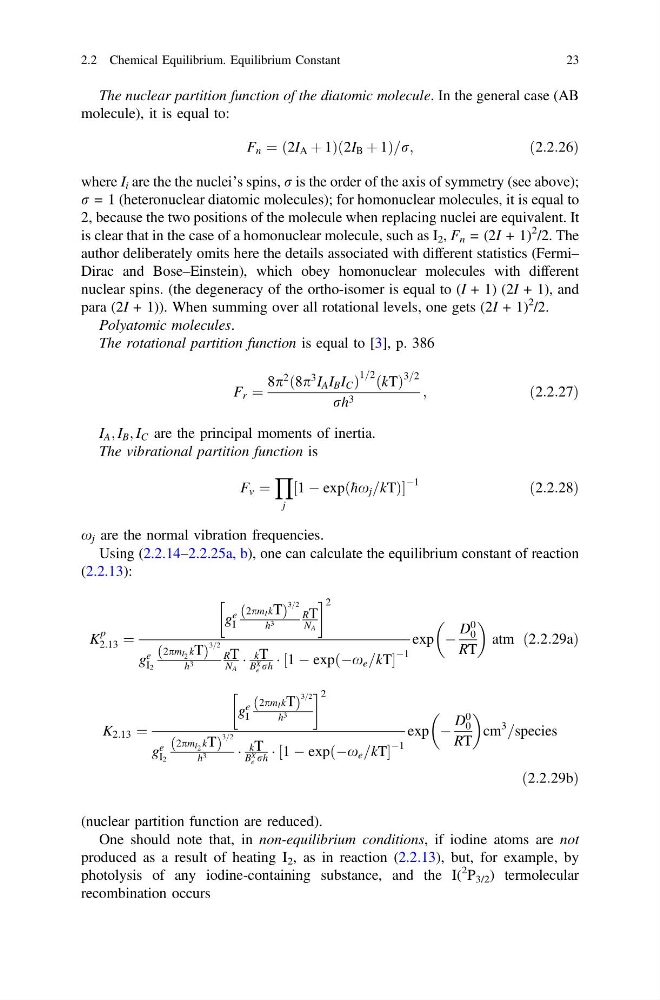
Using (2.2.14–2.2.25a, b), one can calculate the equilibrium constant of reaction
(2.2.13):
K
p
2:13 ¼
g
e
I
2pm I kT
ð
Þ
3=2
h 3
RT
N A
! 2
g
e
I 2
2pm I 2 kT
ð
Þ
3=2
h 3
RT
N A
Á
kT
B X
e rh Á ½1 À exp Àx e =kT
ð
À1
exp À
D
0
0
RT
atm ð2:2:29aÞ
K 2:13 ¼
g
e
I
2pm I kT
ð
Þ
3=2
h 3
! 2
g
e
I 2
2pm I 2 kT
ð
Þ
3=2
h 3
Á
kT
B X
e rh Á ½1 À exp Àx e =kT
ð
À1
exp À
D
0
0
RT
cm
3
=species
ð2:2:29bÞ
(nuclear partition function are reduced).
One should note that, in non-equilibrium conditions, if iodine atoms are not
produced as a result of heating I 2 , as in reaction (2.2.13), but, for example, by
photolysis of any iodine-containing substance, and the I(
2 P 3/2 ) termolecular
recombination occurs
2.2 Chemical Equilibrium. Equilibrium Constant
23
molecule), it is equal to:
F n ¼ 2I A þ 1
ð
Þ2I B þ 1
ð
Þ=r;
ð2:2:26Þ
where I i are the the nuclei’s spins, r is the order of the axis of symmetry (see above);
r = 1 (heteronuclear diatomic molecules); for homonuclear molecules, it is equal to
2, because the two positions of the molecule when replacing nuclei are equivalent. It
is clear that in the case of a homonuclear molecule, such as I 2 , F n = (2I + 1)
2 /2. The
author deliberately omits here the details associated with different statistics (Fermi–
Dirac and Bose–Einstein), which obey homonuclear molecules with different
nuclear spins. (the degeneracy of the ortho-isomer is equal to (I + 1) (2I + 1), and
para (2I + 1)). When summing over all rotational levels, one gets (2I + 1)
2
/2.
Polyatomic molecules.
The rotational partition function is equal to [3], p. 386
F r ¼
8p
2 8p
3
I A I B I C
ð
Þ
1=2 kT
ð Þ
3=2
rh 3
;
ð2:2:27Þ
I A ; I B ; I C are the principal moments of inertia.
The vibrational partition function is
F v ¼
Y
j
½1 À expð hx j =kTÞ
À1
ð2:2:28Þ
x j are the normal vibration frequencies.
Using (2.2.14–2.2.25a, b), one can calculate the equilibrium constant of reaction
(2.2.13):
K
p
2:13 ¼
g
e
I
2pm I kT
ð
Þ
3=2
h 3
RT
N A
! 2
g
e
I 2
2pm I 2 kT
ð
Þ
3=2
h 3
RT
N A
Á
kT
B X
e rh Á ½1 À exp Àx e =kT
ð
À1
exp À
D
0
0
RT
atm ð2:2:29aÞ
K 2:13 ¼
g
e
I
2pm I kT
ð
Þ
3=2
h 3
! 2
g
e
I 2
2pm I 2 kT
ð
Þ
3=2
h 3
Á
kT
B X
e rh Á ½1 À exp Àx e =kT
ð
À1
exp À
D
0
0
RT
cm
3
=species
ð2:2:29bÞ
(nuclear partition function are reduced).
One should note that, in non-equilibrium conditions, if iodine atoms are not
produced as a result of heating I 2 , as in reaction (2.2.13), but, for example, by
photolysis of any iodine-containing substance, and the I(
2 P 3/2 ) termolecular
recombination occurs
2.2 Chemical Equilibrium. Equilibrium Constant
23