

2I
2 P 3=2
À
Á $ I 2 X0
þ
g ; A
0 2 u ; A1 u . . .; v max
ð2:2:30Þ
I 2 X0
þ
g A
0 2 u ; A1 u . . .; v max
$
M I 2 X0
þ
g ; A
0 2 u ; A1 u . . .; v\v max
ð2:2:31Þ
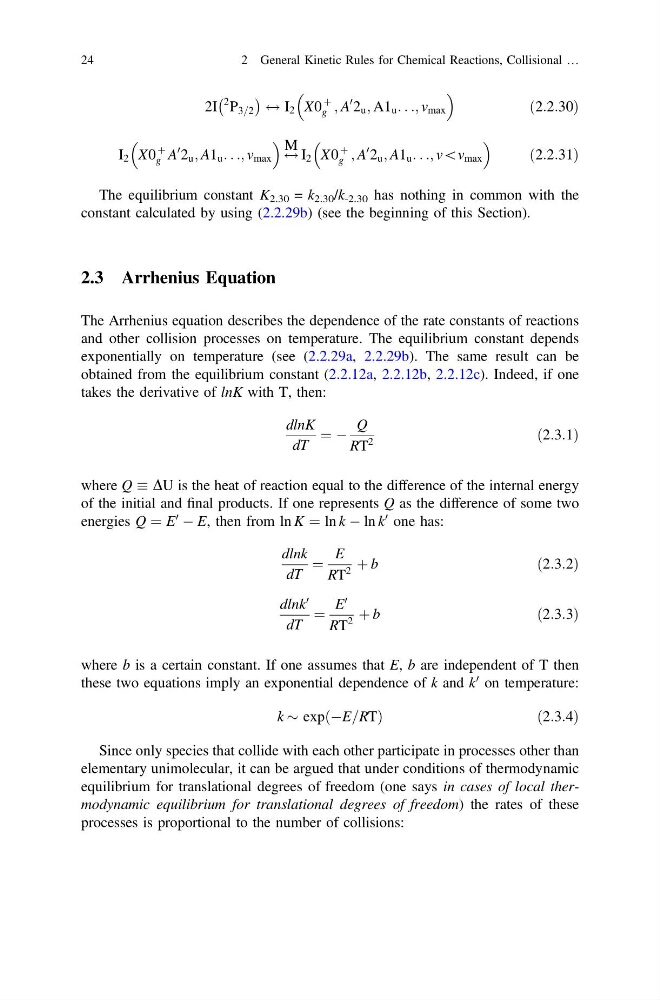
The equilibrium constant K 2.30 = k 2.30 /k -2.30 has nothing in common with the
constant calculated by using (2.2.29b) (see the beginning of this Section).
2.3 Arrhenius Equation
The Arrhenius equation describes the dependence of the rate constants of reactions
and other collision processes on temperature. The equilibrium constant depends
exponentially on temperature (see (2.2.29a, 2.2.29b). The same result can be
obtained from the equilibrium constant (2.2.12a, 2.2.12b, 2.2.12с). Indeed, if one
takes the derivative of lnK with T, then:
dlnK
dT
¼ À
Q
RT
2
ð2:3:1Þ
where Q DU is the heat of reaction equal to the difference of the internal energy
of the initial and final products. If one represents Q as the difference of some two
energies Q ¼ E
0
À E, then from ln K ¼ ln k À ln k
0 one has:
dlnk
dT
¼
E
RT
2
þ b
ð2:3:2Þ
dlnk
0
dT
¼
E
0
RT
2
þ b
ð2:3:3Þ
where b is a certain constant. If one assumes that E, b are independent of T then
these two equations imply an exponential dependence of k and k
0 on temperature:
k $ expðÀE=RTÞ
ð 2:3:4Þ
Since only species that collide with each other participate in processes other than
elementary unimolecular, it can be argued that under conditions of thermodynamic
equilibrium for translational degrees of freedom (one says in cases of local thermodynamic equilibrium for translational degrees of freedom) the rates of these
processes is proportional to the number of collisions:
24
2 General Kinetic Rules for Chemical Reactions, Collisional …
2 P 3=2
À
Á $ I 2 X0
þ
g ; A
0 2 u ; A1 u . . .; v max
ð2:2:30Þ
I 2 X0
þ
g A
0 2 u ; A1 u . . .; v max
$
M I 2 X0
þ
g ; A
0 2 u ; A1 u . . .; v\v max
ð2:2:31Þ
The equilibrium constant K 2.30 = k 2.30 /k -2.30 has nothing in common with the
constant calculated by using (2.2.29b) (see the beginning of this Section).
2.3 Arrhenius Equation
The Arrhenius equation describes the dependence of the rate constants of reactions
and other collision processes on temperature. The equilibrium constant depends
exponentially on temperature (see (2.2.29a, 2.2.29b). The same result can be
obtained from the equilibrium constant (2.2.12a, 2.2.12b, 2.2.12с). Indeed, if one
takes the derivative of lnK with T, then:
dlnK
dT
¼ À
Q
RT
2
ð2:3:1Þ
where Q DU is the heat of reaction equal to the difference of the internal energy
of the initial and final products. If one represents Q as the difference of some two
energies Q ¼ E
0
À E, then from ln K ¼ ln k À ln k
0 one has:
dlnk
dT
¼
E
RT
2
þ b
ð2:3:2Þ
dlnk
0
dT
¼
E
0
RT
2
þ b
ð2:3:3Þ
where b is a certain constant. If one assumes that E, b are independent of T then
these two equations imply an exponential dependence of k and k
0 on temperature:
k $ expðÀE=RTÞ
ð 2:3:4Þ
Since only species that collide with each other participate in processes other than
elementary unimolecular, it can be argued that under conditions of thermodynamic
equilibrium for translational degrees of freedom (one says in cases of local thermodynamic equilibrium for translational degrees of freedom) the rates of these
processes is proportional to the number of collisions:
24
2 General Kinetic Rules for Chemical Reactions, Collisional …