

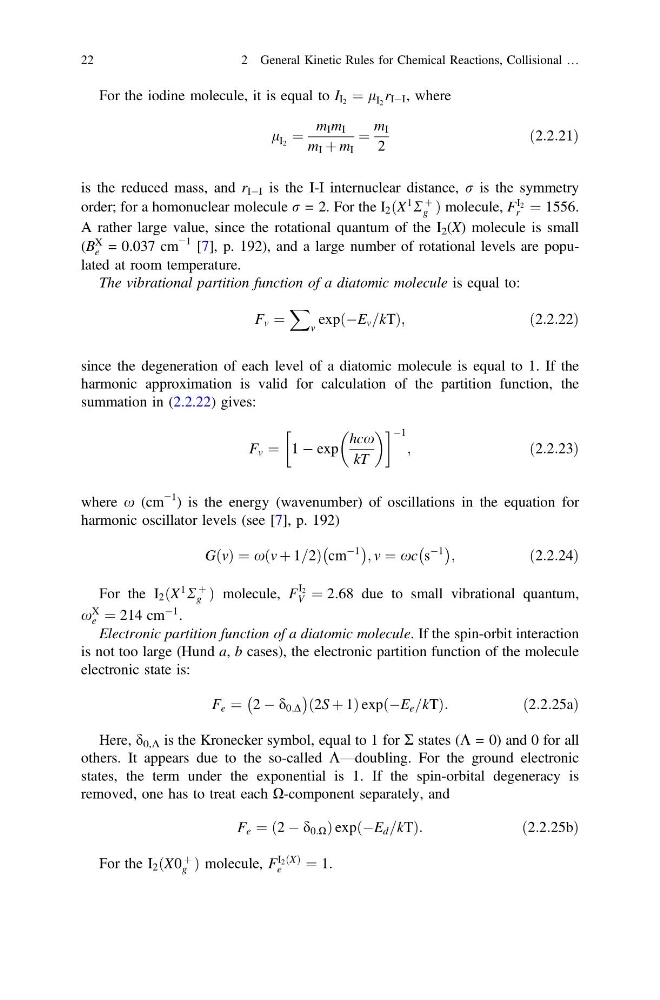
For the iodine molecule, it is equal to I I 2 ¼ l I 2 r IÀI , where
l I 2 ¼
m I m I
m I þ m I
¼
m I
2
ð2:2:21Þ
is the reduced mass, and r IÀI is the I-I internuclear distance, r is the symmetry
order; for a homonuclear molecule r = 2. For the I 2 ðX
1
R
þ
g Þ molecule, F
I 2
r ¼ 1556.
A rather large value, since the rotational quantum of the I 2 (X) molecule is small
(B
X
e = 0.037 cm
−1 [7], p. 192), and a large number of rotational levels are populated at room temperature.
The vibrational partition function of a diatomic molecule is equal to:
F v ¼
X
v
expðÀE v =kTÞ;
ð2:2:22Þ
since the degeneration of each level of a diatomic molecule is equal to 1. If the
harmonic approximation is valid for calculation of the partition function, the
summation in (2.2.22) gives:
F v ¼ 1 À exp
hcx
kT
! À1
;
ð2:2:23Þ
where x (cm
−1 ) is the energy (wavenumber) of oscillations in the equation for
harmonic oscillator levels (see [7], p. 192)
GðvÞ ¼ xðv þ 1=2Þ cm
À1
À
Á ; v ¼ xc s
À1
À Á ;
ð2:2:24Þ
For the I 2 ðX
1
R
þ
g Þ molecule, F
I 2
V ¼ 2:68 due to small vibrational quantum,
x
X
e ¼ 214 cm
À1 .
Electronic partition function of a diatomic molecule. If the spin-orbit interaction
is not too large (Hund a, b cases), the electronic partition function of the molecule
electronic state is:
F e ¼ 2 À d 0;D
À
Á ð2S þ 1Þ exp ÀE e =kT
ð
Þ :
ð2:2:25aÞ
Here, d 0,K is the Kronecker symbol, equal to 1 for R states (K = 0) and 0 for all
others. It appears due to the so-called K—doubling. For the ground electronic
states, the term under the exponential is 1. If the spin-orbital degeneracy is
removed, one has to treat each X-component separately, and
F e ¼ 2 À d 0:X
ð
Þexp ÀE d =kT
ð
Þ :
ð2:2:25bÞ
For the I 2 ðX0
þ
g Þ molecule, F
I 2 X
ð Þ
e
¼ 1.
22
2 General Kinetic Rules for Chemical Reactions, Collisional …
l I 2 ¼
m I m I
m I þ m I
¼
m I
2
ð2:2:21Þ
is the reduced mass, and r IÀI is the I-I internuclear distance, r is the symmetry
order; for a homonuclear molecule r = 2. For the I 2 ðX
1
R
þ
g Þ molecule, F
I 2
r ¼ 1556.
A rather large value, since the rotational quantum of the I 2 (X) molecule is small
(B
X
e = 0.037 cm
−1 [7], p. 192), and a large number of rotational levels are populated at room temperature.
The vibrational partition function of a diatomic molecule is equal to:
F v ¼
X
v
expðÀE v =kTÞ;
ð2:2:22Þ
since the degeneration of each level of a diatomic molecule is equal to 1. If the
harmonic approximation is valid for calculation of the partition function, the
summation in (2.2.22) gives:
F v ¼ 1 À exp
hcx
kT
! À1
;
ð2:2:23Þ
where x (cm
−1 ) is the energy (wavenumber) of oscillations in the equation for
harmonic oscillator levels (see [7], p. 192)
GðvÞ ¼ xðv þ 1=2Þ cm
À1
À
Á ; v ¼ xc s
À1
À Á ;
ð2:2:24Þ
For the I 2 ðX
1
R
þ
g Þ molecule, F
I 2
V ¼ 2:68 due to small vibrational quantum,
x
X
e ¼ 214 cm
À1 .
Electronic partition function of a diatomic molecule. If the spin-orbit interaction
is not too large (Hund a, b cases), the electronic partition function of the molecule
electronic state is:
F e ¼ 2 À d 0;D
À
Á ð2S þ 1Þ exp ÀE e =kT
ð
Þ :
ð2:2:25aÞ
Here, d 0,K is the Kronecker symbol, equal to 1 for R states (K = 0) and 0 for all
others. It appears due to the so-called K—doubling. For the ground electronic
states, the term under the exponential is 1. If the spin-orbital degeneracy is
removed, one has to treat each X-component separately, and
F e ¼ 2 À d 0:X
ð
Þexp ÀE d =kT
ð
Þ :
ð2:2:25bÞ
For the I 2 ðX0
þ
g Þ molecule, F
I 2 X
ð Þ
e
¼ 1.
22
2 General Kinetic Rules for Chemical Reactions, Collisional …