

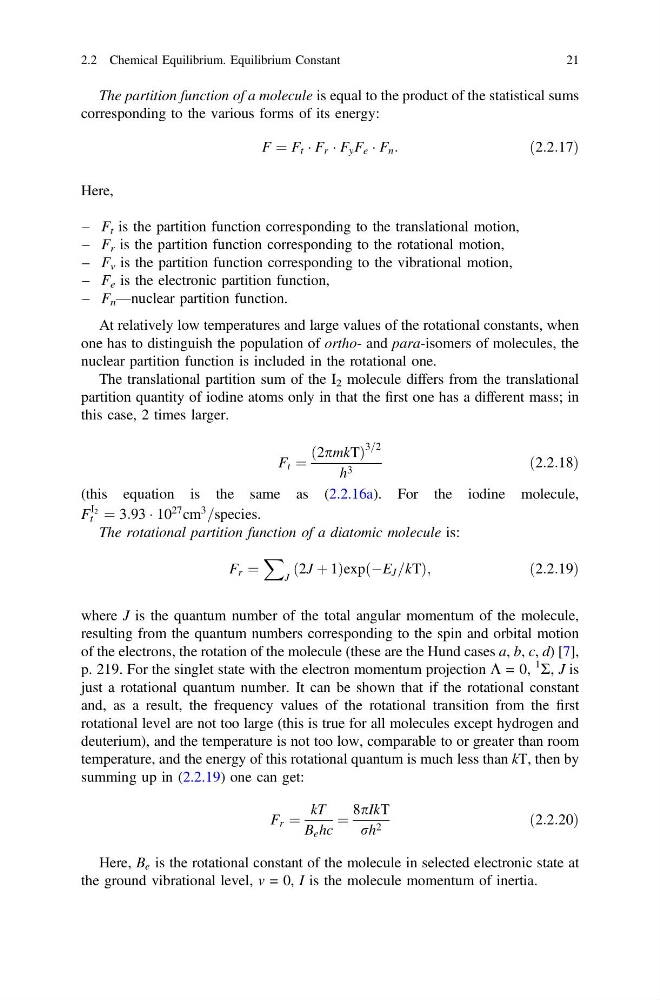
The partition function of a molecule is equal to the product of the statistical sums
corresponding to the various forms of its energy:
F ¼ F t Á F r Á F y F e Á F n :
ð2:2:17Þ
Here,
– F t is the partition function corresponding to the translational motion,
– F r is the partition function corresponding to the rotational motion,
– F v is the partition function corresponding to the vibrational motion,
– F e is the electronic partition function,
– F n —nuclear partition function.
At relatively low temperatures and large values of the rotational constants, when
one has to distinguish the population of ortho- and para-isomers of molecules, the
nuclear partition function is included in the rotational one.
The translational partition sum of the I 2 molecule differs from the translational
partition quantity of iodine atoms only in that the first one has a different mass; in
this case, 2 times larger.
F t ¼
2pmkT
ð
Þ
3=2
h 3
ð2:2:18Þ
(this equation is the same as (2.2.16a). For the iodine molecule,
F
I 2
t ¼ 3:93 Á 10
27 cm
3
=species.
The rotational partition function of a diatomic molecule is:
F r ¼
X
J
2J þ 1
ð
ÞexpðÀE J =kTÞ;
ð2:2:19Þ
where J is the quantum number of the total angular momentum of the molecule,
resulting from the quantum numbers corresponding to the spin and orbital motion
of the electrons, the rotation of the molecule (these are the Hund cases a, b, c, d) [7],
p. 219. For the singlet state with the electron momentum projection K = 0,
1 R, J is
just a rotational quantum number. It can be shown that if the rotational constant
and, as a result, the frequency values of the rotational transition from the first
rotational level are not too large (this is true for all molecules except hydrogen and
deuterium), and the temperature is not too low, comparable to or greater than room
temperature, and the energy of this rotational quantum is much less than kT, then by
summing up in (2.2.19) one can get:
F r ¼
kT
B e hc
¼
8pIkT
rh 2
ð2:2:20Þ
Here, B e is the rotational constant of the molecule in selected electronic state at
the ground vibrational level, v = 0, I is the molecule momentum of inertia.
2.2 Chemical Equilibrium. Equilibrium Constant
21
corresponding to the various forms of its energy:
F ¼ F t Á F r Á F y F e Á F n :
ð2:2:17Þ
Here,
– F t is the partition function corresponding to the translational motion,
– F r is the partition function corresponding to the rotational motion,
– F v is the partition function corresponding to the vibrational motion,
– F e is the electronic partition function,
– F n —nuclear partition function.
At relatively low temperatures and large values of the rotational constants, when
one has to distinguish the population of ortho- and para-isomers of molecules, the
nuclear partition function is included in the rotational one.
The translational partition sum of the I 2 molecule differs from the translational
partition quantity of iodine atoms only in that the first one has a different mass; in
this case, 2 times larger.
F t ¼
2pmkT
ð
Þ
3=2
h 3
ð2:2:18Þ
(this equation is the same as (2.2.16a). For the iodine molecule,
F
I 2
t ¼ 3:93 Á 10
27 cm
3
=species.
The rotational partition function of a diatomic molecule is:
F r ¼
X
J
2J þ 1
ð
ÞexpðÀE J =kTÞ;
ð2:2:19Þ
where J is the quantum number of the total angular momentum of the molecule,
resulting from the quantum numbers corresponding to the spin and orbital motion
of the electrons, the rotation of the molecule (these are the Hund cases a, b, c, d) [7],
p. 219. For the singlet state with the electron momentum projection K = 0,
1 R, J is
just a rotational quantum number. It can be shown that if the rotational constant
and, as a result, the frequency values of the rotational transition from the first
rotational level are not too large (this is true for all molecules except hydrogen and
deuterium), and the temperature is not too low, comparable to or greater than room
temperature, and the energy of this rotational quantum is much less than kT, then by
summing up in (2.2.19) one can get:
F r ¼
kT
B e hc
¼
8pIkT
rh 2
ð2:2:20Þ
Here, B e is the rotational constant of the molecule in selected electronic state at
the ground vibrational level, v = 0, I is the molecule momentum of inertia.
2.2 Chemical Equilibrium. Equilibrium Constant
21