

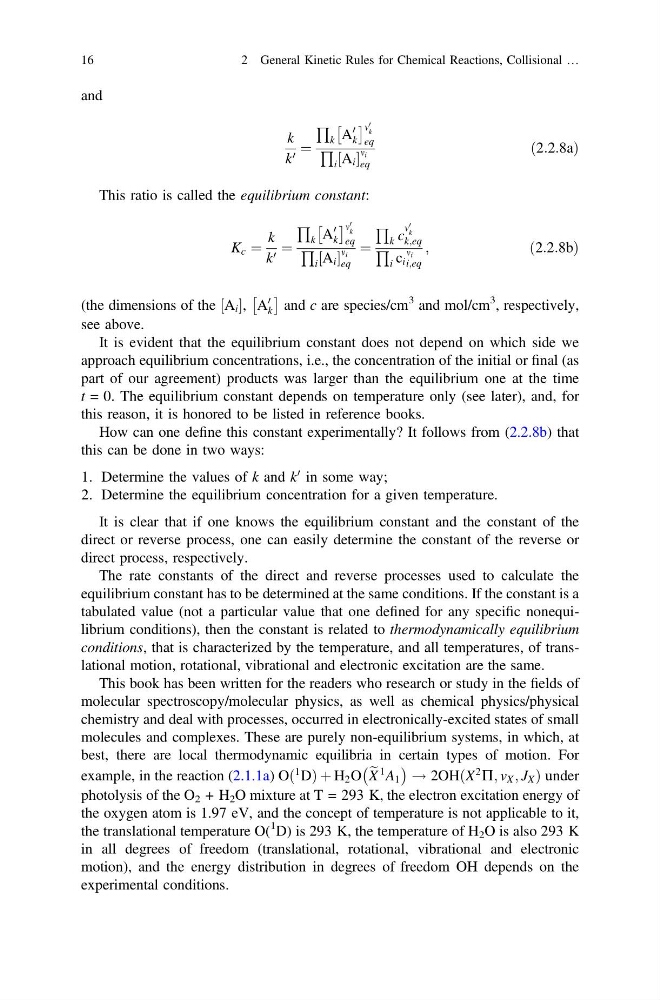
and
k
k 0 ¼
Q
k A
0
k
 à m
0
k
eq
Q
i A i
½
m i
eq
ð2:2:8aÞ
This ratio is called the equilibrium constant:
K c ¼
k
k 0 ¼
Q
k A
0
k
 à m
0
k
eq
Q
i A i
½
m i
eq
¼
Q
k c
m
0
k
k;eq
Q
i c i
m i
i;eq
;
ð2:2:8bÞ
(the dimensions of the A i
½ , A
0
k
 Ã
and c are species/cm
3 and mol/cm
3 , respectively,
see above.
It is evident that the equilibrium constant does not depend on which side we
approach equilibrium concentrations, i.e., the concentration of the initial or final (as
part of our agreement) products was larger than the equilibrium one at the time
t = 0. The equilibrium constant depends on temperature only (see later), and, for
this reason, it is honored to be listed in reference books.
How can one define this constant experimentally? It follows from (2.2.8b) that
this can be done in two ways:
1. Determine the values of k and k
0 in some way;
2. Determine the equilibrium concentration for a given temperature.
It is clear that if one knows the equilibrium constant and the constant of the
direct or reverse process, one can easily determine the constant of the reverse or
direct process, respectively.
The rate constants of the direct and reverse processes used to calculate the
equilibrium constant has to be determined at the same conditions. If the constant is a
tabulated value (not a particular value that one defined for any specific nonequilibrium conditions), then the constant is related to thermodynamically equilibrium
conditions, that is characterized by the temperature, and all temperatures, of translational motion, rotational, vibrational and electronic excitation are the same.
This book has been written for the readers who research or study in the fields of
molecular spectroscopy/molecular physics, as well as chemical physics/physical
chemistry and deal with processes, occurred in electronically-excited states of small
molecules and complexes. These are purely non-equilibrium systems, in which, at
best, there are local thermodynamic equilibria in certain types of motion. For
example, in the reaction (2.1.1a) O
1 D
ð ÞþH 2 O e
X
1
A 1
À
Á ! 2OH X
2 P; v X ; J X
ð
Þunder
photolysis of the O 2 + H 2 O mixture at T = 293 K, the electron excitation energy of
the oxygen atom is 1.97 eV, and the concept of temperature is not applicable to it,
the translational temperature O(
1 D) is 293 K, the temperature of H 2 O is also 293 K
in all degrees of freedom (translational, rotational, vibrational and electronic
motion), and the energy distribution in degrees of freedom OH depends on the
experimental conditions.
16
2 General Kinetic Rules for Chemical Reactions, Collisional …
k
k 0 ¼
Q
k A
0
k
 à m
0
k
eq
Q
i A i
½
m i
eq
ð2:2:8aÞ
This ratio is called the equilibrium constant:
K c ¼
k
k 0 ¼
Q
k A
0
k
 à m
0
k
eq
Q
i A i
½
m i
eq
¼
Q
k c
m
0
k
k;eq
Q
i c i
m i
i;eq
;
ð2:2:8bÞ
(the dimensions of the A i
½ , A
0
k
 Ã
and c are species/cm
3 and mol/cm
3 , respectively,
see above.
It is evident that the equilibrium constant does not depend on which side we
approach equilibrium concentrations, i.e., the concentration of the initial or final (as
part of our agreement) products was larger than the equilibrium one at the time
t = 0. The equilibrium constant depends on temperature only (see later), and, for
this reason, it is honored to be listed in reference books.
How can one define this constant experimentally? It follows from (2.2.8b) that
this can be done in two ways:
1. Determine the values of k and k
0 in some way;
2. Determine the equilibrium concentration for a given temperature.
It is clear that if one knows the equilibrium constant and the constant of the
direct or reverse process, one can easily determine the constant of the reverse or
direct process, respectively.
The rate constants of the direct and reverse processes used to calculate the
equilibrium constant has to be determined at the same conditions. If the constant is a
tabulated value (not a particular value that one defined for any specific nonequilibrium conditions), then the constant is related to thermodynamically equilibrium
conditions, that is characterized by the temperature, and all temperatures, of translational motion, rotational, vibrational and electronic excitation are the same.
This book has been written for the readers who research or study in the fields of
molecular spectroscopy/molecular physics, as well as chemical physics/physical
chemistry and deal with processes, occurred in electronically-excited states of small
molecules and complexes. These are purely non-equilibrium systems, in which, at
best, there are local thermodynamic equilibria in certain types of motion. For
example, in the reaction (2.1.1a) O
1 D
ð ÞþH 2 O e
X
1
A 1
À
Á ! 2OH X
2 P; v X ; J X
ð
Þunder
photolysis of the O 2 + H 2 O mixture at T = 293 K, the electron excitation energy of
the oxygen atom is 1.97 eV, and the concept of temperature is not applicable to it,
the translational temperature O(
1 D) is 293 K, the temperature of H 2 O is also 293 K
in all degrees of freedom (translational, rotational, vibrational and electronic
motion), and the energy distribution in degrees of freedom OH depends on the
experimental conditions.
16
2 General Kinetic Rules for Chemical Reactions, Collisional …