

Nevertheless, if one uses the equilibrium constants correctly, this concept and
even sometimes tabulated data can be useful not only for ‘traditional equilibrium’
chemists but also for a researcher who investigates non-equilibrium systems. In
1996, the author discovered the effect of the presence of local thermodynamic
equilibrium in covalent states of a chlorine molecule in all degrees of freedom,
excluding electronic. The electronic ‘temperature’, so to speak, of the triplet states,
was much higher than the ground singlet state, since these groups of states were not
collisionally mixed (see Sect. 7.2.3).
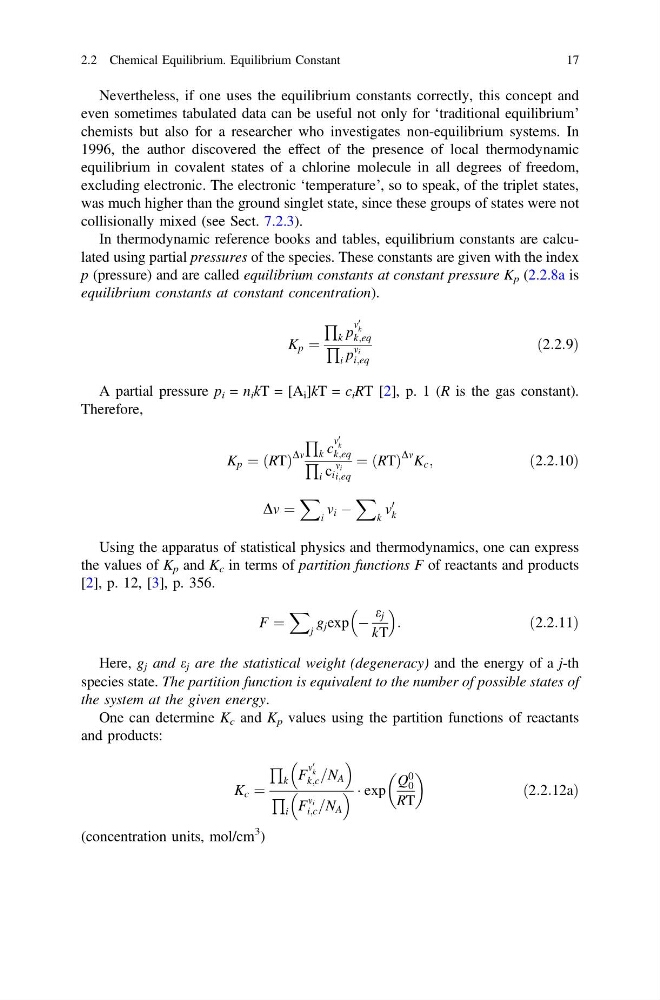
In thermodynamic reference books and tables, equilibrium constants are calculated using partial pressures of the species. These constants are given with the index
p (pressure) and are called equilibrium constants at constant pressure K p (2.2.8a is
equilibrium constants at constant concentration).
K p ¼
Q
k p
m
0
k
k;eq
Q
i p
m i
i;eq
ð2:2:9Þ
A partial pressure p i = n i kT = [A i ]kT = c i RT [2], p. 1 (R is the gas constant).
Therefore,
K p ¼ RT
ð Þ
Dm
Q
k c
m
0
k
k;eq
Q
i c i
m i
i;eq
¼ RT
ð Þ
Dm K c ;
ð2:2:10Þ
Dv ¼
X
i
v i À
X
k
v
0
k
Using the apparatus of statistical physics and thermodynamics, one can express
the values of K p and K c in terms of partition functions F of reactants and products
[2], p. 12, [3], p. 356.
F ¼
X
j
g j exp À
e j
kT
:
ð2:2:11Þ
Here, g j and e j are the statistical weight (degeneracy) and the energy of a j-th
species state. The partition function is equivalent to the number of possible states of
the system at the given energy.
One can determine K c and K p values using the partition functions of reactants
and products:
K c ¼
Q
k F
m
0
k
k;c =N A
Q
i F
m i
i;c =N A
Á exp
Q
0
0
RT
ð2:2:12aÞ
(concentration units, mol/cm
3 )
2.2 Chemical Equilibrium. Equilibrium Constant
17
even sometimes tabulated data can be useful not only for ‘traditional equilibrium’
chemists but also for a researcher who investigates non-equilibrium systems. In
1996, the author discovered the effect of the presence of local thermodynamic
equilibrium in covalent states of a chlorine molecule in all degrees of freedom,
excluding electronic. The electronic ‘temperature’, so to speak, of the triplet states,
was much higher than the ground singlet state, since these groups of states were not
collisionally mixed (see Sect. 7.2.3).
In thermodynamic reference books and tables, equilibrium constants are calculated using partial pressures of the species. These constants are given with the index
p (pressure) and are called equilibrium constants at constant pressure K p (2.2.8a is
equilibrium constants at constant concentration).
K p ¼
Q
k p
m
0
k
k;eq
Q
i p
m i
i;eq
ð2:2:9Þ
A partial pressure p i = n i kT = [A i ]kT = c i RT [2], p. 1 (R is the gas constant).
Therefore,
K p ¼ RT
ð Þ
Dm
Q
k c
m
0
k
k;eq
Q
i c i
m i
i;eq
¼ RT
ð Þ
Dm K c ;
ð2:2:10Þ
Dv ¼
X
i
v i À
X
k
v
0
k
Using the apparatus of statistical physics and thermodynamics, one can express
the values of K p and K c in terms of partition functions F of reactants and products
[2], p. 12, [3], p. 356.
F ¼
X
j
g j exp À
e j
kT
:
ð2:2:11Þ
Here, g j and e j are the statistical weight (degeneracy) and the energy of a j-th
species state. The partition function is equivalent to the number of possible states of
the system at the given energy.
One can determine K c and K p values using the partition functions of reactants
and products:
K c ¼
Q
k F
m
0
k
k;c =N A
Q
i F
m i
i;c =N A
Á exp
Q
0
0
RT
ð2:2:12aÞ
(concentration units, mol/cm
3 )
2.2 Chemical Equilibrium. Equilibrium Constant
17