

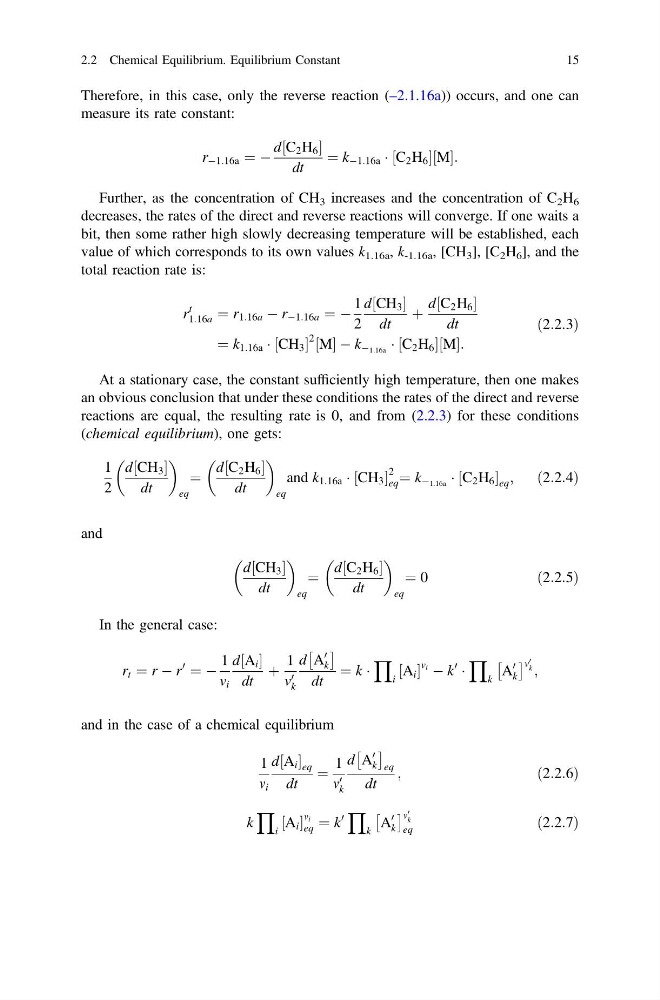
Therefore, in this case, only the reverse reaction (–2.1.16a)) occurs, and one can
measure its rate constant:
r À1:16a ¼ À
d C 2 H 6
½
dt
¼ k À1:16a Á C 2 H 6
½
½M:
Further, as the concentration of CH 3 increases and the concentration of C 2 H 6
decreases, the rates of the direct and reverse reactions will converge. If one waits a
bit, then some rather high slowly decreasing temperature will be established, each
value of which corresponds to its own values k 1.16a , k -1.16a , [CH 3 ], [C 2 H 6 ], and the
total reaction rate is:
r
t
1:16a ¼ r 1:16a À r À1:16a ¼ À
1
2
d CH 3
½
dt
þ
d C 2 H 6
½
dt
¼ k 1:16a Á CH 3
½
2 ½M À k À 1:16a Á C 2 H 6
½
½M:
ð2:2:3Þ
At a stationary case, the constant sufficiently high temperature, then one makes
an obvious conclusion that under these conditions the rates of the direct and reverse
reactions are equal, the resulting rate is 0, and from (2.2.3) for these conditions
(chemical equilibrium), one gets:
1
2
d CH 3
½
dt
eq
¼
d C 2 H 6
½
dt
eq
and k 1:16a Á CH 3
½
2
eq ¼ k À 1:16a Á C 2 H 6
½
eq ;
ð2:2:4Þ
and
d CH 3
½
dt
eq
¼
d C 2 H 6
½
dt
eq
¼ 0
ð2:2:5Þ
In the general case:
r t ¼ r À r
0
¼ À
1
v i
d A i
½
dt
þ
1
v 0
k
d A
0
k
 Ã
dt
¼ k Á
Y
i
A i
½
v i
À k
0
Á
Y
k
A
0
k
 à v
0
k
;
and in the case of a chemical equilibrium
1
m i
d A i
½ eq
dt
¼
1
m 0
k
d A
0
k
 Ã
eq
dt
;
ð2:2:6Þ
k
Y
i
A i
½
m i
eq ¼ k
0
Y
k
A
0
k
 à m
0
k
eq
ð2:2:7Þ
2.2 Chemical Equilibrium. Equilibrium Constant
15
measure its rate constant:
r À1:16a ¼ À
d C 2 H 6
½
dt
¼ k À1:16a Á C 2 H 6
½
½M:
Further, as the concentration of CH 3 increases and the concentration of C 2 H 6
decreases, the rates of the direct and reverse reactions will converge. If one waits a
bit, then some rather high slowly decreasing temperature will be established, each
value of which corresponds to its own values k 1.16a , k -1.16a , [CH 3 ], [C 2 H 6 ], and the
total reaction rate is:
r
t
1:16a ¼ r 1:16a À r À1:16a ¼ À
1
2
d CH 3
½
dt
þ
d C 2 H 6
½
dt
¼ k 1:16a Á CH 3
½
2 ½M À k À 1:16a Á C 2 H 6
½
½M:
ð2:2:3Þ
At a stationary case, the constant sufficiently high temperature, then one makes
an obvious conclusion that under these conditions the rates of the direct and reverse
reactions are equal, the resulting rate is 0, and from (2.2.3) for these conditions
(chemical equilibrium), one gets:
1
2
d CH 3
½
dt
eq
¼
d C 2 H 6
½
dt
eq
and k 1:16a Á CH 3
½
2
eq ¼ k À 1:16a Á C 2 H 6
½
eq ;
ð2:2:4Þ
and
d CH 3
½
dt
eq
¼
d C 2 H 6
½
dt
eq
¼ 0
ð2:2:5Þ
In the general case:
r t ¼ r À r
0
¼ À
1
v i
d A i
½
dt
þ
1
v 0
k
d A
0
k
 Ã
dt
¼ k Á
Y
i
A i
½
v i
À k
0
Á
Y
k
A
0
k
 à v
0
k
;
and in the case of a chemical equilibrium
1
m i
d A i
½ eq
dt
¼
1
m 0
k
d A
0
k
 Ã
eq
dt
;
ð2:2:6Þ
k
Y
i
A i
½
m i
eq ¼ k
0
Y
k
A
0
k
 à m
0
k
eq
ð2:2:7Þ
2.2 Chemical Equilibrium. Equilibrium Constant
15