

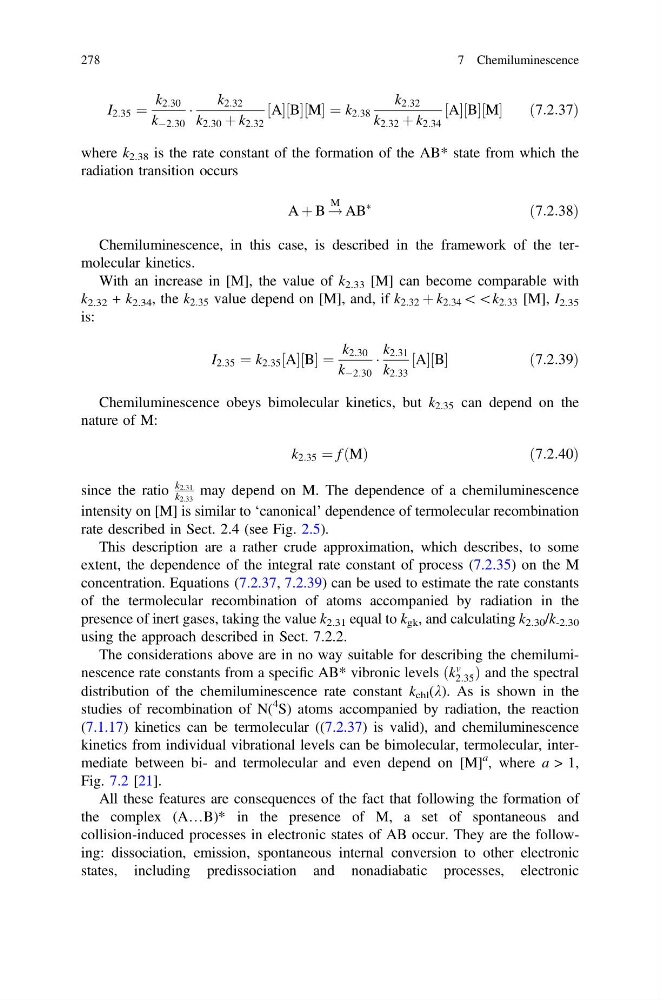
I 2:35 ¼
k 2:30
k À2:30
Á
k 2:32
k 2:30 þ k 2:32
A
½ B
½ M
½ ¼ k 2:38
k 2:32
k 2:32 þ k 2:34
A
½ B
½ M
½
ð7:2:37Þ
where k 2.38 is the rate constant of the formation of the AB* state from which the
radiation transition occurs
A þ B !
M AB
Ã
ð7:2:38Þ
Chemiluminescence, in this case, is described in the framework of the termolecular kinetics.
With an increase in [M], the value of k 2.33 [M] can become comparable with
k 2.32 + k 2.34 , the k 2:35 value depend on [M], and, if k 2:32 þ k 2:34 \\k 2:33 [M], I 2.35
is:
I 2:35 ¼ k 2:35 A
½ B
½ ¼
k 2:30
k À2:30
Á
k 2:31
k 2:33
A
½ B
½
ð7:2:39Þ
Chemiluminescence obeys bimolecular kinetics, but k 2:35 can depend on the
nature of M:
k 2:35 ¼ f ðMÞ
ð 7:2:40Þ
since the ratio
k 2:31
k 2:33
may depend on M. The dependence of a chemiluminescence
intensity on [M] is similar to ‘canonical’ dependence of termolecular recombination
rate described in Sect. 2.4 (see Fig. 2.5).
This description are a rather crude approximation, which describes, to some
extent, the dependence of the integral rate constant of process (7.2.35) on the M
concentration. Equations (7.2.37, 7.2.39) can be used to estimate the rate constants
of the termolecular recombination of atoms accompanied by radiation in the
presence of inert gases, taking the value k 2.31 equal to k gk , and calculating k 2.30 /k -2.30
using the approach described in Sect. 7.2.2.
The considerations above are in no way suitable for describing the chemiluminescence rate constants from a specific AB* vibronic levels ðk
v
2:35 Þ and the spectral
distribution of the chemiluminescence rate constant k chl (k). As is shown in the
studies of recombination of N(
4 S) atoms accompanied by radiation, the reaction
(7.1.17) kinetics can be termolecular ((7.2.37) is valid), and chemiluminescence
kinetics from individual vibrational levels can be bimolecular, termolecular, intermediate between bi- and termolecular and even depend on [M]
a , where a > 1,
Fig. 7.2 [21].
All these features are consequences of the fact that following the formation of
the complex (A…B)* in the presence of M, a set of spontaneous and
collision-induced processes in electronic states of AB occur. They are the following: dissociation, emission, spontaneous internal conversion to other electronic
states, including predissociation and nonadiabatic processes, electronic
278
7 Chemiluminescence
k 2:30
k À2:30
Á
k 2:32
k 2:30 þ k 2:32
A
½ B
½ M
½ ¼ k 2:38
k 2:32
k 2:32 þ k 2:34
A
½ B
½ M
½
ð7:2:37Þ
where k 2.38 is the rate constant of the formation of the AB* state from which the
radiation transition occurs
A þ B !
M AB
Ã
ð7:2:38Þ
Chemiluminescence, in this case, is described in the framework of the termolecular kinetics.
With an increase in [M], the value of k 2.33 [M] can become comparable with
k 2.32 + k 2.34 , the k 2:35 value depend on [M], and, if k 2:32 þ k 2:34 \\k 2:33 [M], I 2.35
is:
I 2:35 ¼ k 2:35 A
½ B
½ ¼
k 2:30
k À2:30
Á
k 2:31
k 2:33
A
½ B
½
ð7:2:39Þ
Chemiluminescence obeys bimolecular kinetics, but k 2:35 can depend on the
nature of M:
k 2:35 ¼ f ðMÞ
ð 7:2:40Þ
since the ratio
k 2:31
k 2:33
may depend on M. The dependence of a chemiluminescence
intensity on [M] is similar to ‘canonical’ dependence of termolecular recombination
rate described in Sect. 2.4 (see Fig. 2.5).
This description are a rather crude approximation, which describes, to some
extent, the dependence of the integral rate constant of process (7.2.35) on the M
concentration. Equations (7.2.37, 7.2.39) can be used to estimate the rate constants
of the termolecular recombination of atoms accompanied by radiation in the
presence of inert gases, taking the value k 2.31 equal to k gk , and calculating k 2.30 /k -2.30
using the approach described in Sect. 7.2.2.
The considerations above are in no way suitable for describing the chemiluminescence rate constants from a specific AB* vibronic levels ðk
v
2:35 Þ and the spectral
distribution of the chemiluminescence rate constant k chl (k). As is shown in the
studies of recombination of N(
4 S) atoms accompanied by radiation, the reaction
(7.1.17) kinetics can be termolecular ((7.2.37) is valid), and chemiluminescence
kinetics from individual vibrational levels can be bimolecular, termolecular, intermediate between bi- and termolecular and even depend on [M]
a , where a > 1,
Fig. 7.2 [21].
All these features are consequences of the fact that following the formation of
the complex (A…B)* in the presence of M, a set of spontaneous and
collision-induced processes in electronic states of AB occur. They are the following: dissociation, emission, spontaneous internal conversion to other electronic
states, including predissociation and nonadiabatic processes, electronic
278
7 Chemiluminescence