

deactivation, collision-induced internal conversion to other electronic states, proceeding with a large or low loss of energy, including collision-induced predissociation, vibrational and rotational relaxation within the same electronic state. The
mechanisms of these processes are discussed in Chap. 4.
One must also be aware that k
AB
Ã
2:32 is not equal to k
AB
ÃÃ
2:32 in the general case.
Besides, the collision-induced processes:
AB
Ã
$
M AB
ÃÃ
ðÀ7:2:41Þ
may take place, and several AB*, AB** states can be populated in the process
(7.2.30), as is the case in the complex of valence and ion-pair states of halogens (see
Figs. 4.4 and 4.10). And, finally, the rate constants of the processes under consideration (both nonradiative and radiation) in the general case depend on the state
vibrational quantum numbers and mixing of the states.
Another example: At the 90-s of the last century, the author and his colleague
found ‘non-canonical behavior’ of the dependence of the rate constant of termolecular recombination of Cl(
2
P 3/2 ) (Cl), atoms accompanied by radiation
Cl þ Cl !
ðMÞ
Cl 2 A
3 P 1 u
ð Þ; v A
À
Á ! Cl 2 X
1 R 0
þ
g
; v X
þ hv
ð7:2:42aÞ
(a)
(b)
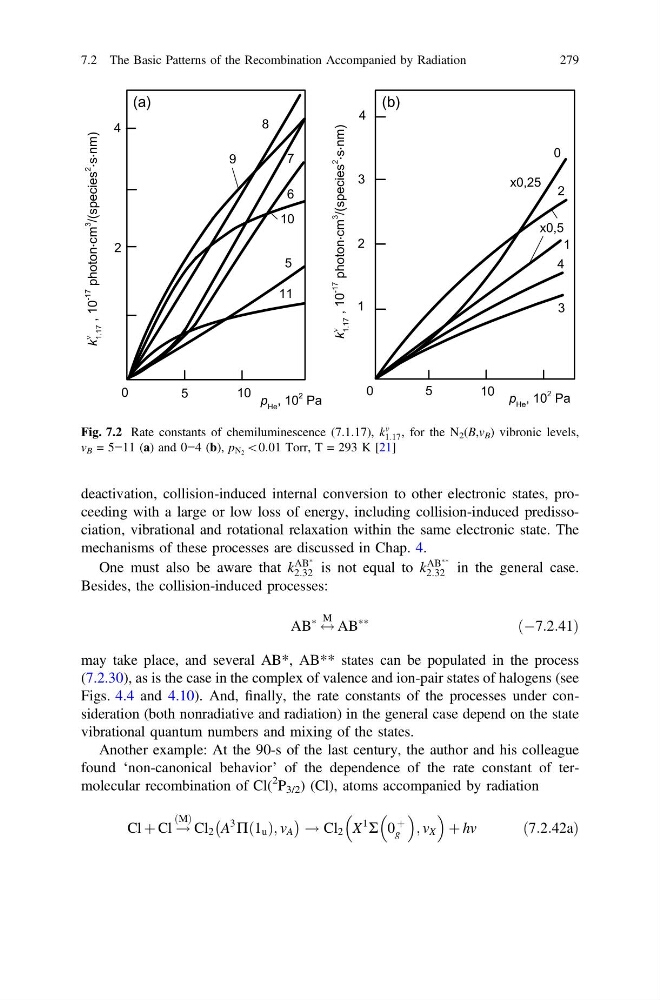
Fig. 7.2 Rate constants of chemiluminescence (7.1.17), k
v
1:17 , for the N 2 (B,v B ) vibronic levels,
v B = 5−11 (a) and 0−4 (b), p N2 \0:01 Torr, T = 293 K [21]
7.2 The Basic Patterns of the Recombination Accompanied by Radiation
279
mechanisms of these processes are discussed in Chap. 4.
One must also be aware that k
AB
Ã
2:32 is not equal to k
AB
ÃÃ
2:32 in the general case.
Besides, the collision-induced processes:
AB
Ã
$
M AB
ÃÃ
ðÀ7:2:41Þ
may take place, and several AB*, AB** states can be populated in the process
(7.2.30), as is the case in the complex of valence and ion-pair states of halogens (see
Figs. 4.4 and 4.10). And, finally, the rate constants of the processes under consideration (both nonradiative and radiation) in the general case depend on the state
vibrational quantum numbers and mixing of the states.
Another example: At the 90-s of the last century, the author and his colleague
found ‘non-canonical behavior’ of the dependence of the rate constant of termolecular recombination of Cl(
2
P 3/2 ) (Cl), atoms accompanied by radiation
Cl þ Cl !
ðMÞ
Cl 2 A
3 P 1 u
ð Þ; v A
À
Á ! Cl 2 X
1 R 0
þ
g
; v X
þ hv
ð7:2:42aÞ
(a)
(b)
Fig. 7.2 Rate constants of chemiluminescence (7.1.17), k
v
1:17 , for the N 2 (B,v B ) vibronic levels,
v B = 5−11 (a) and 0−4 (b), p N2 \0:01 Torr, T = 293 K [21]
7.2 The Basic Patterns of the Recombination Accompanied by Radiation
279