

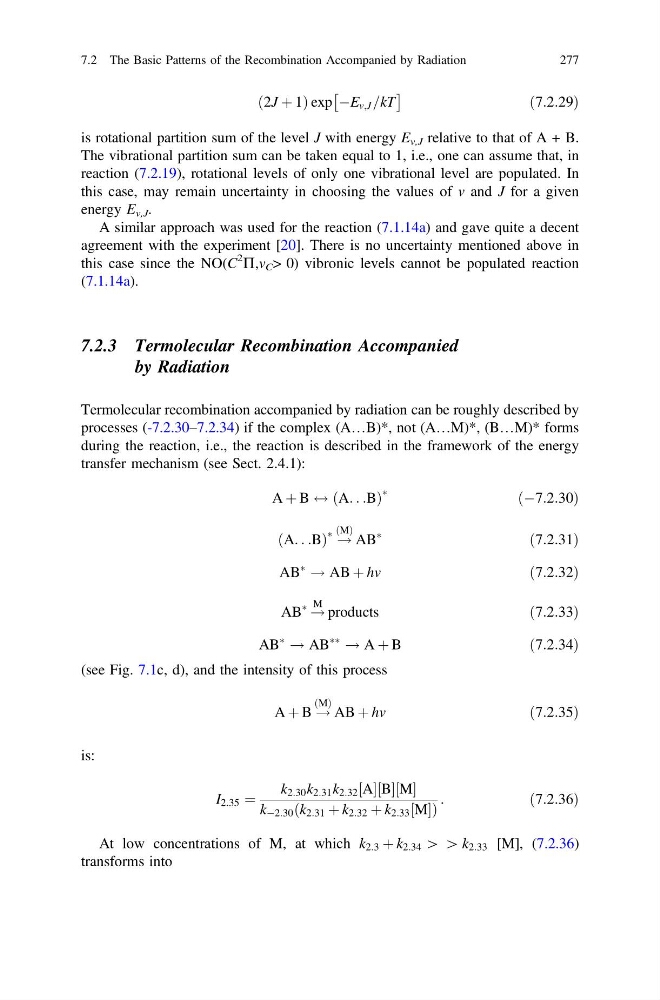
ð2J þ 1Þ exp ÀE v;J =kT
Â
Ã
ð7:2:29Þ
is rotational partition sum of the level J with energy E v,J relative to that of A + B.
The vibrational partition sum can be taken equal to 1, i.e., one can assume that, in
reaction (7.2.19), rotational levels of only one vibrational level are populated. In
this case, may remain uncertainty in choosing the values of v and J for a given
energy E v,J .
A similar approach was used for the reaction (7.1.14a) and gave quite a decent
agreement with the experiment [20]. There is no uncertainty mentioned above in
this case since the NO(C
2 P,v C > 0) vibronic levels cannot be populated reaction
(7.1.14a).
7.2.3 Termolecular Recombination Accompanied
by Radiation
Termolecular recombination accompanied by radiation can be roughly described by
processes (-7.2.30–7.2.34) if the complex (A…B)*, not (A…M)*, (B…M)* forms
during the reaction, i.e., the reaction is described in the framework of the energy
transfer mechanism (see Sect. 2.4.1):
A þ B $ ðA. . .BÞ
Ã
ðÀ7:2:30Þ
ðA. . .BÞ
à !
ðMÞ
AB
Ã
ð7:2:31Þ
AB
Ã
! AB þ hv
ð7:2:32Þ
AB
Ã
!
M products
ð7:2:33Þ
AB
Ã
! AB
ÃÃ
! A þ B
ð7:2:34Þ
(see Fig. 7.1c, d), and the intensity of this process
A þ B !
ðMÞ
AB þ hv
ð7:2:35Þ
is:
I 2:35 ¼
k 2:30 k 2:31 k 2:32 A
½ B
½ M
½
k À2:30 k 2:31 þ k 2:32 þ k 2:33 ½M
ð
Þ
:
ð7:2:36Þ
At low concentrations of M, at which k 2:3 þ k 2:34 [ [ k 2:33 [M], (7.2.36)
transforms into
7.2 The Basic Patterns of the Recombination Accompanied by Radiation
277
Â
Ã
ð7:2:29Þ
is rotational partition sum of the level J with energy E v,J relative to that of A + B.
The vibrational partition sum can be taken equal to 1, i.e., one can assume that, in
reaction (7.2.19), rotational levels of only one vibrational level are populated. In
this case, may remain uncertainty in choosing the values of v and J for a given
energy E v,J .
A similar approach was used for the reaction (7.1.14a) and gave quite a decent
agreement with the experiment [20]. There is no uncertainty mentioned above in
this case since the NO(C
2 P,v C > 0) vibronic levels cannot be populated reaction
(7.1.14a).
7.2.3 Termolecular Recombination Accompanied
by Radiation
Termolecular recombination accompanied by radiation can be roughly described by
processes (-7.2.30–7.2.34) if the complex (A…B)*, not (A…M)*, (B…M)* forms
during the reaction, i.e., the reaction is described in the framework of the energy
transfer mechanism (see Sect. 2.4.1):
A þ B $ ðA. . .BÞ
Ã
ðÀ7:2:30Þ
ðA. . .BÞ
à !
ðMÞ
AB
Ã
ð7:2:31Þ
AB
Ã
! AB þ hv
ð7:2:32Þ
AB
Ã
!
M products
ð7:2:33Þ
AB
Ã
! AB
ÃÃ
! A þ B
ð7:2:34Þ
(see Fig. 7.1c, d), and the intensity of this process
A þ B !
ðMÞ
AB þ hv
ð7:2:35Þ
is:
I 2:35 ¼
k 2:30 k 2:31 k 2:32 A
½ B
½ M
½
k À2:30 k 2:31 þ k 2:32 þ k 2:33 ½M
ð
Þ
:
ð7:2:36Þ
At low concentrations of M, at which k 2:3 þ k 2:34 [ [ k 2:33 [M], (7.2.36)
transforms into
7.2 The Basic Patterns of the Recombination Accompanied by Radiation
277