

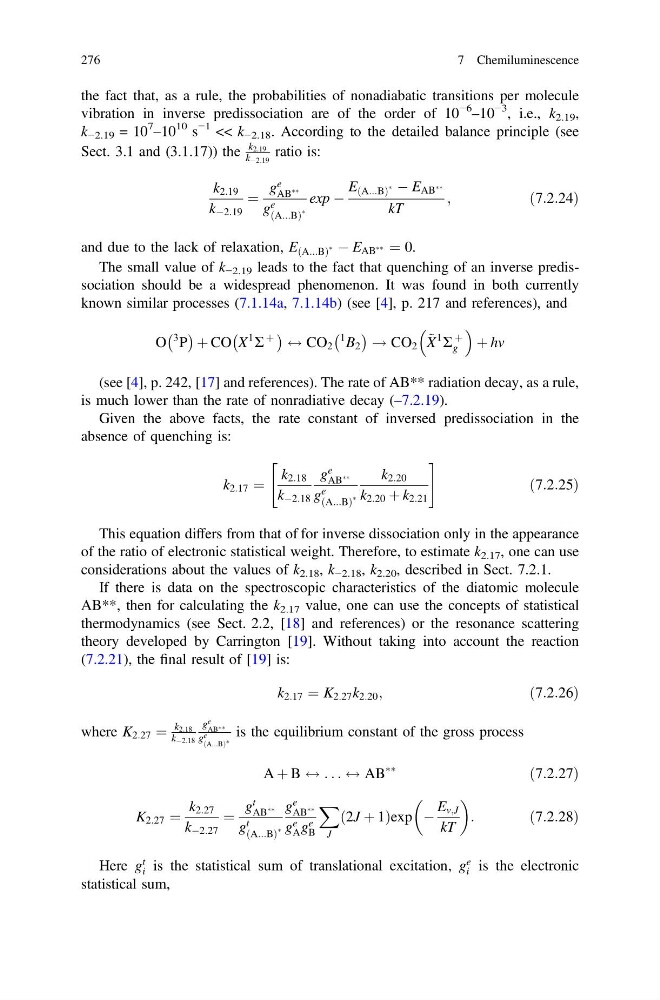
the fact that, as a rule, the probabilities of nonadiabatic transitions per molecule
vibration in inverse predissociation are of the order of 10
−6
–10
−3 , i.e., k 2.19 ,
k −2.19 = 10
7
–10
10 s
−1 << k −2.18 . According to the detailed balance principle (see
Sect. 3.1 and (3.1.17)) the
k 2:19
k À2:19
ratio is:
k 2:19
k À2:19
¼
g
e
AB
ÃÃ
g
e
A...B
ð
Þ
Ã
exp À
E A...B
ð
Þ
à À E AB
ÃÃ
kT
;
ð7:2:24Þ
and due to the lack of relaxation, E A...B
ð
Þ
à À E AB
ÃÃ ¼ 0.
The small value of k −2.19 leads to the fact that quenching of an inverse predissociation should be a widespread phenomenon. It was found in both currently
known similar processes (7.1.14a, 7.1.14b) (see [4], p. 217 and references), and
O
3 P
À Á þ CO X
1 R
þ
À
Á $ CO 2
1
B 2
À Á ! CO 2 ~
X
1 R
þ
g
þ hv
(see [4], p. 242, [17] and references). The rate of AB** radiation decay, as a rule,
is much lower than the rate of nonradiative decay (–7.2.19).
Given the above facts, the rate constant of inversed predissociation in the
absence of quenching is:
k 2:17 ¼
k 2:18
k À2:18
g
e
AB
ÃÃ
g
e
A...B
ð
Þ
Ã
k 2:20
k 2:20 þ k 2:21
"
#
ð7:2:25Þ
This equation differs from that of for inverse dissociation only in the appearance
of the ratio of electronic statistical weight. Therefore, to estimate k 2.17 , one can use
considerations about the values of k 2.18 , k −2.18 , k 2.20 , described in Sect. 7.2.1.
If there is data on the spectroscopic characteristics of the diatomic molecule
AB**, then for calculating the k 2.17 value, one can use the concepts of statistical
thermodynamics (see Sect. 2.2, [18] and references) or the resonance scattering
theory developed by Carrington [19]. Without taking into account the reaction
(7.2.21), the final result of [19] is:
k 2:17 ¼ K 2:27 k 2:20 ;
ð7:2:26Þ
where K 2:27 ¼
k 2:18
k À2:18
g
e
AB ÃÃ
g e
A...B
ð
Þ Ã
is the equilibrium constant of the gross process
A þ B $ . . . $ AB
ÃÃ
ð7:2:27Þ
K 2:27 ¼
k 2:27
k À2:27
¼
g
t
AB
ÃÃ
g
t
A...B
ð
Þ
Ã
g
e
AB
ÃÃ
g
e
A g
e
B
X
J
2J þ 1
ð
Þexp À
E v;J
kT
:
ð7:2:28Þ
Here g
t
i is the statistical sum of translational excitation, g
e
i is the electronic
statistical sum,
276
7 Chemiluminescence
vibration in inverse predissociation are of the order of 10
−6
–10
−3 , i.e., k 2.19 ,
k −2.19 = 10
7
–10
10 s
−1 << k −2.18 . According to the detailed balance principle (see
Sect. 3.1 and (3.1.17)) the
k 2:19
k À2:19
ratio is:
k 2:19
k À2:19
¼
g
e
AB
ÃÃ
g
e
A...B
ð
Þ
Ã
exp À
E A...B
ð
Þ
à À E AB
ÃÃ
kT
;
ð7:2:24Þ
and due to the lack of relaxation, E A...B
ð
Þ
à À E AB
ÃÃ ¼ 0.
The small value of k −2.19 leads to the fact that quenching of an inverse predissociation should be a widespread phenomenon. It was found in both currently
known similar processes (7.1.14a, 7.1.14b) (see [4], p. 217 and references), and
O
3 P
À Á þ CO X
1 R
þ
À
Á $ CO 2
1
B 2
À Á ! CO 2 ~
X
1 R
þ
g
þ hv
(see [4], p. 242, [17] and references). The rate of AB** radiation decay, as a rule,
is much lower than the rate of nonradiative decay (–7.2.19).
Given the above facts, the rate constant of inversed predissociation in the
absence of quenching is:
k 2:17 ¼
k 2:18
k À2:18
g
e
AB
ÃÃ
g
e
A...B
ð
Þ
Ã
k 2:20
k 2:20 þ k 2:21
"
#
ð7:2:25Þ
This equation differs from that of for inverse dissociation only in the appearance
of the ratio of electronic statistical weight. Therefore, to estimate k 2.17 , one can use
considerations about the values of k 2.18 , k −2.18 , k 2.20 , described in Sect. 7.2.1.
If there is data on the spectroscopic characteristics of the diatomic molecule
AB**, then for calculating the k 2.17 value, one can use the concepts of statistical
thermodynamics (see Sect. 2.2, [18] and references) or the resonance scattering
theory developed by Carrington [19]. Without taking into account the reaction
(7.2.21), the final result of [19] is:
k 2:17 ¼ K 2:27 k 2:20 ;
ð7:2:26Þ
where K 2:27 ¼
k 2:18
k À2:18
g
e
AB ÃÃ
g e
A...B
ð
Þ Ã
is the equilibrium constant of the gross process
A þ B $ . . . $ AB
ÃÃ
ð7:2:27Þ
K 2:27 ¼
k 2:27
k À2:27
¼
g
t
AB
ÃÃ
g
t
A...B
ð
Þ
Ã
g
e
AB
ÃÃ
g
e
A g
e
B
X
J
2J þ 1
ð
Þexp À
E v;J
kT
:
ð7:2:28Þ
Here g
t
i is the statistical sum of translational excitation, g
e
i is the electronic
statistical sum,
276
7 Chemiluminescence