

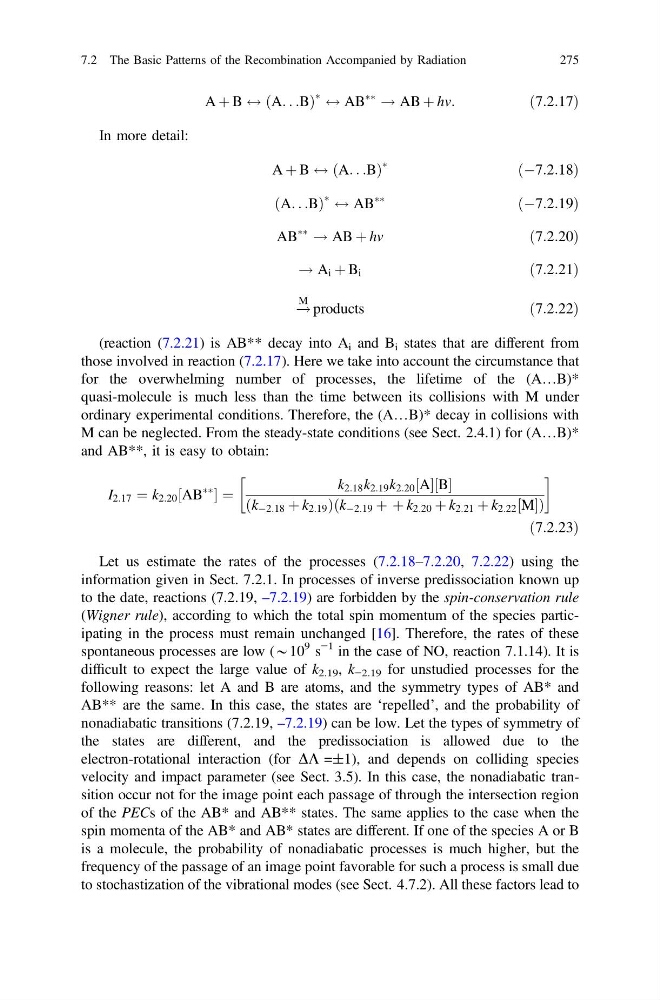
A þ B $ ðA. . .BÞ
à $ AB
ÃÃ
! AB þ hv:
ð7:2:17Þ
In more detail:
A þ B $ ðA. . .BÞ
Ã
ðÀ7:2:18Þ
ðA. . .BÞ
à $ AB
ÃÃ
ðÀ7:2:19Þ
AB
ÃÃ
! AB þ hv
ð7:2:20Þ
! A i þ B i
ð7:2:21Þ
!
M products
ð7:2:22Þ
(reaction (7.2.21) is AB** decay into A i and B i states that are different from
those involved in reaction (7.2.17). Here we take into account the circumstance that
for the overwhelming number of processes, the lifetime of the (A…B)*
quasi-molecule is much less than the time between its collisions with M under
ordinary experimental conditions. Therefore, the (A…B)* decay in collisions with
M can be neglected. From the steady-state conditions (see Sect. 2.4.1) for (A…B)*
and AB**, it is easy to obtain:
I 2:17 ¼ k 2:20 ½AB
ÃÃ
¼
k 2:18 k 2:19 k 2:20 A
½ B
½
k À2:18 þ k 2:19
ð
Þk À2:19 þ þ k 2:20 þ k 2:21 þ k 2:22 M
½
ð
Þ
!
ð7:2:23Þ
Let us estimate the rates of the processes (7.2.18–7.2.20, 7.2.22) using the
information given in Sect. 7.2.1. In processes of inverse predissociation known up
to the date, reactions (7.2.19, –7.2.19) are forbidden by the spin-conservation rule
(Wigner rule), according to which the total spin momentum of the species participating in the process must remain unchanged [16]. Therefore, the rates of these
spontaneous processes are low (*10
9 s
−1 in the case of NO, reaction 7.1.14). It is
difficult to expect the large value of k 2.19 , k −2.19 for unstudied processes for the
following reasons: let A and B are atoms, and the symmetry types of AB* and
AB** are the same. In this case, the states are ‘repelled’, and the probability of
nonadiabatic transitions (7.2.19, –7.2.19) can be low. Let the types of symmetry of
the states are different, and the predissociation is allowed due to the
electron-rotational interaction (for DK =±1), and depends on colliding species
velocity and impact parameter (see Sect. 3.5). In this case, the nonadiabatic transition occur not for the image point each passage of through the intersection region
of the PECs of the AB* and AB** states. The same applies to the case when the
spin momenta of the AB* and AB* states are different. If one of the species A or B
is a molecule, the probability of nonadiabatic processes is much higher, but the
frequency of the passage of an image point favorable for such a process is small due
to stochastization of the vibrational modes (see Sect. 4.7.2). All these factors lead to
7.2 The Basic Patterns of the Recombination Accompanied by Radiation
275
à $ AB
ÃÃ
! AB þ hv:
ð7:2:17Þ
In more detail:
A þ B $ ðA. . .BÞ
Ã
ðÀ7:2:18Þ
ðA. . .BÞ
à $ AB
ÃÃ
ðÀ7:2:19Þ
AB
ÃÃ
! AB þ hv
ð7:2:20Þ
! A i þ B i
ð7:2:21Þ
!
M products
ð7:2:22Þ
(reaction (7.2.21) is AB** decay into A i and B i states that are different from
those involved in reaction (7.2.17). Here we take into account the circumstance that
for the overwhelming number of processes, the lifetime of the (A…B)*
quasi-molecule is much less than the time between its collisions with M under
ordinary experimental conditions. Therefore, the (A…B)* decay in collisions with
M can be neglected. From the steady-state conditions (see Sect. 2.4.1) for (A…B)*
and AB**, it is easy to obtain:
I 2:17 ¼ k 2:20 ½AB
ÃÃ
¼
k 2:18 k 2:19 k 2:20 A
½ B
½
k À2:18 þ k 2:19
ð
Þk À2:19 þ þ k 2:20 þ k 2:21 þ k 2:22 M
½
ð
Þ
!
ð7:2:23Þ
Let us estimate the rates of the processes (7.2.18–7.2.20, 7.2.22) using the
information given in Sect. 7.2.1. In processes of inverse predissociation known up
to the date, reactions (7.2.19, –7.2.19) are forbidden by the spin-conservation rule
(Wigner rule), according to which the total spin momentum of the species participating in the process must remain unchanged [16]. Therefore, the rates of these
spontaneous processes are low (*10
9 s
−1 in the case of NO, reaction 7.1.14). It is
difficult to expect the large value of k 2.19 , k −2.19 for unstudied processes for the
following reasons: let A and B are atoms, and the symmetry types of AB* and
AB** are the same. In this case, the states are ‘repelled’, and the probability of
nonadiabatic transitions (7.2.19, –7.2.19) can be low. Let the types of symmetry of
the states are different, and the predissociation is allowed due to the
electron-rotational interaction (for DK =±1), and depends on colliding species
velocity and impact parameter (see Sect. 3.5). In this case, the nonadiabatic transition occur not for the image point each passage of through the intersection region
of the PECs of the AB* and AB** states. The same applies to the case when the
spin momenta of the AB* and AB* states are different. If one of the species A or B
is a molecule, the probability of nonadiabatic processes is much higher, but the
frequency of the passage of an image point favorable for such a process is small due
to stochastization of the vibrational modes (see Sect. 4.7.2). All these factors lead to
7.2 The Basic Patterns of the Recombination Accompanied by Radiation
275