

#
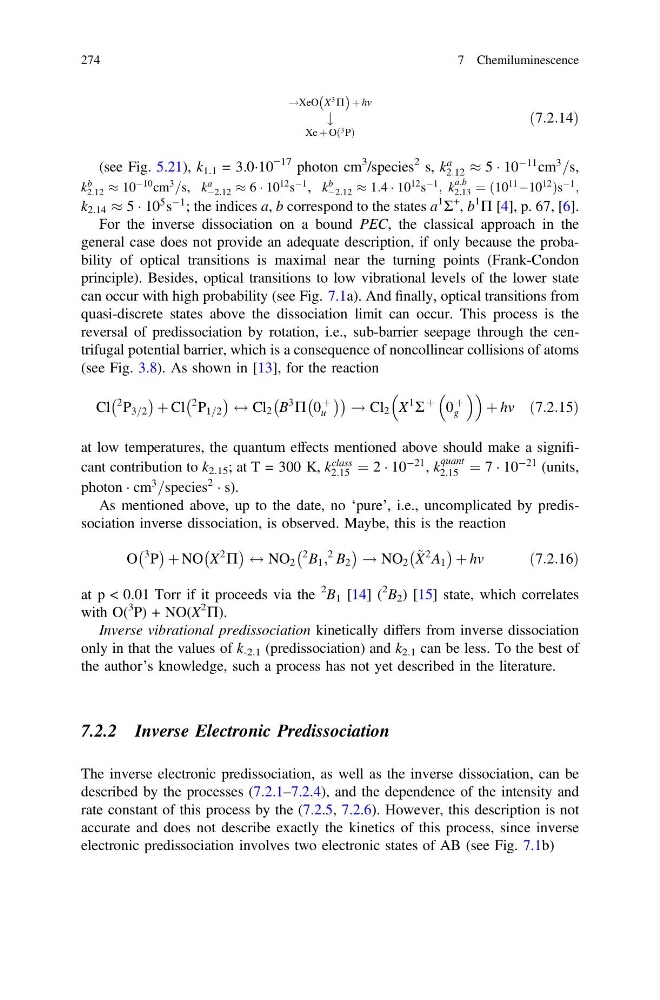
!XeO X
3 P
ð Þþ hv
Xe þ O 3 P
ð Þ
ð7:2:14Þ
(see Fig. 5.21), k 1.1 = 3.0Á10
−17 photon cm
3 /species
2 s, k
a
2:12 % 5 Á 10
À11 cm
3
=s,
k
b
2:12 % 10
À10 cm
3
=s, k
a
À2:12 % 6 Á 10
12 s
À1 , k
b
À2:12 % 1:4 Á 10
12 s
À1
; k
a;b
2:13 ¼ 10
11
À10
12
ð
Þ s
À1
;
k 2:14 % 5 Á 10
5 s
À1 ; the indices a, b correspond to the states a
1 R
+
, b
1 P [4], p. 67, [6].
For the inverse dissociation on a bound PEC, the classical approach in the
general case does not provide an adequate description, if only because the probability of optical transitions is maximal near the turning points (Frank-Condon
principle). Besides, optical transitions to low vibrational levels of the lower state
can occur with high probability (see Fig. 7.1a). And finally, optical transitions from
quasi-discrete states above the dissociation limit can occur. This process is the
reversal of predissociation by rotation, i.e., sub-barrier seepage through the centrifugal potential barrier, which is a consequence of noncollinear collisions of atoms
(see Fig. 3.8). As shown in [13], for the reaction
Cl
2 P 3=2
À
Á þ Cl
2 P 1=2
À
Á $ Cl 2 B
3 P 0
þ
u
À Á
À
Á ! Cl 2 X
1 R
þ 0
þ
g
þ hv ð7:2:15Þ
at low temperatures, the quantum effects mentioned above should make a significant contribution to k 2.15 ; at T = 300 K, k
class
2:15 ¼ 2 Á 10
À21 , k
quant
2:15 ¼ 7 Á 10
À21 (units,
photon Á cm
3
=species
2
Á s).
As mentioned above, up to the date, no ‘pure’, i.e., uncomplicated by predissociation inverse dissociation, is observed. Maybe, this is the reaction
O
3 P
À Á þ NO X
2 P
À
Á $ NO 2
2
B 1 ;
2
B 2
À
Á ! NO 2 ~
X
2
A 1
À
Á þ hv
ð7:2:16Þ
at p < 0.01 Torr if it proceeds via the
2 B 1 [14] (
2 B 2 ) [15] state, which correlates
with O(
3 P) + NO(X
2 P).
Inverse vibrational predissociation kinetically differs from inverse dissociation
only in that the values of k -2.1 (predissociation) and k 2.1 can be less. To the best of
the author’s knowledge, such a process has not yet described in the literature.
7.2.2 Inverse Electronic Predissociation
The inverse electronic predissociation, as well as the inverse dissociation, can be
described by the processes (7.2.1–7.2.4), and the dependence of the intensity and
rate constant of this process by the (7.2.5, 7.2.6). However, this description is not
accurate and does not describe exactly the kinetics of this process, since inverse
electronic predissociation involves two electronic states of AB (see Fig. 7.1b)
274
7 Chemiluminescence
!XeO X
3 P
ð Þþ hv
Xe þ O 3 P
ð Þ
ð7:2:14Þ
(see Fig. 5.21), k 1.1 = 3.0Á10
−17 photon cm
3 /species
2 s, k
a
2:12 % 5 Á 10
À11 cm
3
=s,
k
b
2:12 % 10
À10 cm
3
=s, k
a
À2:12 % 6 Á 10
12 s
À1 , k
b
À2:12 % 1:4 Á 10
12 s
À1
; k
a;b
2:13 ¼ 10
11
À10
12
ð
Þ s
À1
;
k 2:14 % 5 Á 10
5 s
À1 ; the indices a, b correspond to the states a
1 R
+
, b
1 P [4], p. 67, [6].
For the inverse dissociation on a bound PEC, the classical approach in the
general case does not provide an adequate description, if only because the probability of optical transitions is maximal near the turning points (Frank-Condon
principle). Besides, optical transitions to low vibrational levels of the lower state
can occur with high probability (see Fig. 7.1a). And finally, optical transitions from
quasi-discrete states above the dissociation limit can occur. This process is the
reversal of predissociation by rotation, i.e., sub-barrier seepage through the centrifugal potential barrier, which is a consequence of noncollinear collisions of atoms
(see Fig. 3.8). As shown in [13], for the reaction
Cl
2 P 3=2
À
Á þ Cl
2 P 1=2
À
Á $ Cl 2 B
3 P 0
þ
u
À Á
À
Á ! Cl 2 X
1 R
þ 0
þ
g
þ hv ð7:2:15Þ
at low temperatures, the quantum effects mentioned above should make a significant contribution to k 2.15 ; at T = 300 K, k
class
2:15 ¼ 2 Á 10
À21 , k
quant
2:15 ¼ 7 Á 10
À21 (units,
photon Á cm
3
=species
2
Á s).
As mentioned above, up to the date, no ‘pure’, i.e., uncomplicated by predissociation inverse dissociation, is observed. Maybe, this is the reaction
O
3 P
À Á þ NO X
2 P
À
Á $ NO 2
2
B 1 ;
2
B 2
À
Á ! NO 2 ~
X
2
A 1
À
Á þ hv
ð7:2:16Þ
at p < 0.01 Torr if it proceeds via the
2 B 1 [14] (
2 B 2 ) [15] state, which correlates
with O(
3 P) + NO(X
2 P).
Inverse vibrational predissociation kinetically differs from inverse dissociation
only in that the values of k -2.1 (predissociation) and k 2.1 can be less. To the best of
the author’s knowledge, such a process has not yet described in the literature.
7.2.2 Inverse Electronic Predissociation
The inverse electronic predissociation, as well as the inverse dissociation, can be
described by the processes (7.2.1–7.2.4), and the dependence of the intensity and
rate constant of this process by the (7.2.5, 7.2.6). However, this description is not
accurate and does not describe exactly the kinetics of this process, since inverse
electronic predissociation involves two electronic states of AB (see Fig. 7.1b)
274
7 Chemiluminescence