

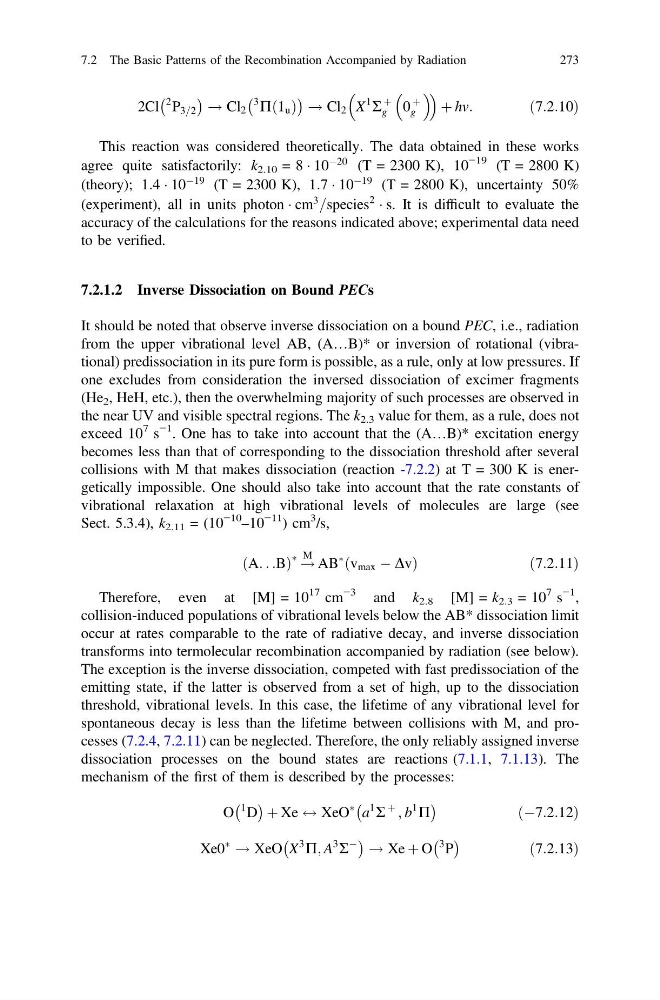
2Cl
2 P 3=2
À
Á ! Cl 2
3 P 1 u
ð Þ
À
Á ! Cl 2 X
1 R
þ
g
0
þ
g
þ hv:
ð7:2:10Þ
This reaction was considered theoretically. The data obtained in these works
agree quite satisfactorily: k 2.10 = 8 Á 10
À20 (T = 2300 K), 10
−19 (T = 2800 K)
(theory); 1:4 Á 10
À19 (T = 2300 K), 1:7 Á 10
À19 (T = 2800 K), uncertainty 50%
(experiment), all in units photon Á cm
3
=species
2
Á s. It is difficult to evaluate the
accuracy of the calculations for the reasons indicated above; experimental data need
to be verified.
7.2.1.2 Inverse Dissociation on Bound PECs
It should be noted that observe inverse dissociation on a bound PEC, i.e., radiation
from the upper vibrational level AB, (A…B)* or inversion of rotational (vibrational) predissociation in its pure form is possible, as a rule, only at low pressures. If
one excludes from consideration the inversed dissociation of excimer fragments
(He 2 , HeH, etc.), then the overwhelming majority of such processes are observed in
the near UV and visible spectral regions. The k 2.3 value for them, as a rule, does not
exceed 10
7 s
−1 . One has to take into account that the (A…B)* excitation energy
becomes less than that of corresponding to the dissociation threshold after several
collisions with M that makes dissociation (reaction -7.2.2) at T = 300 K is energetically impossible. One should also take into account that the rate constants of
vibrational relaxation at high vibrational levels of molecules are large (see
Sect. 5.3.4), k 2.11 = (10
−10
–10
−11 ) cm
3 /s,
ðA. . .BÞ
à !
M AB
à v max À Dv
ð
Þ
ð 7:2:11Þ
Therefore, even at [M] = 10
17 cm
−3
and k 2.8 [M] = k 2.3 = 10
7 s
−1 ,
collision-induced populations of vibrational levels below the AB* dissociation limit
occur at rates comparable to the rate of radiative decay, and inverse dissociation
transforms into termolecular recombination accompanied by radiation (see below).
The exception is the inverse dissociation, competed with fast predissociation of the
emitting state, if the latter is observed from a set of high, up to the dissociation
threshold, vibrational levels. In this case, the lifetime of any vibrational level for
spontaneous decay is less than the lifetime between collisions with M, and processes (7.2.4, 7.2.11) can be neglected. Therefore, the only reliably assigned inverse
dissociation processes on the bound states are reactions (7.1.1, 7.1.13). The
mechanism of the first of them is described by the processes:
O
1 D
À Á þ Xe $ XeO
Ã
a
1 R
þ
; b
1 P
À
Á
ðÀ7:2:12Þ
Xe0
Ã
! XeO X
3 P; A
3 R
À
À
Á ! Xe þ O
3 P
À Á
ð7:2:13Þ
7.2 The Basic Patterns of the Recombination Accompanied by Radiation
273
2 P 3=2
À
Á ! Cl 2
3 P 1 u
ð Þ
À
Á ! Cl 2 X
1 R
þ
g
0
þ
g
þ hv:
ð7:2:10Þ
This reaction was considered theoretically. The data obtained in these works
agree quite satisfactorily: k 2.10 = 8 Á 10
À20 (T = 2300 K), 10
−19 (T = 2800 K)
(theory); 1:4 Á 10
À19 (T = 2300 K), 1:7 Á 10
À19 (T = 2800 K), uncertainty 50%
(experiment), all in units photon Á cm
3
=species
2
Á s. It is difficult to evaluate the
accuracy of the calculations for the reasons indicated above; experimental data need
to be verified.
7.2.1.2 Inverse Dissociation on Bound PECs
It should be noted that observe inverse dissociation on a bound PEC, i.e., radiation
from the upper vibrational level AB, (A…B)* or inversion of rotational (vibrational) predissociation in its pure form is possible, as a rule, only at low pressures. If
one excludes from consideration the inversed dissociation of excimer fragments
(He 2 , HeH, etc.), then the overwhelming majority of such processes are observed in
the near UV and visible spectral regions. The k 2.3 value for them, as a rule, does not
exceed 10
7 s
−1 . One has to take into account that the (A…B)* excitation energy
becomes less than that of corresponding to the dissociation threshold after several
collisions with M that makes dissociation (reaction -7.2.2) at T = 300 K is energetically impossible. One should also take into account that the rate constants of
vibrational relaxation at high vibrational levels of molecules are large (see
Sect. 5.3.4), k 2.11 = (10
−10
–10
−11 ) cm
3 /s,
ðA. . .BÞ
à !
M AB
à v max À Dv
ð
Þ
ð 7:2:11Þ
Therefore, even at [M] = 10
17 cm
−3
and k 2.8 [M] = k 2.3 = 10
7 s
−1 ,
collision-induced populations of vibrational levels below the AB* dissociation limit
occur at rates comparable to the rate of radiative decay, and inverse dissociation
transforms into termolecular recombination accompanied by radiation (see below).
The exception is the inverse dissociation, competed with fast predissociation of the
emitting state, if the latter is observed from a set of high, up to the dissociation
threshold, vibrational levels. In this case, the lifetime of any vibrational level for
spontaneous decay is less than the lifetime between collisions with M, and processes (7.2.4, 7.2.11) can be neglected. Therefore, the only reliably assigned inverse
dissociation processes on the bound states are reactions (7.1.1, 7.1.13). The
mechanism of the first of them is described by the processes:
O
1 D
À Á þ Xe $ XeO
Ã
a
1 R
þ
; b
1 P
À
Á
ðÀ7:2:12Þ
Xe0
Ã
! XeO X
3 P; A
3 R
À
À
Á ! Xe þ O
3 P
À Á
ð7:2:13Þ
7.2 The Basic Patterns of the Recombination Accompanied by Radiation
273