

7.2.1.1 Inverse Dissociation on Repulsive PECs
As far as the author knows, no attempt was made to calculate the rate constants of
inversed dissociation of polyatomic molecules. For the case of collision of two
atoms, such calculations were carried out both in the classical and quantum
mechanical approach. The classical approaches for calculating the rate constant of
inverse dissociation on repulsive PECs were developed in [9, 10]. They are based
on the classical scattering theory [9] and equilibrium statistical mechanics [10] and
are valid if optical transitions from a repulsive curve or above the dissociation limit
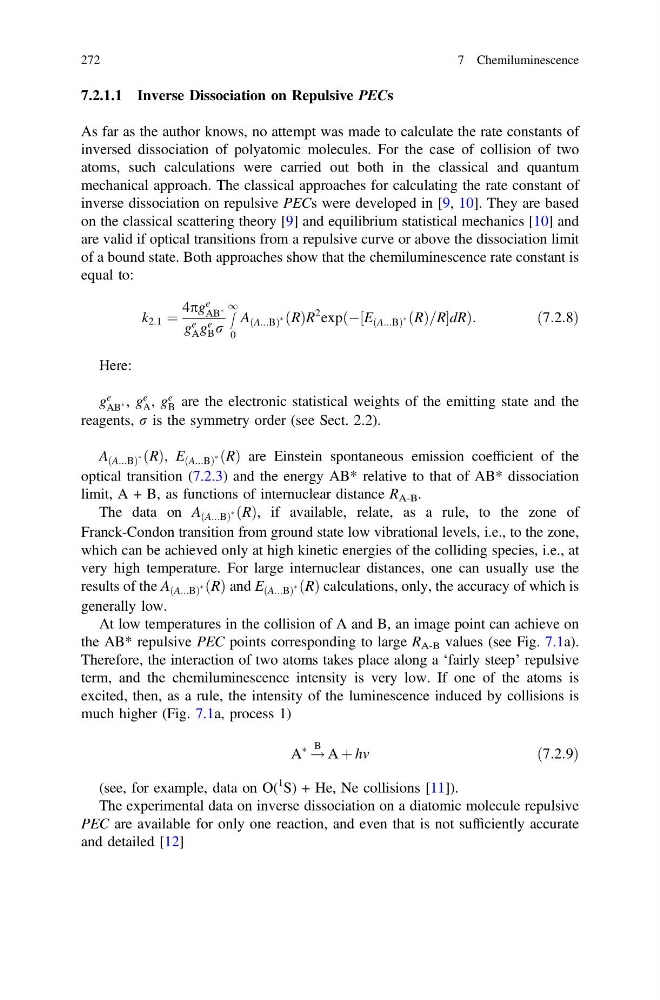
of a bound state. Both approaches show that the chemiluminescence rate constant is
equal to:
k 2:1 ¼
4pg
e
AB
Ã
g
e
A g
e
B r
Z
1
0
A A...B
ð
Þ
à R
ð ÞR
2 expðÀ½E A...B
ð
Þ
à R
ð Þ=RdRÞ:
ð7:2:8Þ
Here:
g
e
AB
à , g
e
A , g
e
B are the electronic statistical weights of the emitting state and the
reagents, r is the symmetry order (see Sect. 2.2).
A A...B
ð
Þ
à R
ð Þ, E A...B
ð
Þ
à R
ð Þ are Einstein spontaneous emission coefficient of the
optical transition (7.2.3) and the energy AB* relative to that of AB* dissociation
limit, A + B, as functions of internuclear distance R A-B .
The data on A A...B
ð
Þ
à R
ð Þ, if available, relate, as a rule, to the zone of
Franck-Condon transition from ground state low vibrational levels, i.e., to the zone,
which can be achieved only at high kinetic energies of the colliding species, i.e., at
very high temperature. For large internuclear distances, one can usually use the
results of the A A...B
ð
Þ
à R
ð Þ and E A...B
ð
Þ
à R
ð Þ calculations, only, the accuracy of which is
generally low.
At low temperatures in the collision of A and B, an image point can achieve on
the AB* repulsive PEC points corresponding to large R A-B values (see Fig. 7.1a).
Therefore, the interaction of two atoms takes place along a ‘fairly steep’ repulsive
term, and the chemiluminescence intensity is very low. If one of the atoms is
excited, then, as a rule, the intensity of the luminescence induced by collisions is
much higher (Fig. 7.1a, process 1)
A
Ã
!
B A þ hv
ð7:2:9Þ
(see, for example, data on O(
1 S) + He, Ne collisions [11]).
The experimental data on inverse dissociation on a diatomic molecule repulsive
PEC are available for only one reaction, and even that is not sufficiently accurate
and detailed [12]
272
7 Chemiluminescence
As far as the author knows, no attempt was made to calculate the rate constants of
inversed dissociation of polyatomic molecules. For the case of collision of two
atoms, such calculations were carried out both in the classical and quantum
mechanical approach. The classical approaches for calculating the rate constant of
inverse dissociation on repulsive PECs were developed in [9, 10]. They are based
on the classical scattering theory [9] and equilibrium statistical mechanics [10] and
are valid if optical transitions from a repulsive curve or above the dissociation limit
of a bound state. Both approaches show that the chemiluminescence rate constant is
equal to:
k 2:1 ¼
4pg
e
AB
Ã
g
e
A g
e
B r
Z
1
0
A A...B
ð
Þ
à R
ð ÞR
2 expðÀ½E A...B
ð
Þ
à R
ð Þ=RdRÞ:
ð7:2:8Þ
Here:
g
e
AB
à , g
e
A , g
e
B are the electronic statistical weights of the emitting state and the
reagents, r is the symmetry order (see Sect. 2.2).
A A...B
ð
Þ
à R
ð Þ, E A...B
ð
Þ
à R
ð Þ are Einstein spontaneous emission coefficient of the
optical transition (7.2.3) and the energy AB* relative to that of AB* dissociation
limit, A + B, as functions of internuclear distance R A-B .
The data on A A...B
ð
Þ
à R
ð Þ, if available, relate, as a rule, to the zone of
Franck-Condon transition from ground state low vibrational levels, i.e., to the zone,
which can be achieved only at high kinetic energies of the colliding species, i.e., at
very high temperature. For large internuclear distances, one can usually use the
results of the A A...B
ð
Þ
à R
ð Þ and E A...B
ð
Þ
à R
ð Þ calculations, only, the accuracy of which is
generally low.
At low temperatures in the collision of A and B, an image point can achieve on
the AB* repulsive PEC points corresponding to large R A-B values (see Fig. 7.1a).
Therefore, the interaction of two atoms takes place along a ‘fairly steep’ repulsive
term, and the chemiluminescence intensity is very low. If one of the atoms is
excited, then, as a rule, the intensity of the luminescence induced by collisions is
much higher (Fig. 7.1a, process 1)
A
Ã
!
B A þ hv
ð7:2:9Þ
(see, for example, data on O(
1 S) + He, Ne collisions [11]).
The experimental data on inverse dissociation on a diatomic molecule repulsive
PEC are available for only one reaction, and even that is not sufficiently accurate
and detailed [12]
272
7 Chemiluminescence