

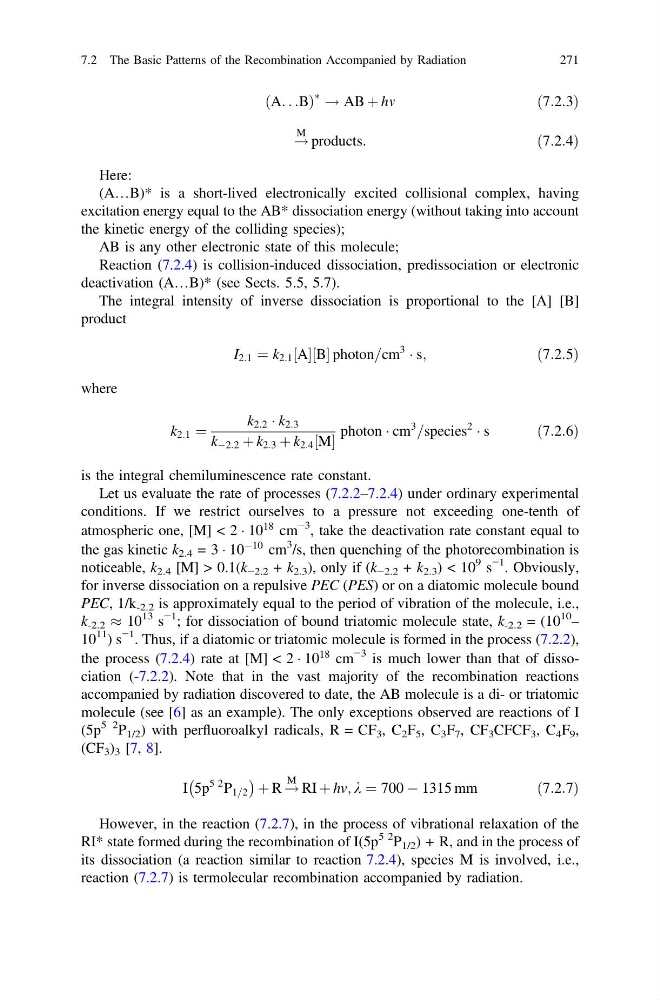
ðA. . .BÞ
à ! AB þ hm
ð7:2:3Þ
!
M products:
ð7:2:4Þ
Here:
(A…B)* is a short-lived electronically excited collisional complex, having
excitation energy equal to the AB* dissociation energy (without taking into account
the kinetic energy of the colliding species);
AB is any other electronic state of this molecule;
Reaction (7.2.4) is collision-induced dissociation, predissociation or electronic
deactivation (A…B)* (see Sects. 5.5, 5.7).
The integral intensity of inverse dissociation is proportional to the [A] [B]
product
I 2:1 ¼ k 2:1 ½A½B photon=cm
3
Á s;
ð7:2:5Þ
where
k 2:1 ¼
k 2:2 Á k 2:3
k À2:2 þ k 2:3 þ k 2:4 M
½
photon Á cm
3
=species
2
Á s
ð7:2:6Þ
is the integral chemiluminescence rate constant.
Let us evaluate the rate of processes (7.2.2–7.2.4) under ordinary experimental
conditions. If we restrict ourselves to a pressure not exceeding one-tenth of
atmospheric one, [M] < 2 Á 10
18 cm
−3 , take the deactivation rate constant equal to
the gas kinetic k 2.4 = 3 Á 10
À10 cm
3 /s, then quenching of the photorecombination is
noticeable, k 2.4 [M] > 0.1(k −2.2 + k 2.3 ), only if (k −2.2 + k 2.3 ) < 10
9 s
−1 . Obviously,
for inverse dissociation on a repulsive PEC (PES) or on a diatomic molecule bound
PEC, 1/k -2.2 is approximately equal to the period of vibration of the molecule, i.e.,
k -2.2 % 10
13 s
−1 ; for dissociation of bound triatomic molecule state, k -2.2 = (10
10
–
10
11 ) s
−1 . Thus, if a diatomic or triatomic molecule is formed in the process (7.2.2),
the process (7.2.4) rate at [M] < 2 Á 10
18 cm
−3 is much lower than that of dissociation (-7.2.2). Note that in the vast majority of the recombination reactions
accompanied by radiation discovered to date, the AB molecule is a di- or triatomic
molecule (see [6] as an example). The only exceptions observed are reactions of I
(5p
5 2 P 1/2 ) with perfluoroalkyl radicals, R = CF 3 , C 2 F 5 , C 3 F 7 , CF 3 CFCF 3 , C 4 F 9 ,
(CF 3 ) 3 [7, 8].
I 5p
5 2 P 1=2
À
Á þ R !
M RI þ hv; k ¼ 700 À 1315 mm
ð7:2:7Þ
However, in the reaction (7.2.7), in the process of vibrational relaxation of the
RI* state formed during the recombination of I(5p
5 2 P 1/2 ) + R, and in the process of
its dissociation (a reaction similar to reaction 7.2.4), species M is involved, i.e.,
reaction (7.2.7) is termolecular recombination accompanied by radiation.
7.2 The Basic Patterns of the Recombination Accompanied by Radiation
271
à ! AB þ hm
ð7:2:3Þ
!
M products:
ð7:2:4Þ
Here:
(A…B)* is a short-lived electronically excited collisional complex, having
excitation energy equal to the AB* dissociation energy (without taking into account
the kinetic energy of the colliding species);
AB is any other electronic state of this molecule;
Reaction (7.2.4) is collision-induced dissociation, predissociation or electronic
deactivation (A…B)* (see Sects. 5.5, 5.7).
The integral intensity of inverse dissociation is proportional to the [A] [B]
product
I 2:1 ¼ k 2:1 ½A½B photon=cm
3
Á s;
ð7:2:5Þ
where
k 2:1 ¼
k 2:2 Á k 2:3
k À2:2 þ k 2:3 þ k 2:4 M
½
photon Á cm
3
=species
2
Á s
ð7:2:6Þ
is the integral chemiluminescence rate constant.
Let us evaluate the rate of processes (7.2.2–7.2.4) under ordinary experimental
conditions. If we restrict ourselves to a pressure not exceeding one-tenth of
atmospheric one, [M] < 2 Á 10
18 cm
−3 , take the deactivation rate constant equal to
the gas kinetic k 2.4 = 3 Á 10
À10 cm
3 /s, then quenching of the photorecombination is
noticeable, k 2.4 [M] > 0.1(k −2.2 + k 2.3 ), only if (k −2.2 + k 2.3 ) < 10
9 s
−1 . Obviously,
for inverse dissociation on a repulsive PEC (PES) or on a diatomic molecule bound
PEC, 1/k -2.2 is approximately equal to the period of vibration of the molecule, i.e.,
k -2.2 % 10
13 s
−1 ; for dissociation of bound triatomic molecule state, k -2.2 = (10
10
–
10
11 ) s
−1 . Thus, if a diatomic or triatomic molecule is formed in the process (7.2.2),
the process (7.2.4) rate at [M] < 2 Á 10
18 cm
−3 is much lower than that of dissociation (-7.2.2). Note that in the vast majority of the recombination reactions
accompanied by radiation discovered to date, the AB molecule is a di- or triatomic
molecule (see [6] as an example). The only exceptions observed are reactions of I
(5p
5 2 P 1/2 ) with perfluoroalkyl radicals, R = CF 3 , C 2 F 5 , C 3 F 7 , CF 3 CFCF 3 , C 4 F 9 ,
(CF 3 ) 3 [7, 8].
I 5p
5 2 P 1=2
À
Á þ R !
M RI þ hv; k ¼ 700 À 1315 mm
ð7:2:7Þ
However, in the reaction (7.2.7), in the process of vibrational relaxation of the
RI* state formed during the recombination of I(5p
5 2 P 1/2 ) + R, and in the process of
its dissociation (a reaction similar to reaction 7.2.4), species M is involved, i.e.,
reaction (7.2.7) is termolecular recombination accompanied by radiation.
7.2 The Basic Patterns of the Recombination Accompanied by Radiation
271