

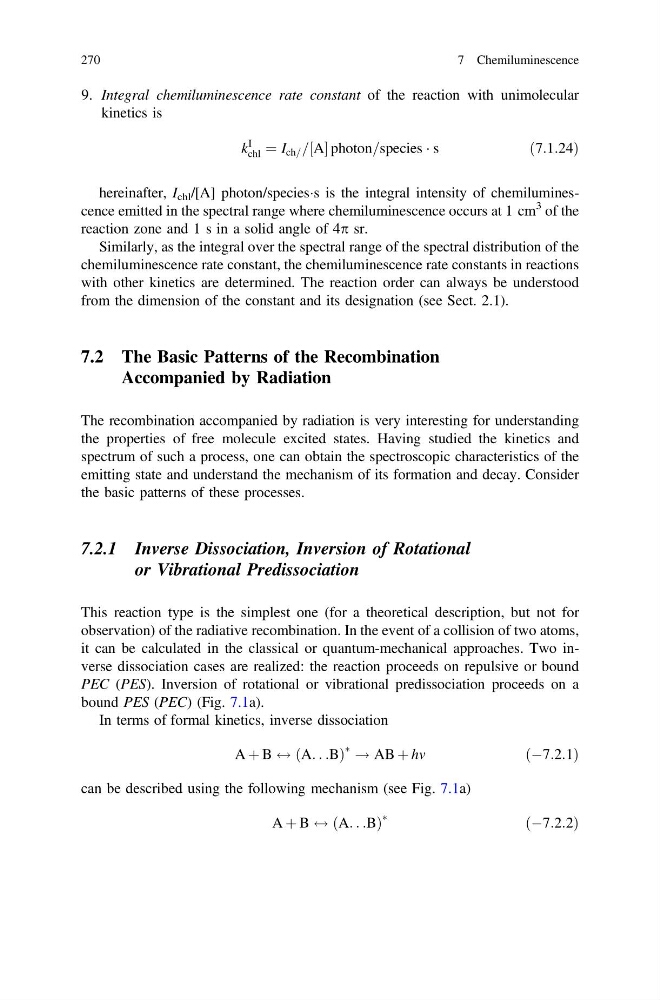
9. Integral chemiluminescence rate constant of the reaction with unimolecular
kinetics is
k
I
chl ¼ I ch= =½A photon=species Á s
ð7:1:24Þ
hereinafter, I chl /[A] photon/speciesÁs is the integral intensity of chemiluminescence emitted in the spectral range where chemiluminescence occurs at 1 cm
3 of the
reaction zone and 1 s in a solid angle of 4p sr.
Similarly, as the integral over the spectral range of the spectral distribution of the
chemiluminescence rate constant, the chemiluminescence rate constants in reactions
with other kinetics are determined. The reaction order can always be understood
from the dimension of the constant and its designation (see Sect. 2.1).
7.2 The Basic Patterns of the Recombination
Accompanied by Radiation
The recombination accompanied by radiation is very interesting for understanding
the properties of free molecule excited states. Having studied the kinetics and
spectrum of such a process, one can obtain the spectroscopic characteristics of the
emitting state and understand the mechanism of its formation and decay. Consider
the basic patterns of these processes.
7.2.1 Inverse Dissociation, Inversion of Rotational
or Vibrational Predissociation
This reaction type is the simplest one (for a theoretical description, but not for
observation) of the radiative recombination. In the event of a collision of two atoms,
it can be calculated in the classical or quantum-mechanical approaches. Two inverse dissociation cases are realized: the reaction proceeds on repulsive or bound
PEC (PES). Inversion of rotational or vibrational predissociation proceeds on a
bound PES (PEC) (Fig. 7.1a).
In terms of formal kinetics, inverse dissociation
A þ B $ ðA. . .BÞ
à ! AB þ hv
ðÀ7:2:1Þ
can be described using the following mechanism (see Fig. 7.1a)
A þ B $ ðA. . .BÞ
Ã
ðÀ7:2:2Þ
270
7 Chemiluminescence
kinetics is
k
I
chl ¼ I ch= =½A photon=species Á s
ð7:1:24Þ
hereinafter, I chl /[A] photon/speciesÁs is the integral intensity of chemiluminescence emitted in the spectral range where chemiluminescence occurs at 1 cm
3 of the
reaction zone and 1 s in a solid angle of 4p sr.
Similarly, as the integral over the spectral range of the spectral distribution of the
chemiluminescence rate constant, the chemiluminescence rate constants in reactions
with other kinetics are determined. The reaction order can always be understood
from the dimension of the constant and its designation (see Sect. 2.1).
7.2 The Basic Patterns of the Recombination
Accompanied by Radiation
The recombination accompanied by radiation is very interesting for understanding
the properties of free molecule excited states. Having studied the kinetics and
spectrum of such a process, one can obtain the spectroscopic characteristics of the
emitting state and understand the mechanism of its formation and decay. Consider
the basic patterns of these processes.
7.2.1 Inverse Dissociation, Inversion of Rotational
or Vibrational Predissociation
This reaction type is the simplest one (for a theoretical description, but not for
observation) of the radiative recombination. In the event of a collision of two atoms,
it can be calculated in the classical or quantum-mechanical approaches. Two inverse dissociation cases are realized: the reaction proceeds on repulsive or bound
PEC (PES). Inversion of rotational or vibrational predissociation proceeds on a
bound PES (PEC) (Fig. 7.1a).
In terms of formal kinetics, inverse dissociation
A þ B $ ðA. . .BÞ
à ! AB þ hv
ðÀ7:2:1Þ
can be described using the following mechanism (see Fig. 7.1a)
A þ B $ ðA. . .BÞ
Ã
ðÀ7:2:2Þ
270
7 Chemiluminescence