

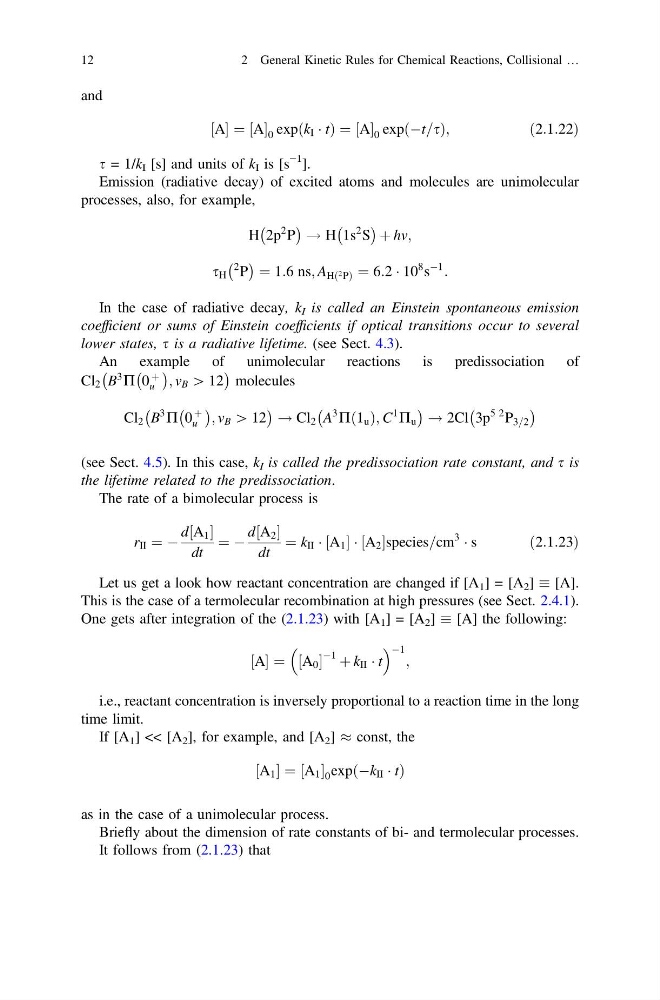
and
½A ¼ ½A 0 exp k I Á t
ð
Þ ¼ ½A 0 expðÀt=sÞ;
ð2:1:22Þ
s = 1/k I [s] and units of k I is [s
−1 ].
Emission (radiative decay) of excited atoms and molecules are unimolecular
processes, also, for example,
H 2p
2 P
À
Á ! H 1s
2 S
À
Á þ hv;
s H
2 P
À Á ¼ 1:6 ns; A H 2 P
ð Þ ¼ 6:2 Á 10
8 s
À1
:
In the case of radiative decay, k I is called an Einstein spontaneous emission
coefficient or sums of Einstein coefficients if optical transitions occur to several
lower states, s is a radiative lifetime. (see Sect. 4.3).
An example of unimolecular reactions is predissociation of
Cl 2 B
3 P 0
þ
u
À Á ; v B [ 12
À
Á
molecules
Cl 2 B
3 P 0
þ
u
À Á ; v B [ 12
À
Á ! Cl 2 A
3 P 1 u
ð Þ; C
1 P u
À
Á ! 2Cl 3p
5 2 P 3=2
À
Á
(see Sect. 4.5). In this case, k I is called the predissociation rate constant, and s is
the lifetime related to the predissociation.
The rate of a bimolecular process is
r II ¼ À
d A 1
½
dt
¼ À
d A 2
½
dt
¼ k II Á A 1
½ Á A 2
½ species=cm
3
Á s
ð2:1:23Þ
Let us get a look how reactant concentration are changed if [A 1 ] = [A 2 ] [A].
This is the case of a termolecular recombination at high pressures (see Sect. 2.4.1).
One gets after integration of the (2.1.23) with [A 1 ] = [A 2 ] [A] the following:
½A ¼ A 0
½
À1 þ k II Á t
À1 ;
i.e., reactant concentration is inversely proportional to a reaction time in the long
time limit.
If [A 1 ] << [A 2 ], for example, and [A 2 ] % const, the
½A 1 ¼ A 1
½ 0 expðÀk II Á tÞ
as in the case of a unimolecular process.
Briefly about the dimension of rate constants of bi- and termolecular processes.
It follows from (2.1.23) that
12
2 General Kinetic Rules for Chemical Reactions, Collisional …
½A ¼ ½A 0 exp k I Á t
ð
Þ ¼ ½A 0 expðÀt=sÞ;
ð2:1:22Þ
s = 1/k I [s] and units of k I is [s
−1 ].
Emission (radiative decay) of excited atoms and molecules are unimolecular
processes, also, for example,
H 2p
2 P
À
Á ! H 1s
2 S
À
Á þ hv;
s H
2 P
À Á ¼ 1:6 ns; A H 2 P
ð Þ ¼ 6:2 Á 10
8 s
À1
:
In the case of radiative decay, k I is called an Einstein spontaneous emission
coefficient or sums of Einstein coefficients if optical transitions occur to several
lower states, s is a radiative lifetime. (see Sect. 4.3).
An example of unimolecular reactions is predissociation of
Cl 2 B
3 P 0
þ
u
À Á ; v B [ 12
À
Á
molecules
Cl 2 B
3 P 0
þ
u
À Á ; v B [ 12
À
Á ! Cl 2 A
3 P 1 u
ð Þ; C
1 P u
À
Á ! 2Cl 3p
5 2 P 3=2
À
Á
(see Sect. 4.5). In this case, k I is called the predissociation rate constant, and s is
the lifetime related to the predissociation.
The rate of a bimolecular process is
r II ¼ À
d A 1
½
dt
¼ À
d A 2
½
dt
¼ k II Á A 1
½ Á A 2
½ species=cm
3
Á s
ð2:1:23Þ
Let us get a look how reactant concentration are changed if [A 1 ] = [A 2 ] [A].
This is the case of a termolecular recombination at high pressures (see Sect. 2.4.1).
One gets after integration of the (2.1.23) with [A 1 ] = [A 2 ] [A] the following:
½A ¼ A 0
½
À1 þ k II Á t
À1 ;
i.e., reactant concentration is inversely proportional to a reaction time in the long
time limit.
If [A 1 ] << [A 2 ], for example, and [A 2 ] % const, the
½A 1 ¼ A 1
½ 0 expðÀk II Á tÞ
as in the case of a unimolecular process.
Briefly about the dimension of rate constants of bi- and termolecular processes.
It follows from (2.1.23) that
12
2 General Kinetic Rules for Chemical Reactions, Collisional …