

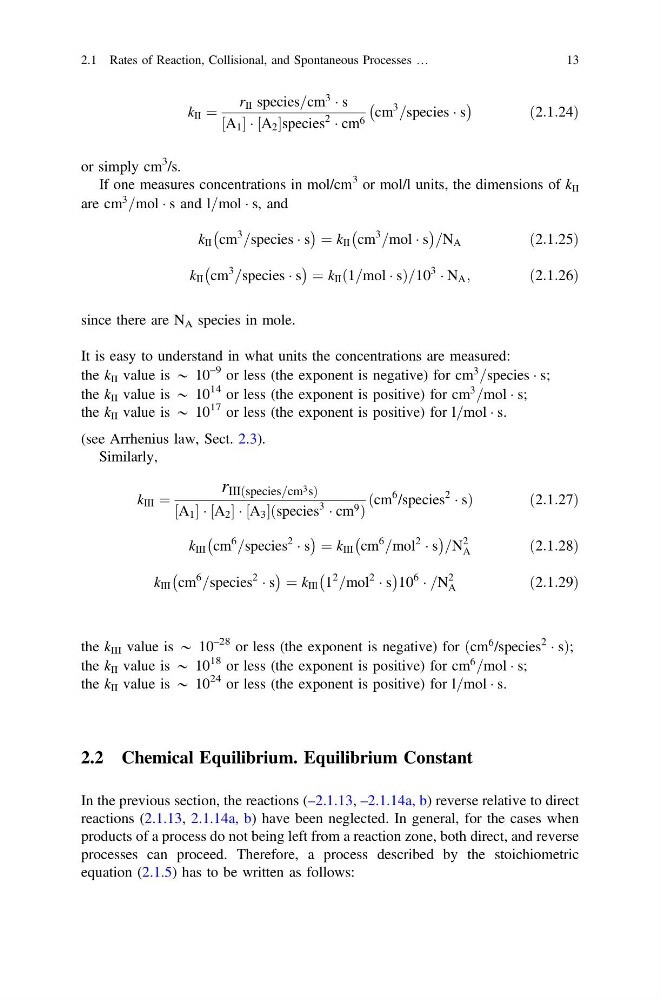
k II ¼
r II species=cm
3
Á s
A 1
½ Á A 2
½ species
2
Á cm 6 cm
3
=species Á s
À
Á
ð2:1:24Þ
or simply cm
3 /s.
If one measures concentrations in mol/cm
3 or mol/l units, the dimensions of k II
are cm
3
=mol Á s and l=mol Á s, and
k II cm
3
=species Á s
À
Á ¼ k II cm
3
=mol Á s
À
Á =N A
ð2:1:25Þ
k II cm
3
=species Á s
À
Á ¼ k II 1=mol Á s
ð
Þ =10
3
Á N A ;
ð2:1:26Þ
since there are N A species in mole.
It is easy to understand in what units the concentrations are measured:
the k II value is * 10
–9 or less (the exponent is negative) for cm
3
=species Á s;
the k II value is * 10
14 or less (the exponent is positive) for cm
3
=mol Á s;
the k II value is * 10
17 or less (the exponent is positive) for l=mol Á s.
(see Arrhenius law, Sect. 2.3).
Similarly,
k III ¼
r IIIðspecies=cm 3 sÞ
A 1
½ Á A 2
½ Á A 3
½ ðspecies
3
Á cm 9 Þ
ðcm
6 /species
2
Á sÞ
ð 2:1:27Þ
k III cm
6
=species
2
Á s
À
Á ¼ k III cm
6
=mol
2
Á s
À
Á =N
2
A
ð2:1:28Þ
k III cm
6
=species
2
Á s
À
Á ¼ k IIl 1
2
=mol
2
Á s
À
Á
10
6
Á =N
2
A
ð2:1:29Þ
the k III value is * 10
–28 or less (the exponent is negative) for ðcm
6 /species
2
Á sÞ;
the k II value is * 10
18 or less (the exponent is positive) for cm
6
=mol Á s;
the k II value is * 10
24 or less (the exponent is positive) for l=mol Á s.
2.2 Chemical Equilibrium. Equilibrium Constant
In the previous section, the reactions (–2.1.13, –2.1.14a, b) reverse relative to direct
reactions (2.1.13, 2.1.14a, b) have been neglected. In general, for the cases when
products of a process do not being left from a reaction zone, both direct, and reverse
processes can proceed. Therefore, a process described by the stoichiometric
equation (2.1.5) has to be written as follows:
2.1 Rates of Reaction, Collisional, and Spontaneous Processes …
13
r II species=cm
3
Á s
A 1
½ Á A 2
½ species
2
Á cm 6 cm
3
=species Á s
À
Á
ð2:1:24Þ
or simply cm
3 /s.
If one measures concentrations in mol/cm
3 or mol/l units, the dimensions of k II
are cm
3
=mol Á s and l=mol Á s, and
k II cm
3
=species Á s
À
Á ¼ k II cm
3
=mol Á s
À
Á =N A
ð2:1:25Þ
k II cm
3
=species Á s
À
Á ¼ k II 1=mol Á s
ð
Þ =10
3
Á N A ;
ð2:1:26Þ
since there are N A species in mole.
It is easy to understand in what units the concentrations are measured:
the k II value is * 10
–9 or less (the exponent is negative) for cm
3
=species Á s;
the k II value is * 10
14 or less (the exponent is positive) for cm
3
=mol Á s;
the k II value is * 10
17 or less (the exponent is positive) for l=mol Á s.
(see Arrhenius law, Sect. 2.3).
Similarly,
k III ¼
r IIIðspecies=cm 3 sÞ
A 1
½ Á A 2
½ Á A 3
½ ðspecies
3
Á cm 9 Þ
ðcm
6 /species
2
Á sÞ
ð 2:1:27Þ
k III cm
6
=species
2
Á s
À
Á ¼ k III cm
6
=mol
2
Á s
À
Á =N
2
A
ð2:1:28Þ
k III cm
6
=species
2
Á s
À
Á ¼ k IIl 1
2
=mol
2
Á s
À
Á
10
6
Á =N
2
A
ð2:1:29Þ
the k III value is * 10
–28 or less (the exponent is negative) for ðcm
6 /species
2
Á sÞ;
the k II value is * 10
18 or less (the exponent is positive) for cm
6
=mol Á s;
the k II value is * 10
24 or less (the exponent is positive) for l=mol Á s.
2.2 Chemical Equilibrium. Equilibrium Constant
In the previous section, the reactions (–2.1.13, –2.1.14a, b) reverse relative to direct
reactions (2.1.13, 2.1.14a, b) have been neglected. In general, for the cases when
products of a process do not being left from a reaction zone, both direct, and reverse
processes can proceed. Therefore, a process described by the stoichiometric
equation (2.1.5) has to be written as follows:
2.1 Rates of Reaction, Collisional, and Spontaneous Processes …
13