

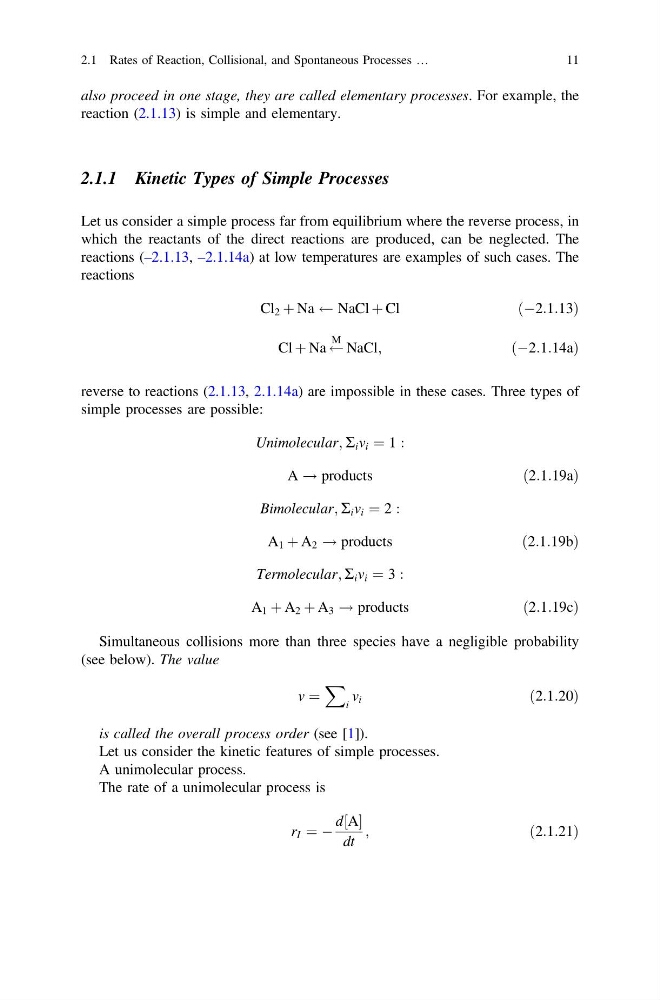
also proceed in one stage, they are called elementary processes. For example, the
reaction (2.1.13) is simple and elementary.
2.1.1 Kinetic Types of Simple Processes
Let us consider a simple process far from equilibrium where the reverse process, in
which the reactants of the direct reactions are produced, can be neglected. The
reactions (–2.1.13, –2.1.14a) at low temperatures are examples of such cases. The
reactions
Cl 2 þ Na
NaCl þ Cl
ðÀ2:1:13Þ
Cl þ Na
M NaCl;
ðÀ2:1:14aÞ
reverse to reactions (2.1.13, 2.1.14a) are impossible in these cases. Three types of
simple processes are possible:
Unimolecular; R i v i ¼ 1 :
A ! products
ð2:1:19aÞ
Bimolecular; R i v i ¼ 2 :
A 1 þ A 2 ! products
ð2:1:19bÞ
Termolecular; R i v i ¼ 3 :
A 1 þ A 2 þ A 3 ! products
ð2:1:19cÞ
Simultaneous collisions more than three species have a negligible probability
(see below). The value
v ¼
X
i
v i
ð2:1:20Þ
is called the overall process order (see [1]).
Let us consider the kinetic features of simple processes.
A unimolecular process.
The rate of a unimolecular process is
r I ¼ À
d½A
dt
;
ð2:1:21Þ
2.1 Rates of Reaction, Collisional, and Spontaneous Processes …
11
reaction (2.1.13) is simple and elementary.
2.1.1 Kinetic Types of Simple Processes
Let us consider a simple process far from equilibrium where the reverse process, in
which the reactants of the direct reactions are produced, can be neglected. The
reactions (–2.1.13, –2.1.14a) at low temperatures are examples of such cases. The
reactions
Cl 2 þ Na
NaCl þ Cl
ðÀ2:1:13Þ
Cl þ Na
M NaCl;
ðÀ2:1:14aÞ
reverse to reactions (2.1.13, 2.1.14a) are impossible in these cases. Three types of
simple processes are possible:
Unimolecular; R i v i ¼ 1 :
A ! products
ð2:1:19aÞ
Bimolecular; R i v i ¼ 2 :
A 1 þ A 2 ! products
ð2:1:19bÞ
Termolecular; R i v i ¼ 3 :
A 1 þ A 2 þ A 3 ! products
ð2:1:19cÞ
Simultaneous collisions more than three species have a negligible probability
(see below). The value
v ¼
X
i
v i
ð2:1:20Þ
is called the overall process order (see [1]).
Let us consider the kinetic features of simple processes.
A unimolecular process.
The rate of a unimolecular process is
r I ¼ À
d½A
dt
;
ð2:1:21Þ
2.1 Rates of Reaction, Collisional, and Spontaneous Processes …
11