

excitation) by withdrawal of a part of the energy, thus ensuring physical stability of
the product. The (Na … Cl)
# quasi-molecule (collision complex) is produced in the
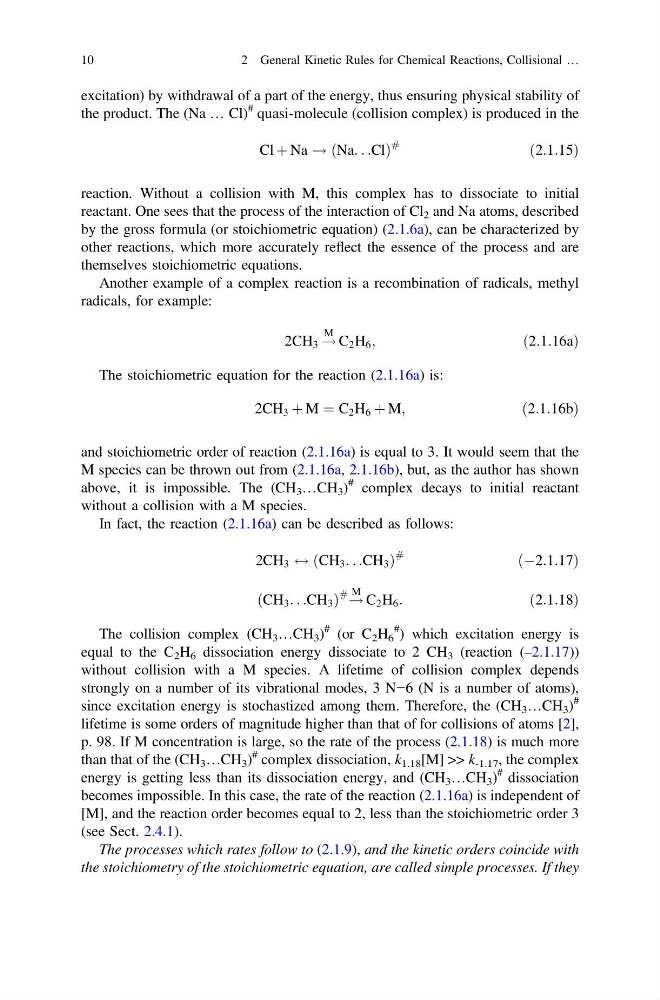
Cl þ Na ! ðNa. . .ClÞ
#
ð2:1:15Þ
reaction. Without a collision with M, this complex has to dissociate to initial
reactant. One sees that the process of the interaction of Cl 2 and Na atoms, described
by the gross formula (or stoichiometric equation) (2.1.6a), can be characterized by
other reactions, which more accurately reflect the essence of the process and are
themselves stoichiometric equations.
Another example of a complex reaction is a recombination of radicals, methyl
radicals, for example:
2CH 3 !
M C 2 H 6 ;
ð2:1:16aÞ
The stoichiometric equation for the reaction (2.1.16a) is:
2CH 3 þ M ¼ C 2 H 6 þ M;
ð2:1:16bÞ
and stoichiometric order of reaction (2.1.16a) is equal to 3. It would seem that the
M species can be thrown out from (2.1.16a, 2.1.16b), but, as the author has shown
above, it is impossible. The (CH 3 …CH 3 )
# complex decays to initial reactant
without a collision with a M species.
In fact, the reaction (2.1.16a) can be described as follows:
2CH 3 $ CH 3 . . .CH 3
ð
Þ
#
ðÀ2:1:17Þ
CH 3 . . .CH 3
ð
Þ
# !
M C 2 H 6 :
ð2:1:18Þ
The collision complex (CH 3 …CH 3 )
# (or C 2 H 6
# ) which excitation energy is
equal to the C 2 H 6 dissociation energy dissociate to 2 CH 3 (reaction (–2.1.17))
without collision with a M species. A lifetime of collision complex depends
strongly on a number of its vibrational modes, 3 N−6 (N is a number of atoms),
since excitation energy is stochastized among them. Therefore, the (CH 3 …CH 3 )
#
lifetime is some orders of magnitude higher than that of for collisions of atoms [2],
p. 98. If M concentration is large, so the rate of the process (2.1.18) is much more
than that of the (CH 3 …CH 3 )
# complex dissociation, k 1.18 [M] >> k -1.17 , the complex
energy is getting less than its dissociation energy, and (CH 3 …CH 3 )
# dissociation
becomes impossible. In this case, the rate of the reaction (2.1.16a) is independent of
[M], and the reaction order becomes equal to 2, less than the stoichiometric order 3
(see Sect. 2.4.1).
The processes which rates follow to (2.1.9), and the kinetic orders coincide with
the stoichiometry of the stoichiometric equation, are called simple processes. If they
10
2 General Kinetic Rules for Chemical Reactions, Collisional …
the product. The (Na … Cl)
# quasi-molecule (collision complex) is produced in the
Cl þ Na ! ðNa. . .ClÞ
#
ð2:1:15Þ
reaction. Without a collision with M, this complex has to dissociate to initial
reactant. One sees that the process of the interaction of Cl 2 and Na atoms, described
by the gross formula (or stoichiometric equation) (2.1.6a), can be characterized by
other reactions, which more accurately reflect the essence of the process and are
themselves stoichiometric equations.
Another example of a complex reaction is a recombination of radicals, methyl
radicals, for example:
2CH 3 !
M C 2 H 6 ;
ð2:1:16aÞ
The stoichiometric equation for the reaction (2.1.16a) is:
2CH 3 þ M ¼ C 2 H 6 þ M;
ð2:1:16bÞ
and stoichiometric order of reaction (2.1.16a) is equal to 3. It would seem that the
M species can be thrown out from (2.1.16a, 2.1.16b), but, as the author has shown
above, it is impossible. The (CH 3 …CH 3 )
# complex decays to initial reactant
without a collision with a M species.
In fact, the reaction (2.1.16a) can be described as follows:
2CH 3 $ CH 3 . . .CH 3
ð
Þ
#
ðÀ2:1:17Þ
CH 3 . . .CH 3
ð
Þ
# !
M C 2 H 6 :
ð2:1:18Þ
The collision complex (CH 3 …CH 3 )
# (or C 2 H 6
# ) which excitation energy is
equal to the C 2 H 6 dissociation energy dissociate to 2 CH 3 (reaction (–2.1.17))
without collision with a M species. A lifetime of collision complex depends
strongly on a number of its vibrational modes, 3 N−6 (N is a number of atoms),
since excitation energy is stochastized among them. Therefore, the (CH 3 …CH 3 )
#
lifetime is some orders of magnitude higher than that of for collisions of atoms [2],
p. 98. If M concentration is large, so the rate of the process (2.1.18) is much more
than that of the (CH 3 …CH 3 )
# complex dissociation, k 1.18 [M] >> k -1.17 , the complex
energy is getting less than its dissociation energy, and (CH 3 …CH 3 )
# dissociation
becomes impossible. In this case, the rate of the reaction (2.1.16a) is independent of
[M], and the reaction order becomes equal to 2, less than the stoichiometric order 3
(see Sect. 2.4.1).
The processes which rates follow to (2.1.9), and the kinetic orders coincide with
the stoichiometry of the stoichiometric equation, are called simple processes. If they
10
2 General Kinetic Rules for Chemical Reactions, Collisional …