

89], the HeI 2 (B,v B ,n B = 2-4 ← X,0,n X = 0,1) transitions are the strongest, and corresponding bands are broad and strongly overlapped. Transitions via all these,
n B = 2-4, levels have to contribute to the two-step spectra (6.3.8). According to
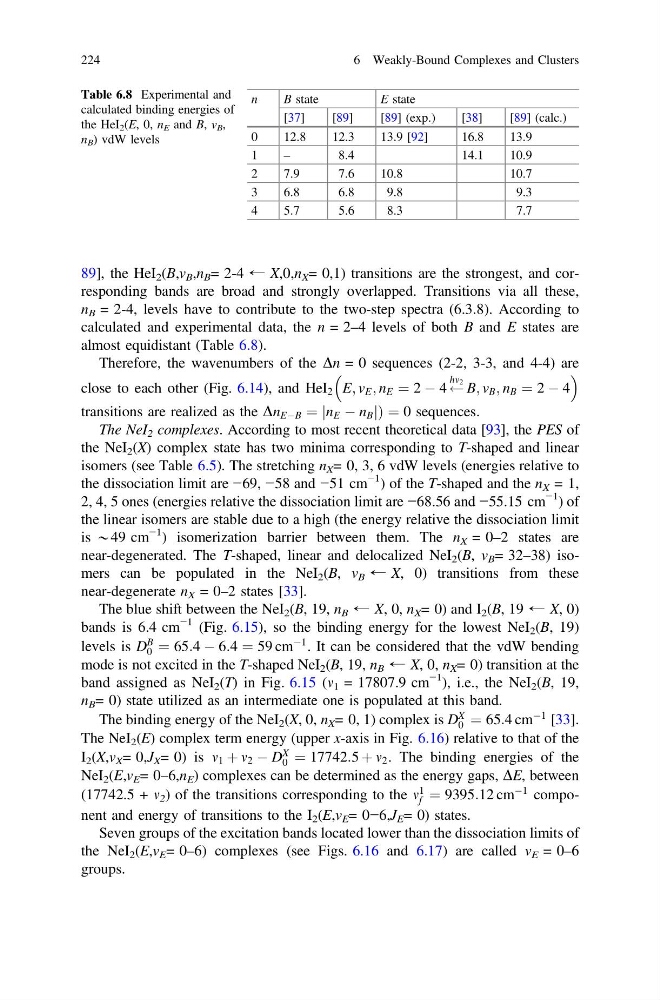
calculated and experimental data, the n = 2–4 levels of both B and E states are
almost equidistant (Table 6.8).
Therefore, the wavenumbers of the Dn = 0 sequences (2-2, 3-3, and 4-4) are
close to each other (Fig. 6.14), and HeI 2 E; v E ; n E ¼ 2 À 4
hm 2 B; v B ; n B ¼ 2 À 4
transitions are realized as the Dn EÀB ¼ n E À n B
j
j Þ¼ 0 sequences.
The NeI 2 complexes. According to most recent theoretical data [93], the PES of
the NeI 2 (X) complex state has two minima corresponding to T-shaped and linear
isomers (see Table 6.5). The stretching n X = 0, 3, 6 vdW levels (energies relative to
the dissociation limit are −69, −58 and −51 cm
−1 ) of the T-shaped and the n X = 1,
2, 4, 5 ones (energies relative the dissociation limit are −68.56 and −55.15 cm
−1 ) of
the linear isomers are stable due to a high (the energy relative the dissociation limit
is *49 cm
−1 ) isomerization barrier between them. The n X = 0–2 states are
near-degenerated. The T-shaped, linear and delocalized NeI 2 (B, v B = 32–38) isomers can be populated in the NeI 2 (B, v B ← X, 0) transitions from these
near-degenerate n X = 0–2 states [33].
The blue shift between the NeI 2 (B, 19, n B ← X, 0, n X = 0) and I 2 (B, 19 ← X, 0)
bands is 6.4 cm
−1 (Fig. 6.15), so the binding energy for the lowest NeI 2 (B, 19)
levels is D
B
0 ¼ 65:4 À 6:4 ¼ 59 cm
À1 . It can be considered that the vdW bending
mode is not excited in the T-shaped NeI 2 (B, 19, n B ← X, 0, n X = 0) transition at the
band assigned as NeI 2 (T) in Fig. 6.15 (m 1 = 17807.9 cm
−1 ), i.e., the NeI 2 (B, 19,
n B = 0) state utilized as an intermediate one is populated at this band.
The binding energy of the NeI 2 (X, 0, n X = 0, 1) complex is D
X
0 ¼ 65:4 cm
À1 [33].
The NeI 2 (E) complex term energy (upper x-axis in Fig. 6.16) relative to that of the
I 2 (X,v X = 0,J X = 0) is m 1 þ m 2 À D
X
0 ¼ 17742:5 þ m 2 . The binding energies of the
NeI 2 (E,v E = 0–6,n E ) complexes can be determined as the energy gaps, DE, between
(17742.5 + m 2 ) of the transitions corresponding to the m
1
f ¼ 9395:12 cm
À1 component and energy of transitions to the I 2 (E,v E = 0−6,J E = 0) states.
Seven groups of the excitation bands located lower than the dissociation limits of
the NeI 2 (E,v E = 0–6) complexes (see Figs. 6.16 and 6.17) are called v E = 0–6
groups.
Table 6.8 Experimental and
calculated binding energies of
the HeI 2 (E, 0, n E and B, v B ,
n B ) vdW levels
n
Bstate
E state
[37]
[89]
[89] (exp.)
[38]
[89] (calc.)
0
12.8
12.3
13.9 [92]
16.8
13.9
1
–
8.4
14.1
10.9
2
7.9
7.6
10.8
10.7
3
6.8
6.8
9.8
9.3
4
5.7
5.6
8.3
7.7
224
6 Weakly-Bound Complexes and Clusters
n B = 2-4, levels have to contribute to the two-step spectra (6.3.8). According to
calculated and experimental data, the n = 2–4 levels of both B and E states are
almost equidistant (Table 6.8).
Therefore, the wavenumbers of the Dn = 0 sequences (2-2, 3-3, and 4-4) are
close to each other (Fig. 6.14), and HeI 2 E; v E ; n E ¼ 2 À 4
hm 2 B; v B ; n B ¼ 2 À 4
transitions are realized as the Dn EÀB ¼ n E À n B
j
j Þ¼ 0 sequences.
The NeI 2 complexes. According to most recent theoretical data [93], the PES of
the NeI 2 (X) complex state has two minima corresponding to T-shaped and linear
isomers (see Table 6.5). The stretching n X = 0, 3, 6 vdW levels (energies relative to
the dissociation limit are −69, −58 and −51 cm
−1 ) of the T-shaped and the n X = 1,
2, 4, 5 ones (energies relative the dissociation limit are −68.56 and −55.15 cm
−1 ) of
the linear isomers are stable due to a high (the energy relative the dissociation limit
is *49 cm
−1 ) isomerization barrier between them. The n X = 0–2 states are
near-degenerated. The T-shaped, linear and delocalized NeI 2 (B, v B = 32–38) isomers can be populated in the NeI 2 (B, v B ← X, 0) transitions from these
near-degenerate n X = 0–2 states [33].
The blue shift between the NeI 2 (B, 19, n B ← X, 0, n X = 0) and I 2 (B, 19 ← X, 0)
bands is 6.4 cm
−1 (Fig. 6.15), so the binding energy for the lowest NeI 2 (B, 19)
levels is D
B
0 ¼ 65:4 À 6:4 ¼ 59 cm
À1 . It can be considered that the vdW bending
mode is not excited in the T-shaped NeI 2 (B, 19, n B ← X, 0, n X = 0) transition at the
band assigned as NeI 2 (T) in Fig. 6.15 (m 1 = 17807.9 cm
−1 ), i.e., the NeI 2 (B, 19,
n B = 0) state utilized as an intermediate one is populated at this band.
The binding energy of the NeI 2 (X, 0, n X = 0, 1) complex is D
X
0 ¼ 65:4 cm
À1 [33].
The NeI 2 (E) complex term energy (upper x-axis in Fig. 6.16) relative to that of the
I 2 (X,v X = 0,J X = 0) is m 1 þ m 2 À D
X
0 ¼ 17742:5 þ m 2 . The binding energies of the
NeI 2 (E,v E = 0–6,n E ) complexes can be determined as the energy gaps, DE, between
(17742.5 + m 2 ) of the transitions corresponding to the m
1
f ¼ 9395:12 cm
À1 component and energy of transitions to the I 2 (E,v E = 0−6,J E = 0) states.
Seven groups of the excitation bands located lower than the dissociation limits of
the NeI 2 (E,v E = 0–6) complexes (see Figs. 6.16 and 6.17) are called v E = 0–6
groups.
Table 6.8 Experimental and
calculated binding energies of
the HeI 2 (E, 0, n E and B, v B ,
n B ) vdW levels
n
Bstate
E state
[37]
[89]
[89] (exp.)
[38]
[89] (calc.)
0
12.8
12.3
13.9 [92]
16.8
13.9
1
–
8.4
14.1
10.9
2
7.9
7.6
10.8
10.7
3
6.8
6.8
9.8
9.3
4
5.7
5.6
8.3
7.7
224
6 Weakly-Bound Complexes and Clusters