

n E ) ! He + I 2 (E,v E -Dv E ), Dv E = 0, VP channels are energetically closed, as it
occurs for the T-shaped HeI 2 (E,v E ,n E ) complexes (see above). A weak luminescence, br.r. % 0.1 in the k lum = 4000–4400 Å spectral range at the v E = 0 band
belongs to the HeI 2 (E,v E = 0,n E ) complex itself. The VP probabilities (if they are
energetically allowed) are *2–3 times higher than those of EP (Table 6.7) as
opposed to what is observed in T-shaped complexes (see Table 6.6).
As it has been mentioned above (see Fig. 6.9), two degenerated HeI 2 (X,0,
n X = 0,1) states are localized at the linear geometry. As to the B state, n B > 0 states
are delocalized. The n B states of different parity can be populated from the n X = 0, 1
states in the Dn = even transitions. According to experimental data obtained in [37,
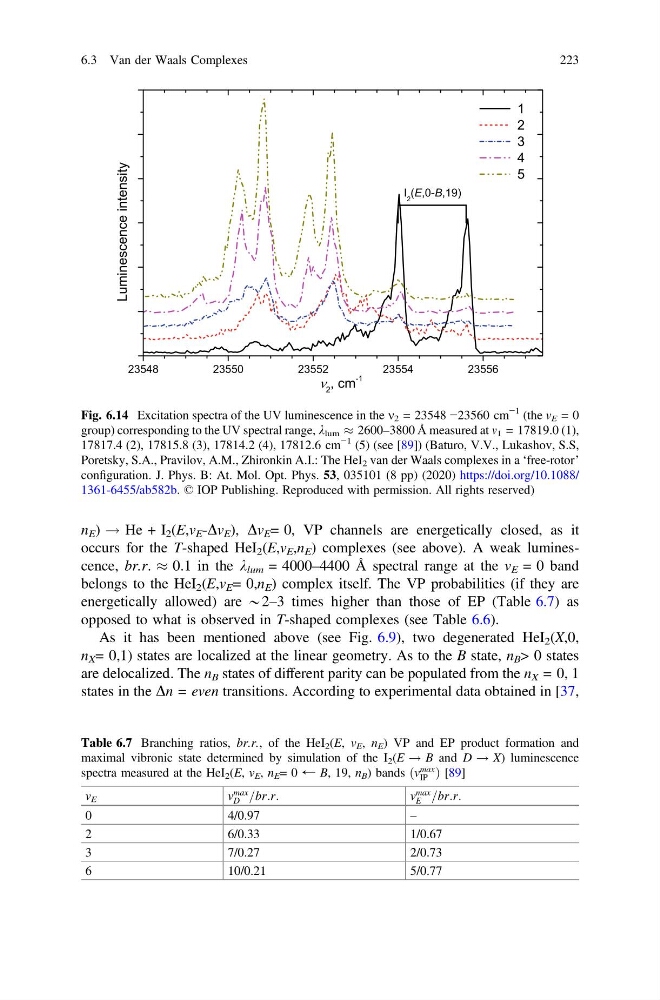
Fig. 6.14 Excitation spectra of the UV luminescence in the m 2 = 23548 −23560 cm
−1 (the v E = 0
group) corresponding to the UV spectral range, k lum % 2600–3800 Å measured at m 1 = 17819.0 (1),
17817.4 (2), 17815.8 (3), 17814.2 (4), 17812.6 cm
−1 (5) (see [89]) (Baturo, V.V., Lukashov, S.S,
Poretsky, S.A., Pravilov, A.M., Zhironkin A.I.: The HeI 2 van der Waals complexes in a ‘free-rotor’
configuration. J. Phys. B: At. Mol. Opt. Phys. 53, 035101 (8 pp) (2020) https://doi.org/10.1088/
1361-6455/ab582b. © IOP Publishing. Reproduced with permission. All rights reserved)
Table 6.7 Branching ratios, br.r., of the HeI 2 (E, v E , n E ) VP and EP product formation and
maximal vibronic state determined by simulation of the I 2 (E ! B and D ! X) luminescence
spectra measured at the HeI 2 (E, v E , n E = 0 ← B, 19, n B ) bands ðv
max
IP Þ [89]
v E
v
max
D =br:r:
v
max
E =br:r:
0
4/0.97
–
2
6/0.33
1/0.67
3
7/0.27
2/0.73
6
10/0.21
5/0.77
6.3 Van der Waals Complexes
223
occurs for the T-shaped HeI 2 (E,v E ,n E ) complexes (see above). A weak luminescence, br.r. % 0.1 in the k lum = 4000–4400 Å spectral range at the v E = 0 band
belongs to the HeI 2 (E,v E = 0,n E ) complex itself. The VP probabilities (if they are
energetically allowed) are *2–3 times higher than those of EP (Table 6.7) as
opposed to what is observed in T-shaped complexes (see Table 6.6).
As it has been mentioned above (see Fig. 6.9), two degenerated HeI 2 (X,0,
n X = 0,1) states are localized at the linear geometry. As to the B state, n B > 0 states
are delocalized. The n B states of different parity can be populated from the n X = 0, 1
states in the Dn = even transitions. According to experimental data obtained in [37,
Fig. 6.14 Excitation spectra of the UV luminescence in the m 2 = 23548 −23560 cm
−1 (the v E = 0
group) corresponding to the UV spectral range, k lum % 2600–3800 Å measured at m 1 = 17819.0 (1),
17817.4 (2), 17815.8 (3), 17814.2 (4), 17812.6 cm
−1 (5) (see [89]) (Baturo, V.V., Lukashov, S.S,
Poretsky, S.A., Pravilov, A.M., Zhironkin A.I.: The HeI 2 van der Waals complexes in a ‘free-rotor’
configuration. J. Phys. B: At. Mol. Opt. Phys. 53, 035101 (8 pp) (2020) https://doi.org/10.1088/
1361-6455/ab582b. © IOP Publishing. Reproduced with permission. All rights reserved)
Table 6.7 Branching ratios, br.r., of the HeI 2 (E, v E , n E ) VP and EP product formation and
maximal vibronic state determined by simulation of the I 2 (E ! B and D ! X) luminescence
spectra measured at the HeI 2 (E, v E , n E = 0 ← B, 19, n B ) bands ðv
max
IP Þ [89]
v E
v
max
D =br:r:
v
max
E =br:r:
0
4/0.97
–
2
6/0.33
1/0.67
3
7/0.27
2/0.73
6
10/0.21
5/0.77
6.3 Van der Waals Complexes
223