

5.6 Vibrational Relaxation Via a Complex of Electronic
States
The rate constant of vibrational relaxation of the lower vibrational levels N 2 X
1 R
þ
g
is small; for v X = 1, it is of the order of 10
–18 cm
3 /s (see Sect. 5.3). What can it be
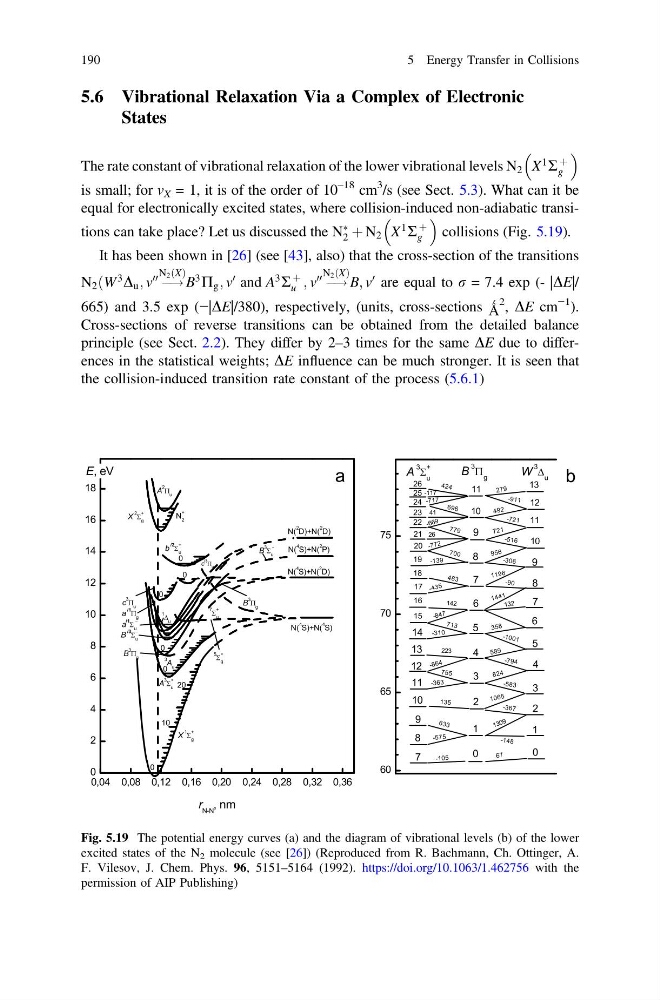
equal for electronically excited states, where collision-induced non-adiabatic transitions can take place? Let us discussed the N
Ã
2 þ N 2 X
1 R
þ
g
collisions (Fig. 5.19).
It has been shown in [26] (see [43], also) that the cross-section of the transitions
N 2 ðW
3 D u ; v
00
À!
N 2 ðXÞ
B
3 P g ; v
0 and A
3 R
þ
u ; v
00
À!
N 2 ðXÞ
B; v
0 are equal to r = 7.4 exp (- |DE|/
665) and 3.5 exp (−|DE|/380), respectively, (units, cross-sections
2 , DE cm
−1 ).
Cross-sections of reverse transitions can be obtained from the detailed balance
principle (see Sect. 2.2). They differ by 2–3 times for the same DE due to differences in the statistical weights; DE influence can be much stronger. It is seen that
the collision-induced transition rate constant of the process (5.6.1)
Fig. 5.19 The potential energy curves (a) and the diagram of vibrational levels (b) of the lower
excited states of the N 2 molecule (see [26]) (Reproduced from R. Bachmann, Ch. Ottinger, A.
F. Vilesov, J. Chem. Phys. 96, 5151–5164 (1992). https://doi.org/10.1063/1.462756 with the
permission of AIP Publishing)
190
5 Energy Transfer in Collisions
States
The rate constant of vibrational relaxation of the lower vibrational levels N 2 X
1 R
þ
g
is small; for v X = 1, it is of the order of 10
–18 cm
3 /s (see Sect. 5.3). What can it be
equal for electronically excited states, where collision-induced non-adiabatic transitions can take place? Let us discussed the N
Ã
2 þ N 2 X
1 R
þ
g
collisions (Fig. 5.19).
It has been shown in [26] (see [43], also) that the cross-section of the transitions
N 2 ðW
3 D u ; v
00
À!
N 2 ðXÞ
B
3 P g ; v
0 and A
3 R
þ
u ; v
00
À!
N 2 ðXÞ
B; v
0 are equal to r = 7.4 exp (- |DE|/
665) and 3.5 exp (−|DE|/380), respectively, (units, cross-sections
2 , DE cm
−1 ).
Cross-sections of reverse transitions can be obtained from the detailed balance
principle (see Sect. 2.2). They differ by 2–3 times for the same DE due to differences in the statistical weights; DE influence can be much stronger. It is seen that
the collision-induced transition rate constant of the process (5.6.1)
Fig. 5.19 The potential energy curves (a) and the diagram of vibrational levels (b) of the lower
excited states of the N 2 molecule (see [26]) (Reproduced from R. Bachmann, Ch. Ottinger, A.
F. Vilesov, J. Chem. Phys. 96, 5151–5164 (1992). https://doi.org/10.1063/1.462756 with the
permission of AIP Publishing)
190
5 Energy Transfer in Collisions