

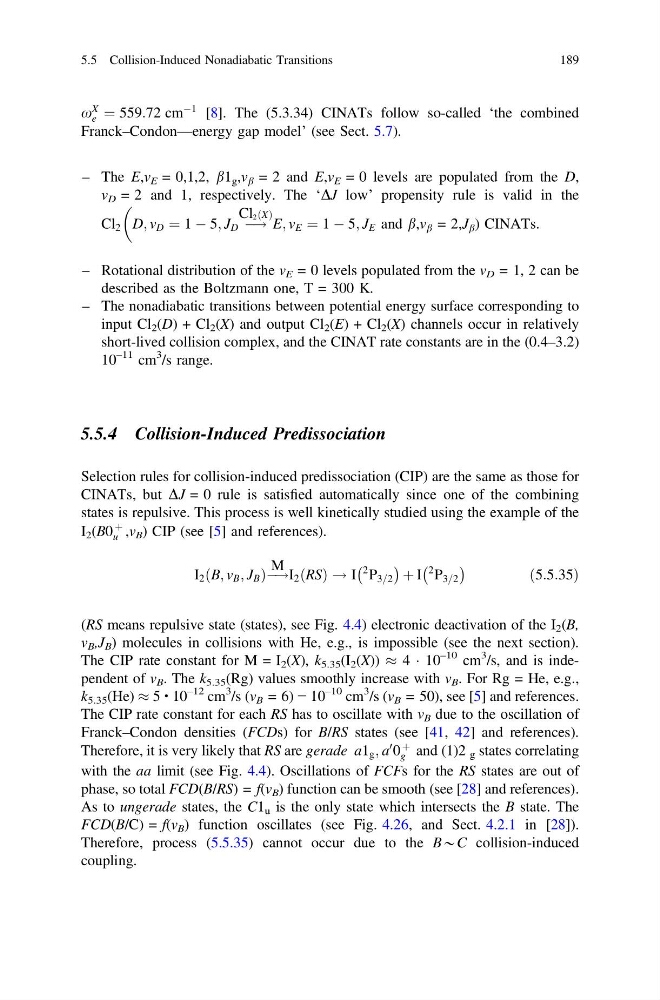
x
X
e ¼ 559:72 cm
À1 [8]. The (5.3.34) CINATs follow so-called ‘the combined
Franck–Condon—energy gap model’ (see Sect. 5.7).
– The E,v E = 0,1,2, b1 g ,v b = 2 and E,v E = 0 levels are populated from the D,
v D = 2 and 1, respectively. The ‘DJ low’ propensity rule is valid in the
Cl 2 D; v D ¼ 1 À 5; J D À!
Cl 2 ðXÞ
E; v E ¼ 1 À 5; J E
and b,v b = 2,J b ) CINATs.
– Rotational distribution of the v E = 0 levels populated from the v D = 1, 2 can be
described as the Boltzmann one, T = 300 K.
– The nonadiabatic transitions between potential energy surface corresponding to
input Cl 2 (D) + Cl 2 (X) and output Cl 2 (E) + Cl 2 (X) channels occur in relatively
short-lived collision complex, and the CINAT rate constants are in the (0.4–3.2)
10
–11 cm
3 /s range.
5.5.4 Collision-Induced Predissociation
Selection rules for collision-induced predissociation (CIP) are the same as those for
CINATs, but DJ = 0 rule is satisfied automatically since one of the combining
states is repulsive. This process is well kinetically studied using the example of the
I 2 (B0
þ
u ,v B ) CIP (see [5] and references).
I 2 B; v B ; J B
ð
Þ À !
M I 2 ðRSÞ ! I
2 P 3=2
À
Á þ I
2 P 3=2
À
Á
ð5:5:35Þ
(RS means repulsive state (states), see Fig. 4.4) electronic deactivation of the I 2 (B,
v B ,J B ) molecules in collisions with He, e.g., is impossible (see the next section).
The CIP rate constant for M = I 2 (X), k 5.35 (I 2 (X)) % 4 Á 10
–10 cm
3 /s, and is independent of v B . The k 5.35 (Rg) values smoothly increase with v B . For Rg = He, e.g.,
k 5.35 (He) % 5 ∙ 10
–12 cm
3 /s (v B = 6) − 10
–10 cm
3 /s (v B = 50), see [5] and references.
The CIP rate constant for each RS has to oscillate with v B due to the oscillation of
Franck–Condon densities (FCDs) for B/RS states (see [41, 42] and references).
Therefore, it is very likely that RS are gerade a1 g ; a
0 0
þ
g and (1)2 g states correlating
with the aa limit (see Fig. 4.4). Oscillations of FCFs for the RS states are out of
phase, so total FCD(B/RS) = f(v B ) function can be smooth (see [28] and references).
As to ungerade states, the C1 u is the only state which intersects the B state. The
FCD(B/C) = f(v B ) function oscillates (see Fig. 4.26, and Sect. 4.2.1 in [28]).
Therefore, process (5.5.35) cannot occur due to the B*C collision-induced
coupling.
5.5 Collision-Induced Nonadiabatic Transitions
189
X
e ¼ 559:72 cm
À1 [8]. The (5.3.34) CINATs follow so-called ‘the combined
Franck–Condon—energy gap model’ (see Sect. 5.7).
– The E,v E = 0,1,2, b1 g ,v b = 2 and E,v E = 0 levels are populated from the D,
v D = 2 and 1, respectively. The ‘DJ low’ propensity rule is valid in the
Cl 2 D; v D ¼ 1 À 5; J D À!
Cl 2 ðXÞ
E; v E ¼ 1 À 5; J E
and b,v b = 2,J b ) CINATs.
– Rotational distribution of the v E = 0 levels populated from the v D = 1, 2 can be
described as the Boltzmann one, T = 300 K.
– The nonadiabatic transitions between potential energy surface corresponding to
input Cl 2 (D) + Cl 2 (X) and output Cl 2 (E) + Cl 2 (X) channels occur in relatively
short-lived collision complex, and the CINAT rate constants are in the (0.4–3.2)
10
–11 cm
3 /s range.
5.5.4 Collision-Induced Predissociation
Selection rules for collision-induced predissociation (CIP) are the same as those for
CINATs, but DJ = 0 rule is satisfied automatically since one of the combining
states is repulsive. This process is well kinetically studied using the example of the
I 2 (B0
þ
u ,v B ) CIP (see [5] and references).
I 2 B; v B ; J B
ð
Þ À !
M I 2 ðRSÞ ! I
2 P 3=2
À
Á þ I
2 P 3=2
À
Á
ð5:5:35Þ
(RS means repulsive state (states), see Fig. 4.4) electronic deactivation of the I 2 (B,
v B ,J B ) molecules in collisions with He, e.g., is impossible (see the next section).
The CIP rate constant for M = I 2 (X), k 5.35 (I 2 (X)) % 4 Á 10
–10 cm
3 /s, and is independent of v B . The k 5.35 (Rg) values smoothly increase with v B . For Rg = He, e.g.,
k 5.35 (He) % 5 ∙ 10
–12 cm
3 /s (v B = 6) − 10
–10 cm
3 /s (v B = 50), see [5] and references.
The CIP rate constant for each RS has to oscillate with v B due to the oscillation of
Franck–Condon densities (FCDs) for B/RS states (see [41, 42] and references).
Therefore, it is very likely that RS are gerade a1 g ; a
0 0
þ
g and (1)2 g states correlating
with the aa limit (see Fig. 4.4). Oscillations of FCFs for the RS states are out of
phase, so total FCD(B/RS) = f(v B ) function can be smooth (see [28] and references).
As to ungerade states, the C1 u is the only state which intersects the B state. The
FCD(B/C) = f(v B ) function oscillates (see Fig. 4.26, and Sect. 4.2.1 in [28]).
Therefore, process (5.5.35) cannot occur due to the B*C collision-induced
coupling.
5.5 Collision-Induced Nonadiabatic Transitions
189