

Cl 2 D0
þ
u ; v D ; J D
hv exc þ hv exc B0
þ
u ; v B ; J B À
hv exc X0
þ
g ; v X ; J X
ð5:5:33Þ
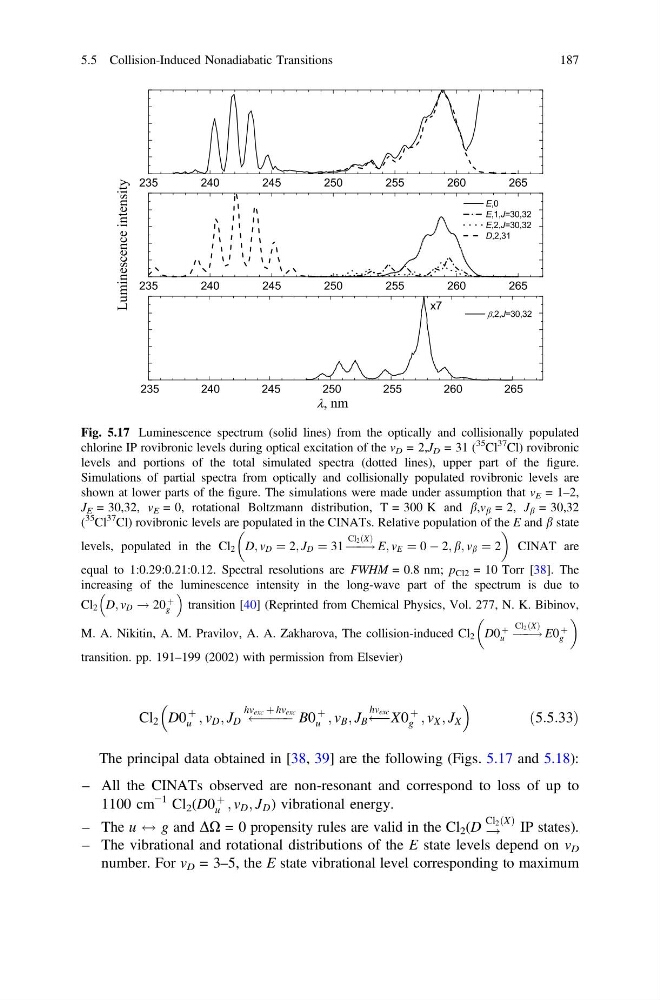
The principal data obtained in [38, 39] are the following (Figs. 5.17 and 5.18):
– All the CINATs observed are non-resonant and correspond to loss of up to
1100 cm
−1 Cl 2 (D0
þ
u ; v D ; J D ) vibrational energy.
– The u $ g and DX = 0 propensity rules are valid in the Cl 2 (D
Cl 2 ðXÞ
! IP states).
– The vibrational and rotational distributions of the E state levels depend on v D
number. For v D = 3–5, the E state vibrational level corresponding to maximum
Fig. 5.17 Luminescence spectrum (solid lines) from the optically and collisionally populated
chlorine IP rovibronic levels during optical excitation of the v D = 2,J D = 31 (
35
Cl
37
Cl) rovibronic
levels and portions of the total simulated spectra (dotted lines), upper part of the figure.
Simulations of partial spectra from optically and collisionally populated rovibronic levels are
shown at lower parts of the figure. The simulations were made under assumption that v E = 1–2,
J E = 30,32, v E = 0, rotational Boltzmann distribution, T = 300 K and b,v b = 2, J b = 30,32
(
35
Cl
37
Cl) rovibronic levels are populated in the CINATs. Relative population of the E and b state
levels, populated in the Cl 2 D; v D ¼ 2; J D ¼ 31 !
Cl2ðXÞ
E; v E ¼ 0 À 2; b; v b ¼ 2
CINAT are
equal to 1:0.29:0.21:0.12. Spectral resolutions are FWHM = 0.8 nm; p Cl2 = 10 Torr [38]. The
increasing of the luminescence intensity in the long-wave part of the spectrum is due to
Cl 2 D; v D ! 20
þ
g
transition [40] (Reprinted from Chemical Physics, Vol. 277, N. K. Bibinov,
M. A. Nikitin, A. M. Pravilov, A. A. Zakharova, The collision-induced Cl 2 D0
þ
u !
Cl2ðXÞ
E0
þ
g
transition. pp. 191–199 (2002) with permission from Elsevier)
5.5 Collision-Induced Nonadiabatic Transitions
187
þ
u ; v D ; J D
hv exc þ hv exc B0
þ
u ; v B ; J B À
hv exc X0
þ
g ; v X ; J X
ð5:5:33Þ
The principal data obtained in [38, 39] are the following (Figs. 5.17 and 5.18):
– All the CINATs observed are non-resonant and correspond to loss of up to
1100 cm
−1 Cl 2 (D0
þ
u ; v D ; J D ) vibrational energy.
– The u $ g and DX = 0 propensity rules are valid in the Cl 2 (D
Cl 2 ðXÞ
! IP states).
– The vibrational and rotational distributions of the E state levels depend on v D
number. For v D = 3–5, the E state vibrational level corresponding to maximum
Fig. 5.17 Luminescence spectrum (solid lines) from the optically and collisionally populated
chlorine IP rovibronic levels during optical excitation of the v D = 2,J D = 31 (
35
Cl
37
Cl) rovibronic
levels and portions of the total simulated spectra (dotted lines), upper part of the figure.
Simulations of partial spectra from optically and collisionally populated rovibronic levels are
shown at lower parts of the figure. The simulations were made under assumption that v E = 1–2,
J E = 30,32, v E = 0, rotational Boltzmann distribution, T = 300 K and b,v b = 2, J b = 30,32
(
35
Cl
37
Cl) rovibronic levels are populated in the CINATs. Relative population of the E and b state
levels, populated in the Cl 2 D; v D ¼ 2; J D ¼ 31 !
Cl2ðXÞ
E; v E ¼ 0 À 2; b; v b ¼ 2
CINAT are
equal to 1:0.29:0.21:0.12. Spectral resolutions are FWHM = 0.8 nm; p Cl2 = 10 Torr [38]. The
increasing of the luminescence intensity in the long-wave part of the spectrum is due to
Cl 2 D; v D ! 20
þ
g
transition [40] (Reprinted from Chemical Physics, Vol. 277, N. K. Bibinov,
M. A. Nikitin, A. M. Pravilov, A. A. Zakharova, The collision-induced Cl 2 D0
þ
u !
Cl2ðXÞ
E0
þ
g
transition. pp. 191–199 (2002) with permission from Elsevier)
5.5 Collision-Induced Nonadiabatic Transitions
187