

– In this case, the leading term of electrostatic expansion corresponds to E –D
transition electric dipole moment–vibrational transitions electric dipole
moment, * R
−3 , interactions. Collisions with these partners produce very
efficient electronic energy transfer with the total rate constant of the order of 10
–
9 cm
3 /s. The total CINAT probability is predominantly associated with the
transitions that lead to dipole allowed excitations of the partner. As a result,
these partners are efficient for I 2 vibrational energy loss.
5.5.3.2 Non-Adiabatic Transitions Between Chlorine Ion-Pair States
The dependences of the Cl 2 D0
þ
u ; v D ; J D !
Cl 2 ðXÞ
E0
þ
g ; v E ; J E
CINAT rate constants on the vibrational v E , v D , rotational J E quantum numbers, energy gaps, and
FCFs of the levels combined in the CINAT have been studied in the range of
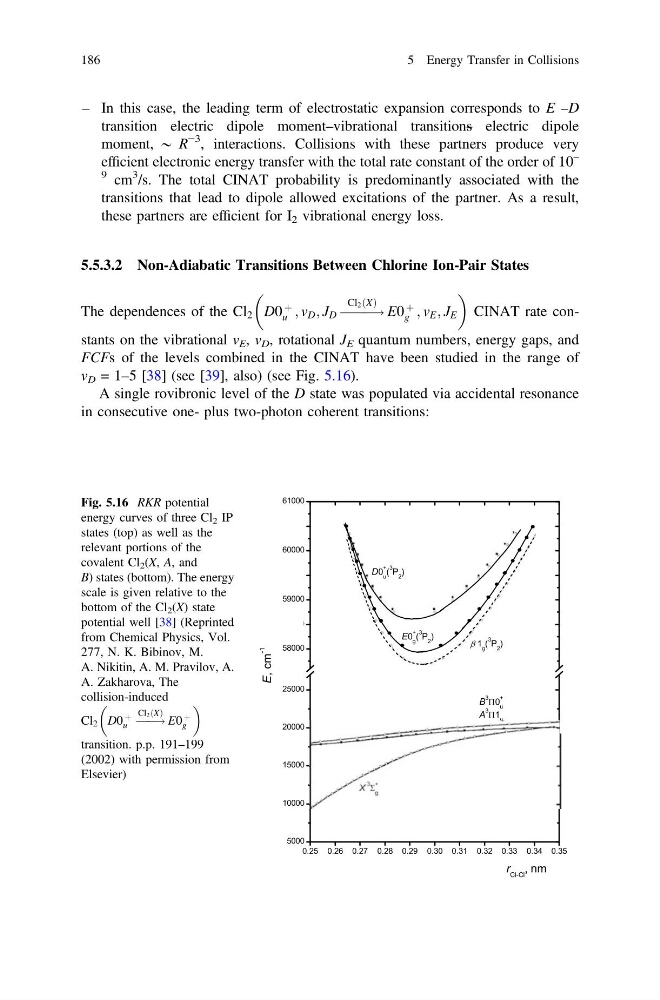
v D = 1–5 [38] (see [39], also) (see Fig. 5.16).
A single rovibronic level of the D state was populated via accidental resonance
in consecutive one- plus two-photon coherent transitions:
Fig. 5.16 RKR potential
energy curves of three Cl 2 IP
states (top) as well as the
relevant portions of the
covalent Cl 2 (X, A, and
B) states (bottom). The energy
scale is given relative to the
bottom of the Cl 2 (X) state
potential well [38] (Reprinted
from Chemical Physics, Vol.
277, N. K. Bibinov, M.
A. Nikitin, A. M. Pravilov, A.
A. Zakharova, The
collision-induced
Cl 2 D0
þ
u !
Cl2ðXÞ
E0
þ
g
transition. p.p. 191–199
(2002) with permission from
Elsevier)
186
5 Energy Transfer in Collisions
transition electric dipole moment–vibrational transitions electric dipole
moment, * R
−3 , interactions. Collisions with these partners produce very
efficient electronic energy transfer with the total rate constant of the order of 10
–
9 cm
3 /s. The total CINAT probability is predominantly associated with the
transitions that lead to dipole allowed excitations of the partner. As a result,
these partners are efficient for I 2 vibrational energy loss.
5.5.3.2 Non-Adiabatic Transitions Between Chlorine Ion-Pair States
The dependences of the Cl 2 D0
þ
u ; v D ; J D !
Cl 2 ðXÞ
E0
þ
g ; v E ; J E
CINAT rate constants on the vibrational v E , v D , rotational J E quantum numbers, energy gaps, and
FCFs of the levels combined in the CINAT have been studied in the range of
v D = 1–5 [38] (see [39], also) (see Fig. 5.16).
A single rovibronic level of the D state was populated via accidental resonance
in consecutive one- plus two-photon coherent transitions:
Fig. 5.16 RKR potential
energy curves of three Cl 2 IP
states (top) as well as the
relevant portions of the
covalent Cl 2 (X, A, and
B) states (bottom). The energy
scale is given relative to the
bottom of the Cl 2 (X) state
potential well [38] (Reprinted
from Chemical Physics, Vol.
277, N. K. Bibinov, M.
A. Nikitin, A. M. Pravilov, A.
A. Zakharova, The
collision-induced
Cl 2 D0
þ
u !
Cl2ðXÞ
E0
þ
g
transition. p.p. 191–199
(2002) with permission from
Elsevier)
186
5 Energy Transfer in Collisions