

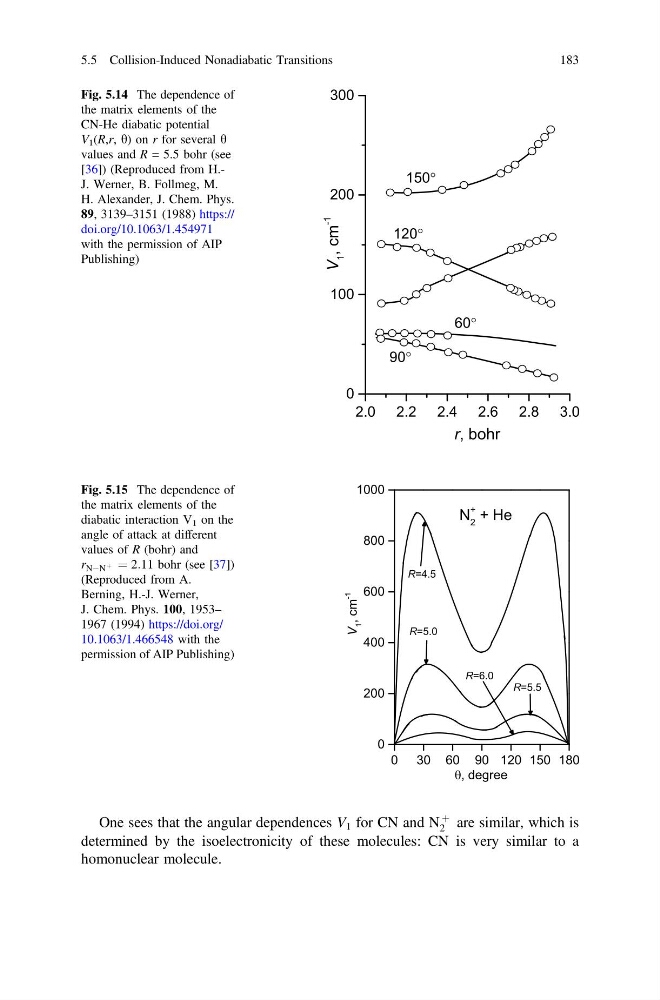
One sees that the angular dependences V 1 for CN and N
þ
2 are similar, which is
determined by the isoelectronicity of these molecules: CN is very similar to a
homonuclear molecule.
Fig. 5.14 The dependence of
the matrix elements of the
CN-He diabatic potential
V 1 (R,r, h) on r for several h
values and R = 5.5 bohr (see
[36]) (Reproduced from H.J. Werner, B. Follmeg, M.
H. Alexander, J. Chem. Phys.
89, 3139–3151 (1988) https://
doi.org/10.1063/1.454971
with the permission of AIP
Publishing)
Fig. 5.15 The dependence of
the matrix elements of the
diabatic interaction V 1 on the
angle of attack at different
values of R (bohr) and
r NÀN
þ ¼ 2:11 bohr (see [37])
(Reproduced from A.
Berning, H.-J. Werner,
J. Chem. Phys. 100, 1953–
1967 (1994) https://doi.org/
10.1063/1.466548 with the
permission of AIP Publishing)
5.5 Collision-Induced Nonadiabatic Transitions
183
þ
2 are similar, which is
determined by the isoelectronicity of these molecules: CN is very similar to a
homonuclear molecule.
Fig. 5.14 The dependence of
the matrix elements of the
CN-He diabatic potential
V 1 (R,r, h) on r for several h
values and R = 5.5 bohr (see
[36]) (Reproduced from H.J. Werner, B. Follmeg, M.
H. Alexander, J. Chem. Phys.
89, 3139–3151 (1988) https://
doi.org/10.1063/1.454971
with the permission of AIP
Publishing)
Fig. 5.15 The dependence of
the matrix elements of the
diabatic interaction V 1 on the
angle of attack at different
values of R (bohr) and
r NÀN
þ ¼ 2:11 bohr (see [37])
(Reproduced from A.
Berning, H.-J. Werner,
J. Chem. Phys. 100, 1953–
1967 (1994) https://doi.org/
10.1063/1.466548 with the
permission of AIP Publishing)
5.5 Collision-Induced Nonadiabatic Transitions
183