

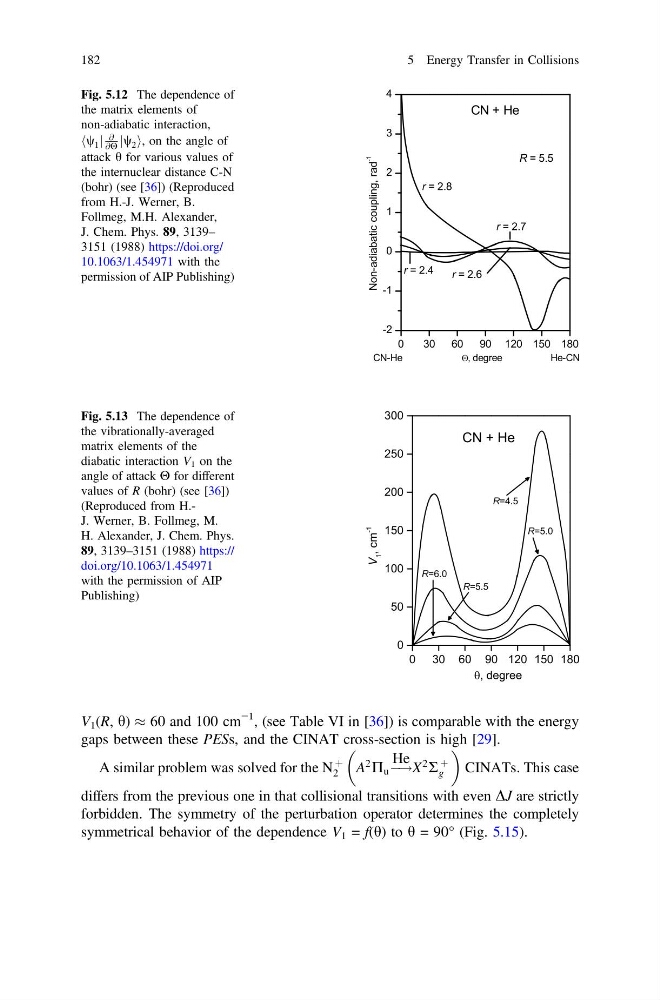
V 1 (R, h) % 60 and 100 cm
−1 , (see Table VI in [36]) is comparable with the energy
gaps between these PESs, and the CINAT cross-section is high [29].
A similar problem was solved for the N
þ
2
A
2 P u À!
He X
2 R
þ
g
CINATs. This case
differs from the previous one in that collisional transitions with even DJ are strictly
forbidden. The symmetry of the perturbation operator determines the completely
symmetrical behavior of the dependence V 1 = f(h) to h = 90° (Fig. 5.15).
Fig. 5.12 The dependence of
the matrix elements of
non-adiabatic interaction,
hw 1 j
@
@H jw 2 i, on the angle of
attack h for various values of
the internuclear distance C-N
(bohr) (see [36]) (Reproduced
from H.-J. Werner, B.
Follmeg, M.H. Alexander,
J. Chem. Phys. 89, 3139–
3151 (1988) https://doi.org/
10.1063/1.454971 with the
permission of AIP Publishing)
Fig. 5.13 The dependence of
the vibrationally-averaged
matrix elements of the
diabatic interaction V 1 on the
angle of attack H for different
values of R (bohr) (see [36])
(Reproduced from H.J. Werner, B. Follmeg, M.
H. Alexander, J. Chem. Phys.
89, 3139–3151 (1988) https://
doi.org/10.1063/1.454971
with the permission of AIP
Publishing)
182
5 Energy Transfer in Collisions
−1 , (see Table VI in [36]) is comparable with the energy
gaps between these PESs, and the CINAT cross-section is high [29].
A similar problem was solved for the N
þ
2
A
2 P u À!
He X
2 R
þ
g
CINATs. This case
differs from the previous one in that collisional transitions with even DJ are strictly
forbidden. The symmetry of the perturbation operator determines the completely
symmetrical behavior of the dependence V 1 = f(h) to h = 90° (Fig. 5.15).
Fig. 5.12 The dependence of
the matrix elements of
non-adiabatic interaction,
hw 1 j
@
@H jw 2 i, on the angle of
attack h for various values of
the internuclear distance C-N
(bohr) (see [36]) (Reproduced
from H.-J. Werner, B.
Follmeg, M.H. Alexander,
J. Chem. Phys. 89, 3139–
3151 (1988) https://doi.org/
10.1063/1.454971 with the
permission of AIP Publishing)
Fig. 5.13 The dependence of
the vibrationally-averaged
matrix elements of the
diabatic interaction V 1 on the
angle of attack H for different
values of R (bohr) (see [36])
(Reproduced from H.J. Werner, B. Follmeg, M.
H. Alexander, J. Chem. Phys.
89, 3139–3151 (1988) https://
doi.org/10.1063/1.454971
with the permission of AIP
Publishing)
182
5 Energy Transfer in Collisions