

w 1
@
@q
w 2
(
)
¼ À w 2
@
@q
w 1
(
)
¼
@v
@q
; q r; R; H
ð5:5:32Þ
Now about the principal results of ab-initio calculations carried out in [36].
The cross-sections of the adiabatic PESs corresponding to the R
+
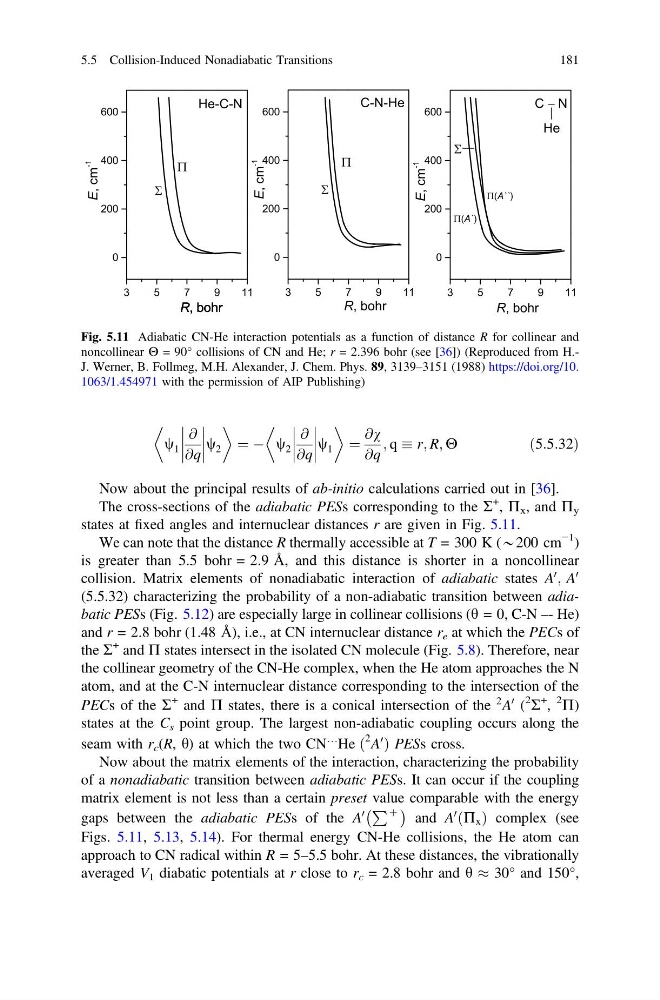
, P x , and P y
states at fixed angles and internuclear distances r are given in Fig. 5.11.
We can note that the distance R thermally accessible at T = 300 K (*200 cm
−1 )
is greater than 5.5 bohr = 2.9 Å, and this distance is shorter in a noncollinear
collision. Matrix elements of nonadiabatic interaction of adiabatic states A
0
; A
0
(5.5.32) characterizing the probability of a non-adiabatic transition between adiabatic PESs (Fig. 5.12) are especially large in collinear collisions (h = 0, C-N –- He)
and r = 2.8 bohr (1.48 Å), i.e., at CN internuclear distance r e at which the PECs of
the R
+ and P states intersect in the isolated CN molecule (Fig. 5.8). Therefore, near
the collinear geometry of the CN-He complex, when the He atom approaches the N
atom, and at the C-N internuclear distance corresponding to the intersection of the
PECs of the R
+ and P states, there is a conical intersection of the
2 A
0 (
2 R
+
,
2 P)
states at the C s point group. The largest non-adiabatic coupling occurs along the
seam with r c (R, h) at which the two CN
… He ð
2 A
0
Þ PESs cross.
Now about the matrix elements of the interaction, characterizing the probability
of a nonadiabatic transition between adiabatic PESs. It can occur if the coupling
matrix element is not less than a certain preset value comparable with the energy
gaps between the adiabatic PESs of the A
0
P þ
À
Á
and A
0 P x
ð Þ complex (see
Figs. 5.11, 5.13, 5.14). For thermal energy CN-He collisions, the He atom can
approach to CN radical within R = 5–5.5 bohr. At these distances, the vibrationally
averaged V 1 diabatic potentials at r close to r c = 2.8 bohr and h % 30° and 150°,
Fig. 5.11 Adiabatic CN-He interaction potentials as a function of distance R for collinear and
noncollinear H = 90° collisions of CN and He; r = 2.396 bohr (see [36]) (Reproduced from H.J. Werner, B. Follmeg, M.H. Alexander, J. Chem. Phys. 89, 3139–3151 (1988) https://doi.org/10.
1063/1.454971 with the permission of AIP Publishing)
5.5 Collision-Induced Nonadiabatic Transitions
181
@
@q
w 2
(
)
¼ À w 2
@
@q
w 1
(
)
¼
@v
@q
; q r; R; H
ð5:5:32Þ
Now about the principal results of ab-initio calculations carried out in [36].
The cross-sections of the adiabatic PESs corresponding to the R
+
, P x , and P y
states at fixed angles and internuclear distances r are given in Fig. 5.11.
We can note that the distance R thermally accessible at T = 300 K (*200 cm
−1 )
is greater than 5.5 bohr = 2.9 Å, and this distance is shorter in a noncollinear
collision. Matrix elements of nonadiabatic interaction of adiabatic states A
0
; A
0
(5.5.32) characterizing the probability of a non-adiabatic transition between adiabatic PESs (Fig. 5.12) are especially large in collinear collisions (h = 0, C-N –- He)
and r = 2.8 bohr (1.48 Å), i.e., at CN internuclear distance r e at which the PECs of
the R
+ and P states intersect in the isolated CN molecule (Fig. 5.8). Therefore, near
the collinear geometry of the CN-He complex, when the He atom approaches the N
atom, and at the C-N internuclear distance corresponding to the intersection of the
PECs of the R
+ and P states, there is a conical intersection of the
2 A
0 (
2 R
+
,
2 P)
states at the C s point group. The largest non-adiabatic coupling occurs along the
seam with r c (R, h) at which the two CN
… He ð
2 A
0
Þ PESs cross.
Now about the matrix elements of the interaction, characterizing the probability
of a nonadiabatic transition between adiabatic PESs. It can occur if the coupling
matrix element is not less than a certain preset value comparable with the energy
gaps between the adiabatic PESs of the A
0
P þ
À
Á
and A
0 P x
ð Þ complex (see
Figs. 5.11, 5.13, 5.14). For thermal energy CN-He collisions, the He atom can
approach to CN radical within R = 5–5.5 bohr. At these distances, the vibrationally
averaged V 1 diabatic potentials at r close to r c = 2.8 bohr and h % 30° and 150°,
Fig. 5.11 Adiabatic CN-He interaction potentials as a function of distance R for collinear and
noncollinear H = 90° collisions of CN and He; r = 2.396 bohr (see [36]) (Reproduced from H.J. Werner, B. Follmeg, M.H. Alexander, J. Chem. Phys. 89, 3139–3151 (1988) https://doi.org/10.
1063/1.454971 with the permission of AIP Publishing)
5.5 Collision-Induced Nonadiabatic Transitions
181