

hR
þ
j b
H el jR
þ
i T R r
ð Þ þ V R R; r; h
ð
Þ¼T R r
ð Þ þ
X 1
l¼0
V
l
R ðr; RÞd
l
00 ðhÞ ð5:5:24Þ
P x;y ^
H el
P x;y T P ðrÞ þ V P ðR; r; hÞ ¼ T P ðrÞ þ V P ðR; r; hÞ Ç V 2 ðR; r; hÞ ¼ T P ðrÞ þ
P
l¼0
1
V
l
P ðr; RÞd
l
00 ðhÞ Ç
P
l¼2
1
V
l
2 ðr; RÞd
l
20 ðhÞ
ð5:5:25Þ
hR
þ
j b
H el jP x i hP x j b
H el jR
þ
i ¼ V 1 R; r; h
ð
Þ¼
ffiffi ffi
2
p X 1
l¼1
V
l
1 ðr; RÞd
l
10 ðhÞ ð5:5:26Þ
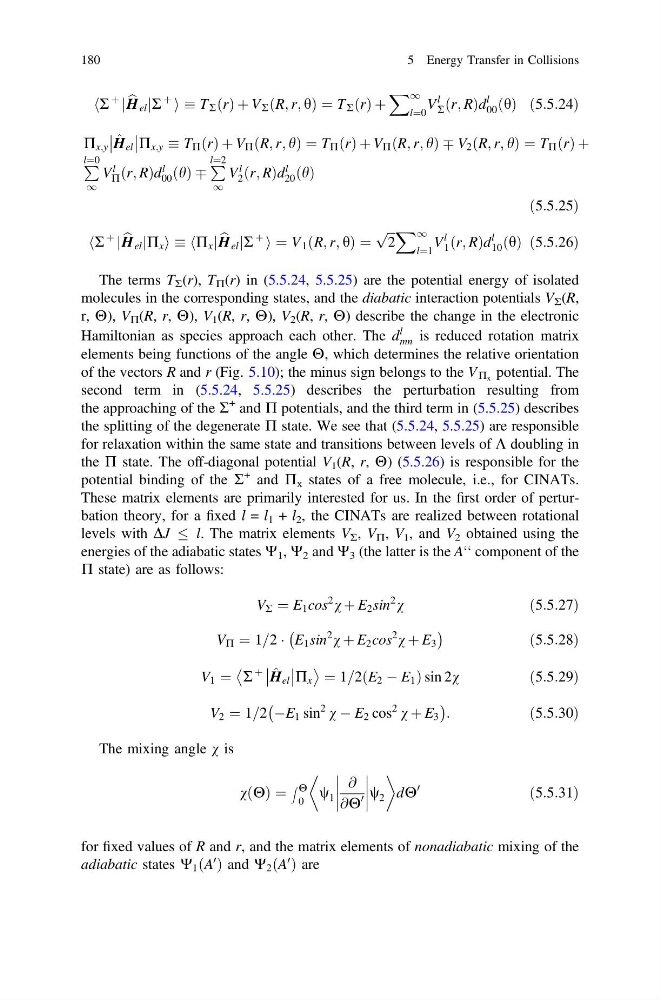
The terms T R (r), T P (r) in (5.5.24, 5.5.25) are the potential energy of isolated
molecules in the corresponding states, and the diabatic interaction potentials V R (R,
r, H), V P (R, r, H), V 1 (R, r, H), V 2 (R, r, H) describe the change in the electronic
Hamiltonian as species approach each other. The d
l
mn is reduced rotation matrix
elements being functions of the angle H, which determines the relative orientation
of the vectors R and r (Fig. 5.10); the minus sign belongs to the V P x potential. The
second term in (5.5.24, 5.5.25) describes the perturbation resulting from
the approaching of the R
+ and P potentials, and the third term in (5.5.25) describes
the splitting of the degenerate P state. We see that (5.5.24, 5.5.25) are responsible
for relaxation within the same state and transitions between levels of K doubling in
the P state. The off-diagonal potential V 1 (R, r, H) (5.5.26) is responsible for the
potential binding of the R
+ and P x states of a free molecule, i.e., for CINATs.
These matrix elements are primarily interested for us. In the first order of perturbation theory, for a fixed l = l 1 + l 2 , the CINATs are realized between rotational
levels with DJ
l. The matrix elements V R , V P , V 1 , and V 2 obtained using the
energies of the adiabatic states W 1 , W 2 and W 3 (the latter is the A‘‘ component of the
P state) are as follows:
V R ¼ E 1 cos
2 v þ E 2 sin
2 v
ð5:5:27Þ
V P ¼ 1=2 Á E 1 sin
2 v þ E 2 cos
2 v þ E 3
À
Á
ð5:5:28Þ
V 1 ¼ R
þ ^
H el
P x
¼ 1=2 E 2 À E 1
ð
Þsin 2v
ð5:5:29Þ
V 2 ¼ 1=2 ÀE 1 sin
2 v À E 2 cos
2 v þ E 3
À
Á
:
ð5:5:30Þ
The mixing angle v is
vðHÞ ¼
Z H
0
w 1
@
@H
0
w 2
(
)
dH
0
ð5:5:31Þ
for fixed values of R and r, and the matrix elements of nonadiabatic mixing of the
adiabatic states W 1 A
0
ð Þ and W 2 A
0
ð Þ are
180
5 Energy Transfer in Collisions
þ
j b
H el jR
þ
i T R r
ð Þ þ V R R; r; h
ð
Þ¼T R r
ð Þ þ
X 1
l¼0
V
l
R ðr; RÞd
l
00 ðhÞ ð5:5:24Þ
P x;y ^
H el
P x;y T P ðrÞ þ V P ðR; r; hÞ ¼ T P ðrÞ þ V P ðR; r; hÞ Ç V 2 ðR; r; hÞ ¼ T P ðrÞ þ
P
l¼0
1
V
l
P ðr; RÞd
l
00 ðhÞ Ç
P
l¼2
1
V
l
2 ðr; RÞd
l
20 ðhÞ
ð5:5:25Þ
hR
þ
j b
H el jP x i hP x j b
H el jR
þ
i ¼ V 1 R; r; h
ð
Þ¼
ffiffi ffi
2
p X 1
l¼1
V
l
1 ðr; RÞd
l
10 ðhÞ ð5:5:26Þ
The terms T R (r), T P (r) in (5.5.24, 5.5.25) are the potential energy of isolated
molecules in the corresponding states, and the diabatic interaction potentials V R (R,
r, H), V P (R, r, H), V 1 (R, r, H), V 2 (R, r, H) describe the change in the electronic
Hamiltonian as species approach each other. The d
l
mn is reduced rotation matrix
elements being functions of the angle H, which determines the relative orientation
of the vectors R and r (Fig. 5.10); the minus sign belongs to the V P x potential. The
second term in (5.5.24, 5.5.25) describes the perturbation resulting from
the approaching of the R
+ and P potentials, and the third term in (5.5.25) describes
the splitting of the degenerate P state. We see that (5.5.24, 5.5.25) are responsible
for relaxation within the same state and transitions between levels of K doubling in
the P state. The off-diagonal potential V 1 (R, r, H) (5.5.26) is responsible for the
potential binding of the R
+ and P x states of a free molecule, i.e., for CINATs.
These matrix elements are primarily interested for us. In the first order of perturbation theory, for a fixed l = l 1 + l 2 , the CINATs are realized between rotational
levels with DJ
l. The matrix elements V R , V P , V 1 , and V 2 obtained using the
energies of the adiabatic states W 1 , W 2 and W 3 (the latter is the A‘‘ component of the
P state) are as follows:
V R ¼ E 1 cos
2 v þ E 2 sin
2 v
ð5:5:27Þ
V P ¼ 1=2 Á E 1 sin
2 v þ E 2 cos
2 v þ E 3
À
Á
ð5:5:28Þ
V 1 ¼ R
þ ^
H el
P x
¼ 1=2 E 2 À E 1
ð
Þsin 2v
ð5:5:29Þ
V 2 ¼ 1=2 ÀE 1 sin
2 v À E 2 cos
2 v þ E 3
À
Á
:
ð5:5:30Þ
The mixing angle v is
vðHÞ ¼
Z H
0
w 1
@
@H
0
w 2
(
)
dH
0
ð5:5:31Þ
for fixed values of R and r, and the matrix elements of nonadiabatic mixing of the
adiabatic states W 1 A
0
ð Þ and W 2 A
0
ð Þ are
180
5 Energy Transfer in Collisions