

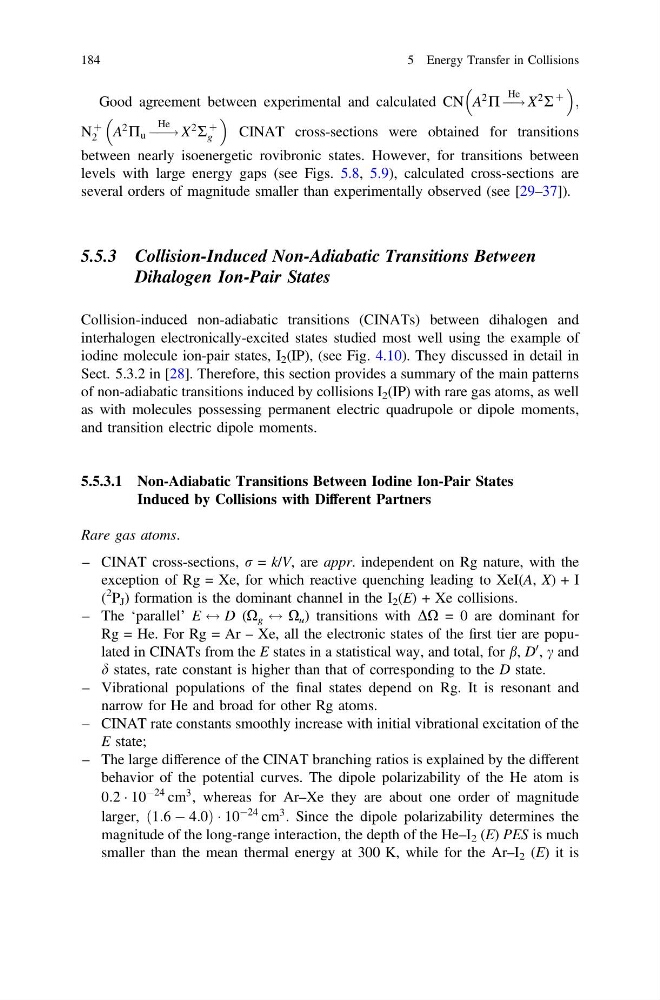
Good agreement between experimental and calculated CN A
2 P !
He X
2 R
þ
;
N
þ
2
A
2 P u !
He X
2 R
þ
g
CINAT cross-sections were obtained for transitions
between nearly isoenergetic rovibronic states. However, for transitions between
levels with large energy gaps (see Figs. 5.8, 5.9), calculated cross-sections are
several orders of magnitude smaller than experimentally observed (see [29–37]).
5.5.3 Collision-Induced Non-Adiabatic Transitions Between
Dihalogen Ion-Pair States
Collision-induced non-adiabatic transitions (CINATs) between dihalogen and
interhalogen electronically-excited states studied most well using the example of
iodine molecule ion-pair states, I 2 (IP), (see Fig. 4.10). They discussed in detail in
Sect. 5.3.2 in [28]. Therefore, this section provides a summary of the main patterns
of non-adiabatic transitions induced by collisions I 2 (IP) with rare gas atoms, as well
as with molecules possessing permanent electric quadrupole or dipole moments,
and transition electric dipole moments.
5.5.3.1 Non-Adiabatic Transitions Between Iodine Ion-Pair States
Induced by Collisions with Different Partners
Rare gas atoms.
– CINAT cross-sections, r = k/V, are appr. independent on Rg nature, with the
exception of Rg = Xe, for which reactive quenching leading to XeI(A, X) + I
(
2 P J ) formation is the dominant channel in the I 2 (E) + Xe collisions.
– The ‘parallel’ E $ D (X g $ X u ) transitions with DX = 0 are dominant for
Rg = He. For Rg = Ar – Xe, all the electronic states of the first tier are populated in CINATs from the E states in a statistical way, and total, for b, D
0 , c and
d states, rate constant is higher than that of corresponding to the D state.
– Vibrational populations of the final states depend on Rg. It is resonant and
narrow for He and broad for other Rg atoms.
– CINAT rate constants smoothly increase with initial vibrational excitation of the
E state;
– The large difference of the CINAT branching ratios is explained by the different
behavior of the potential curves. The dipole polarizability of the He atom is
0:2 Á 10
À24 cm
3 , whereas for Ar–Xe they are about one order of magnitude
larger, 1:6 À 4:0
ð
ÞÁ10
À24 cm
3 . Since the dipole polarizability determines the
magnitude of the long-range interaction, the depth of the He–I 2 (E) PES is much
smaller than the mean thermal energy at 300 K, while for the Ar–I 2 (E) it is
184
5 Energy Transfer in Collisions
2 P !
He X
2 R
þ
;
N
þ
2
A
2 P u !
He X
2 R
þ
g
CINAT cross-sections were obtained for transitions
between nearly isoenergetic rovibronic states. However, for transitions between
levels with large energy gaps (see Figs. 5.8, 5.9), calculated cross-sections are
several orders of magnitude smaller than experimentally observed (see [29–37]).
5.5.3 Collision-Induced Non-Adiabatic Transitions Between
Dihalogen Ion-Pair States
Collision-induced non-adiabatic transitions (CINATs) between dihalogen and
interhalogen electronically-excited states studied most well using the example of
iodine molecule ion-pair states, I 2 (IP), (see Fig. 4.10). They discussed in detail in
Sect. 5.3.2 in [28]. Therefore, this section provides a summary of the main patterns
of non-adiabatic transitions induced by collisions I 2 (IP) with rare gas atoms, as well
as with molecules possessing permanent electric quadrupole or dipole moments,
and transition electric dipole moments.
5.5.3.1 Non-Adiabatic Transitions Between Iodine Ion-Pair States
Induced by Collisions with Different Partners
Rare gas atoms.
– CINAT cross-sections, r = k/V, are appr. independent on Rg nature, with the
exception of Rg = Xe, for which reactive quenching leading to XeI(A, X) + I
(
2 P J ) formation is the dominant channel in the I 2 (E) + Xe collisions.
– The ‘parallel’ E $ D (X g $ X u ) transitions with DX = 0 are dominant for
Rg = He. For Rg = Ar – Xe, all the electronic states of the first tier are populated in CINATs from the E states in a statistical way, and total, for b, D
0 , c and
d states, rate constant is higher than that of corresponding to the D state.
– Vibrational populations of the final states depend on Rg. It is resonant and
narrow for He and broad for other Rg atoms.
– CINAT rate constants smoothly increase with initial vibrational excitation of the
E state;
– The large difference of the CINAT branching ratios is explained by the different
behavior of the potential curves. The dipole polarizability of the He atom is
0:2 Á 10
À24 cm
3 , whereas for Ar–Xe they are about one order of magnitude
larger, 1:6 À 4:0
ð
ÞÁ10
À24 cm
3 . Since the dipole polarizability determines the
magnitude of the long-range interaction, the depth of the He–I 2 (E) PES is much
smaller than the mean thermal energy at 300 K, while for the Ar–I 2 (E) it is
184
5 Energy Transfer in Collisions