

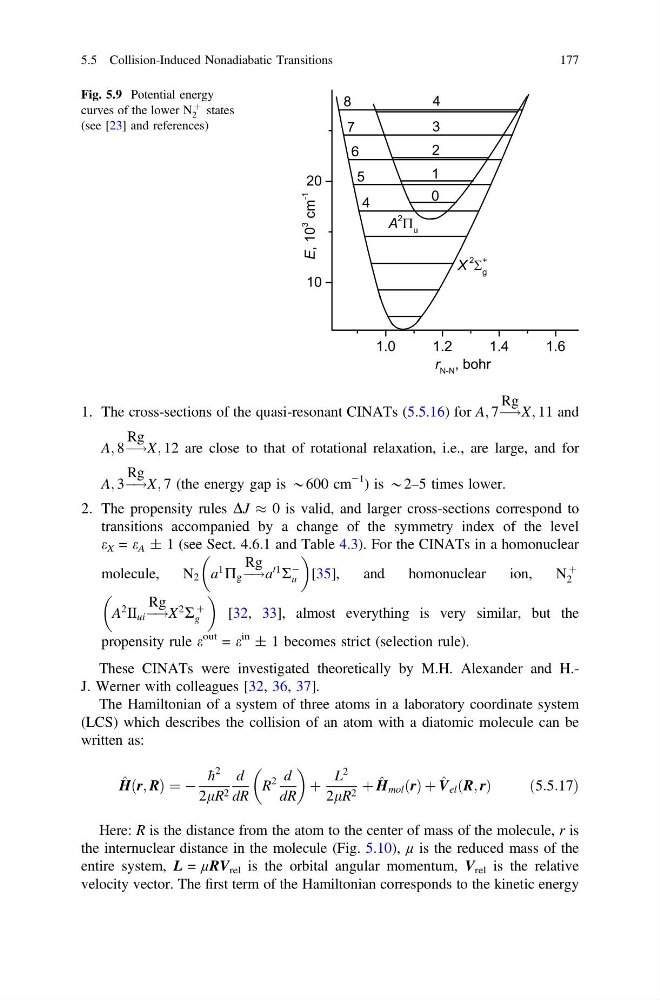
1. The cross-sections of the quasi-resonant CINATs (5.5.16) for A; 7À!
Rg
X; 11 and
A; 8À!
Rg
X; 12 are close to that of rotational relaxation, i.e., are large, and for
A; 3À!
Rg
X; 7 (the energy gap is *600 cm
−1 ) is *2–5 times lower.
2. The propensity rules DJ % 0 is valid, and larger cross-sections correspond to
transitions accompanied by a change of the symmetry index of the level
e X = e A ± 1 (see Sect. 4.6.1 and Table 4.3). For the CINATs in a homonuclear
molecule,
N 2 a
1 P g À!
Rg
a
01 R
À
u
[35],
and
homonuclear
ion,
N
þ
2
A
2 II ui À!
Rg
X
2 R
þ
g
[32, 33], almost everything is very similar, but the
propensity rule e
out = e
in
± 1 becomes strict (selection rule).
These CINATs were investigated theoretically by M.H. Alexander and H.J. Werner with colleagues [32, 36, 37].
The Hamiltonian of a system of three atoms in a laboratory coordinate system
(LCS) which describes the collision of an atom with a diatomic molecule can be
written as:
^
Hðr; RÞ ¼ À
h
2
2lR 2
d
dR
R
2 d
dR
þ
L
2
2lR 2 þ ^
H mol ðrÞ þ ^
V el ðR; rÞ
ð5:5:17Þ
Here: R is the distance from the atom to the center of mass of the molecule, r is
the internuclear distance in the molecule (Fig. 5.10), µ is the reduced mass of the
entire system, L = µRV rel is the orbital angular momentum, V rel is the relative
velocity vector. The first term of the Hamiltonian corresponds to the kinetic energy
Fig. 5.9 Potential energy
curves of the lower N
þ
2 states
(see [23] and references)
5.5 Collision-Induced Nonadiabatic Transitions
177
Rg
X; 11 and
A; 8À!
Rg
X; 12 are close to that of rotational relaxation, i.e., are large, and for
A; 3À!
Rg
X; 7 (the energy gap is *600 cm
−1 ) is *2–5 times lower.
2. The propensity rules DJ % 0 is valid, and larger cross-sections correspond to
transitions accompanied by a change of the symmetry index of the level
e X = e A ± 1 (see Sect. 4.6.1 and Table 4.3). For the CINATs in a homonuclear
molecule,
N 2 a
1 P g À!
Rg
a
01 R
À
u
[35],
and
homonuclear
ion,
N
þ
2
A
2 II ui À!
Rg
X
2 R
þ
g
[32, 33], almost everything is very similar, but the
propensity rule e
out = e
in
± 1 becomes strict (selection rule).
These CINATs were investigated theoretically by M.H. Alexander and H.J. Werner with colleagues [32, 36, 37].
The Hamiltonian of a system of three atoms in a laboratory coordinate system
(LCS) which describes the collision of an atom with a diatomic molecule can be
written as:
^
Hðr; RÞ ¼ À
h
2
2lR 2
d
dR
R
2 d
dR
þ
L
2
2lR 2 þ ^
H mol ðrÞ þ ^
V el ðR; rÞ
ð5:5:17Þ
Here: R is the distance from the atom to the center of mass of the molecule, r is
the internuclear distance in the molecule (Fig. 5.10), µ is the reduced mass of the
entire system, L = µRV rel is the orbital angular momentum, V rel is the relative
velocity vector. The first term of the Hamiltonian corresponds to the kinetic energy
Fig. 5.9 Potential energy
curves of the lower N
þ
2 states
(see [23] and references)
5.5 Collision-Induced Nonadiabatic Transitions
177