

of relative motion, the second to the orbital energy. The third term is the
Hamiltonian of the unperturbed molecule, and the fourth one is the potential energy
of electrostatic interaction; V el (R) ! 0 as R ! ∞. The last two terms of (5.5.17)
b
H mol r
ð Þ þ b
V el ðR; rÞ = b
H el r; R
ð Þ are the electronic Hamiltonian of the system.
For sufficiently large R, the potential of two collision partners (i = 1, 2) with
multipole moments of the order of l 1 and l 2 can be represented as an expansion in
multipole moments (see Sect. 3.3):
V el r; R
ð Þ ¼
X
l 1 ;l 2
C l 1 ;l 2
R
l þ 1
X
m;m;m 2
hl 1 m 1 l 2 m 2 jl 1 l 2 lmiQ l 1 m 1 Q l 2 m 2 Y lm ðh; uÞ
ð5:5:18Þ
Here: C l 1 ;l 2 are the numerical coefficients determined by the type and magnitude
of the electrostatic interaction (for dispersion interaction
C l 1 ;l 2
R
l þ 1 ¼
C 6
R
6 ),
hl 1 m 1 l 2 m 2 jl 1 l 2 lmi are the Clebsch-Gordan coefficients, m i are the projections of l 1 ,
l 2 , l = l 1 , l 2 on the selected axis in the LCS, Q l i m i are the multipole moments of the
collision partners, Y lm ðh; uÞ are the spherical functions of angles that determine the
position of R in the LCS, h is the angle between R and r.
CINAT corresponds to transitions between the states of the continuous spectrum
of the wave equation with the Hamiltonian (5.5.17), and the wave function w(r,
R) is linear combination of the basic functions, for which the wave functions of the
diabatic representation corresponding to V el r; R
ð Þ= 0 are used. For an input channel
at R ! ∞, this function is equal to.
w
d
j ðr; RÞ ¼ u i ðrÞ exp ik j R
À
Á þ
f ij
R
exp ik j R
À
Á
!
:
ð5:5:19Þ
The first term (plane wave) describes the incident stream of species moving to
R ! 0 and having a wave vector k i ¼
2lðEÀe i Þ
h
2
(e i is the internal energy of a free
molecule with the wave function u i (r). The second term (spherical wave) describes
elastic scattering. The asymptotic form of the wave function of the output channel
contains only the spherical wave.
w
d
j ðr; RÞ ¼ u i ðrÞ
f ij
R
exp ik j R
À
Á
ð5:5:20Þ
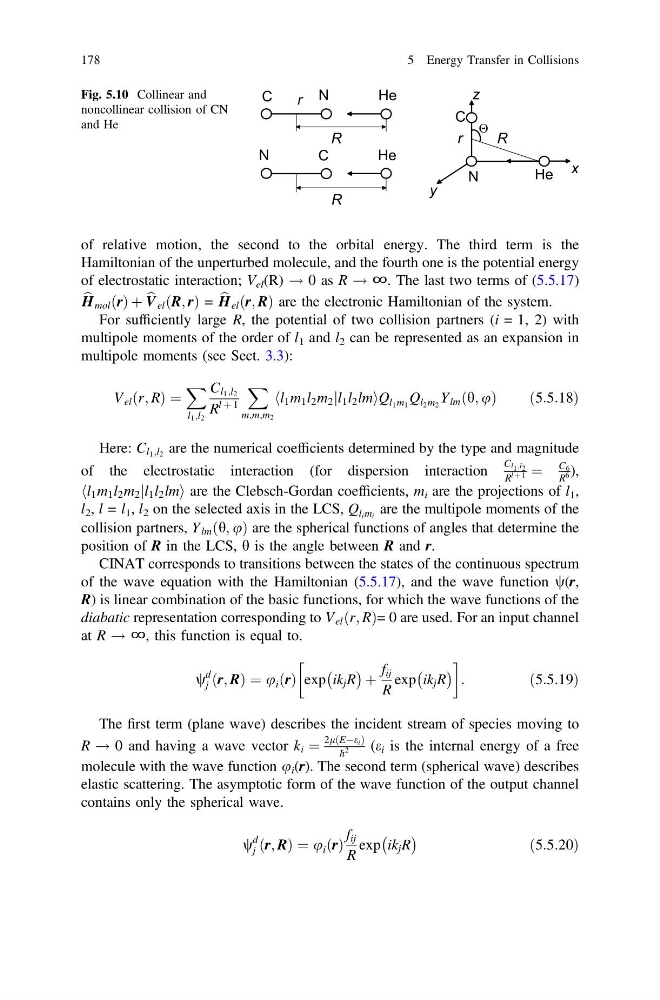
Fig. 5.10 Collinear and
noncollinear collision of CN
and He
178
5 Energy Transfer in Collisions
Hamiltonian of the unperturbed molecule, and the fourth one is the potential energy
of electrostatic interaction; V el (R) ! 0 as R ! ∞. The last two terms of (5.5.17)
b
H mol r
ð Þ þ b
V el ðR; rÞ = b
H el r; R
ð Þ are the electronic Hamiltonian of the system.
For sufficiently large R, the potential of two collision partners (i = 1, 2) with
multipole moments of the order of l 1 and l 2 can be represented as an expansion in
multipole moments (see Sect. 3.3):
V el r; R
ð Þ ¼
X
l 1 ;l 2
C l 1 ;l 2
R
l þ 1
X
m;m;m 2
hl 1 m 1 l 2 m 2 jl 1 l 2 lmiQ l 1 m 1 Q l 2 m 2 Y lm ðh; uÞ
ð5:5:18Þ
Here: C l 1 ;l 2 are the numerical coefficients determined by the type and magnitude
of the electrostatic interaction (for dispersion interaction
C l 1 ;l 2
R
l þ 1 ¼
C 6
R
6 ),
hl 1 m 1 l 2 m 2 jl 1 l 2 lmi are the Clebsch-Gordan coefficients, m i are the projections of l 1 ,
l 2 , l = l 1 , l 2 on the selected axis in the LCS, Q l i m i are the multipole moments of the
collision partners, Y lm ðh; uÞ are the spherical functions of angles that determine the
position of R in the LCS, h is the angle between R and r.
CINAT corresponds to transitions between the states of the continuous spectrum
of the wave equation with the Hamiltonian (5.5.17), and the wave function w(r,
R) is linear combination of the basic functions, for which the wave functions of the
diabatic representation corresponding to V el r; R
ð Þ= 0 are used. For an input channel
at R ! ∞, this function is equal to.
w
d
j ðr; RÞ ¼ u i ðrÞ exp ik j R
À
Á þ
f ij
R
exp ik j R
À
Á
!
:
ð5:5:19Þ
The first term (plane wave) describes the incident stream of species moving to
R ! 0 and having a wave vector k i ¼
2lðEÀe i Þ
h
2
(e i is the internal energy of a free
molecule with the wave function u i (r). The second term (spherical wave) describes
elastic scattering. The asymptotic form of the wave function of the output channel
contains only the spherical wave.
w
d
j ðr; RÞ ¼ u i ðrÞ
f ij
R
exp ik j R
À
Á
ð5:5:20Þ
Fig. 5.10 Collinear and
noncollinear collision of CN
and He
178
5 Energy Transfer in Collisions