

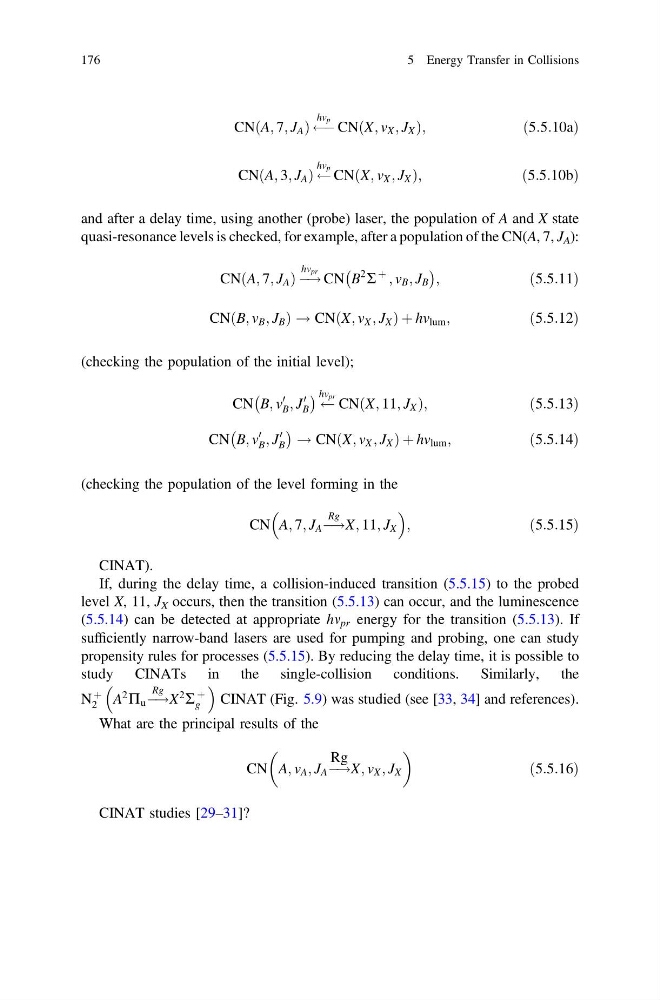
CN A; 7; J A
ð
Þ À
hv p CN X; v X ; J X
ð
Þ ;
ð5:5:10aÞ
CN A; 3; J A
ð
Þ
hv p CN X; v X ; J X
ð
Þ ;
ð5:5:10bÞ
and after a delay time, using another (probe) laser, the population of A and X state
quasi-resonance levels is checked, for example, after a population of the CN(A, 7, J A ):
CN A; 7; J A
ð
ÞÀ !
hv pr CN B
2 R
þ
; v B ; J B
À
Á ;
ð5:5:11Þ
CN B; v B ; J B
ð
Þ!CN X; v X ; J X
ð
Þþhv lum ;
ð5:5:12Þ
(checking the population of the initial level);
CN B; v
0
B ; J
0
B
À
Á hv pr CN X; 11; J X
ð
Þ ;
ð5:5:13Þ
CN B; v
0
B ; J
0
B
À
Á ! CN X; v X ; J X
ð
Þþhv lum ;
ð5:5:14Þ
(checking the population of the level forming in the
CN A; 7; J A À!
Rg X; 11; J X
;
ð5:5:15Þ
CINAT).
If, during the delay time, a collision-induced transition (5.5.15) to the probed
level X, 11, J X occurs, then the transition (5.5.13) can occur, and the luminescence
(5.5.14) can be detected at appropriate hm pr energy for the transition (5.5.13). If
sufficiently narrow-band lasers are used for pumping and probing, one can study
propensity rules for processes (5.5.15). By reducing the delay time, it is possible to
study CINATs in the single-collision conditions. Similarly, the
N
þ
2
A
2 P u À!
Rg X
2 R
þ
g
CINAT (Fig. 5.9) was studied (see [33, 34] and references).
What are the principal results of the
CN A; v A ; J A À!
Rg
X; v X ; J X
ð5:5:16Þ
CINAT studies [29–31]?
176
5 Energy Transfer in Collisions
ð
Þ À
hv p CN X; v X ; J X
ð
Þ ;
ð5:5:10aÞ
CN A; 3; J A
ð
Þ
hv p CN X; v X ; J X
ð
Þ ;
ð5:5:10bÞ
and after a delay time, using another (probe) laser, the population of A and X state
quasi-resonance levels is checked, for example, after a population of the CN(A, 7, J A ):
CN A; 7; J A
ð
ÞÀ !
hv pr CN B
2 R
þ
; v B ; J B
À
Á ;
ð5:5:11Þ
CN B; v B ; J B
ð
Þ!CN X; v X ; J X
ð
Þþhv lum ;
ð5:5:12Þ
(checking the population of the initial level);
CN B; v
0
B ; J
0
B
À
Á hv pr CN X; 11; J X
ð
Þ ;
ð5:5:13Þ
CN B; v
0
B ; J
0
B
À
Á ! CN X; v X ; J X
ð
Þþhv lum ;
ð5:5:14Þ
(checking the population of the level forming in the
CN A; 7; J A À!
Rg X; 11; J X
;
ð5:5:15Þ
CINAT).
If, during the delay time, a collision-induced transition (5.5.15) to the probed
level X, 11, J X occurs, then the transition (5.5.13) can occur, and the luminescence
(5.5.14) can be detected at appropriate hm pr energy for the transition (5.5.13). If
sufficiently narrow-band lasers are used for pumping and probing, one can study
propensity rules for processes (5.5.15). By reducing the delay time, it is possible to
study CINATs in the single-collision conditions. Similarly, the
N
þ
2
A
2 P u À!
Rg X
2 R
þ
g
CINAT (Fig. 5.9) was studied (see [33, 34] and references).
What are the principal results of the
CN A; v A ; J A À!
Rg
X; v X ; J X
ð5:5:16Þ
CINAT studies [29–31]?
176
5 Energy Transfer in Collisions