

g $ g; u $ u
ð5:5:8Þ
reverses
g $ u;
ð5:5:9Þ
exactly the same as for optical transitions. It was suggested that the I 2 (B0
þ
u ) state
CIP (5.5.7) causes by the a
0 0
þ
g and a1 g states, i.e., by the states of the opposite
parity (see [28], p. 95 and (Fig. 4.4).
5.5.2.2 The CN A
2 P !
Rg X
2
R
þ
ð
Þ ; N
þ
2
A
2 P u !
Rg X
2 R
þ
g
CINATs
These processes were studied with a high spectral resolution, allowing one to obtain
information on the populations of individual rovibronic levels and even components
of their fine structures. To study CINATs in these species, one used optical–optical
double resonance, OODR, (CN, N
þ
2 ) and resonance-enhanced multiphoton ionization spectroscopy, REMPI, (N 2 ). Briefly about the technique of only one a series
of experiments performed by Dagdigian et al. [23, 29–32].
Cyanide free radicals, CN(X
2 R
+
), were prepared by the addition of cyanogens,
C 2 N 2 , to a flow containing metastable He, Ar atoms, which were produced in a
low-current d.c. discharge. C 2 N 2 molecules dissociate, and radicals CN(X,v X ,J X ) are
formed. A pump laser radiation is transferred CN(X,v X ,J X ) to the CN(A
2 P,v A = 3 or
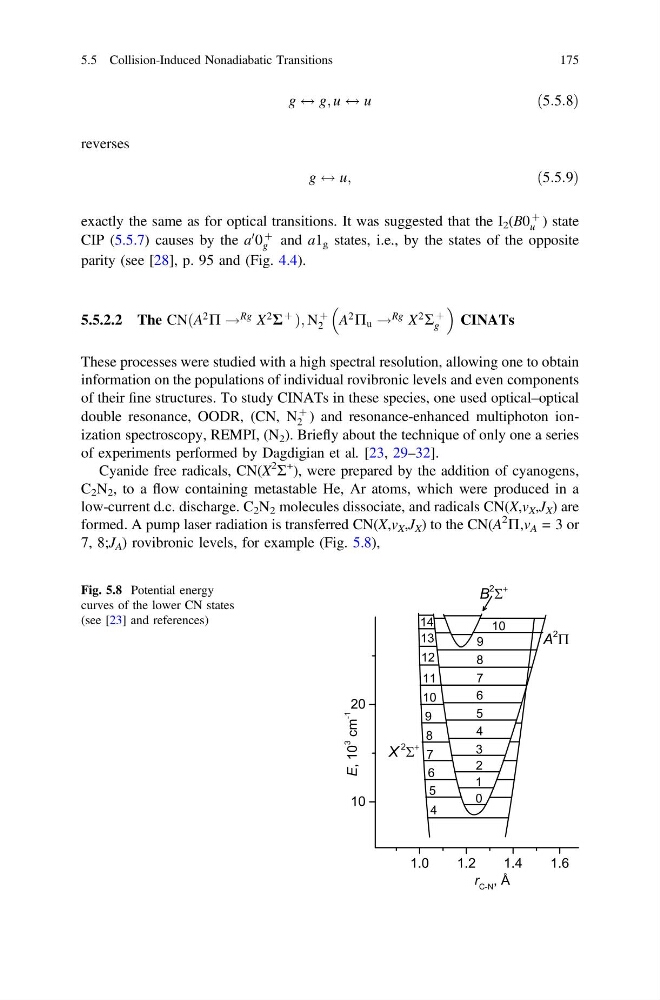
7, 8;J A ) rovibronic levels, for example (Fig. 5.8),
Fig. 5.8 Potential energy
curves of the lower CN states
(see [23] and references)
5.5 Collision-Induced Nonadiabatic Transitions
175
ð5:5:8Þ
reverses
g $ u;
ð5:5:9Þ
exactly the same as for optical transitions. It was suggested that the I 2 (B0
þ
u ) state
CIP (5.5.7) causes by the a
0 0
þ
g and a1 g states, i.e., by the states of the opposite
parity (see [28], p. 95 and (Fig. 4.4).
5.5.2.2 The CN A
2 P !
Rg X
2
R
þ
ð
Þ ; N
þ
2
A
2 P u !
Rg X
2 R
þ
g
CINATs
These processes were studied with a high spectral resolution, allowing one to obtain
information on the populations of individual rovibronic levels and even components
of their fine structures. To study CINATs in these species, one used optical–optical
double resonance, OODR, (CN, N
þ
2 ) and resonance-enhanced multiphoton ionization spectroscopy, REMPI, (N 2 ). Briefly about the technique of only one a series
of experiments performed by Dagdigian et al. [23, 29–32].
Cyanide free radicals, CN(X
2 R
+
), were prepared by the addition of cyanogens,
C 2 N 2 , to a flow containing metastable He, Ar atoms, which were produced in a
low-current d.c. discharge. C 2 N 2 molecules dissociate, and radicals CN(X,v X ,J X ) are
formed. A pump laser radiation is transferred CN(X,v X ,J X ) to the CN(A
2 P,v A = 3 or
7, 8;J A ) rovibronic levels, for example (Fig. 5.8),
Fig. 5.8 Potential energy
curves of the lower CN states
(see [23] and references)
5.5 Collision-Induced Nonadiabatic Transitions
175