

e
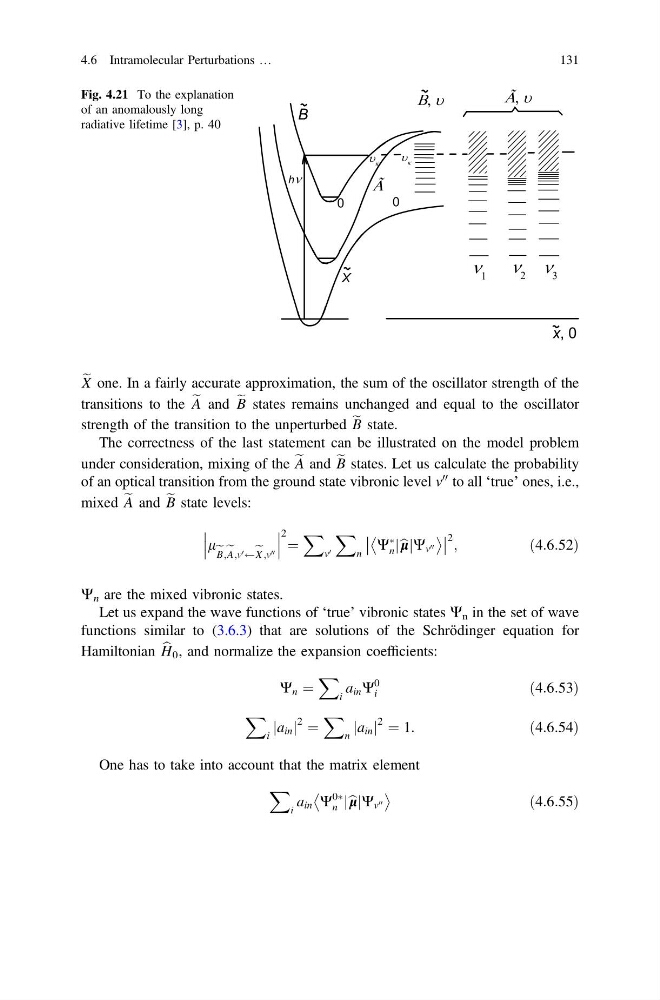
X one. In a fairly accurate approximation, the sum of the oscillator strength of the
transitions to the e
A and e
B states remains unchanged and equal to the oscillator
strength of the transition to the unperturbed e
B state.
The correctness of the last statement can be illustrated on the model problem
under consideration, mixing of the e
A and e
B states. Let us calculate the probability
of an optical transition from the ground state vibronic level v
00 to all ‘true’ ones, i.e.,
mixed e
A and e
B state levels:
l e B; e A;v 0 e X ;v 00
2 ¼
X
v 0
X
n
W
Ã
n b l
j jW v 00
2 ;
ð4:6:52Þ
W n are the mixed vibronic states.
Let us expand the wave functions of ‘true’ vibronic states W n in the set of wave
functions similar to (3.6.3) that are solutions of the Schrödinger equation for
Hamiltonian b
H 0 , and normalize the expansion coefficients:
W n ¼
X
i
a in W
0
i
ð4:6:53Þ
X
i
a in
j j
2 ¼
X
n
a in
j j
2 ¼ 1:
ð4:6:54Þ
One has to take into account that the matrix element
X
i
a in W
0Ã
n b l
j jW v 00
ð4:6:55Þ
Fig. 4.21 To the explanation
of an anomalously long
radiative lifetime [3], p. 40
4.6 Intramolecular Perturbations …
131
X one. In a fairly accurate approximation, the sum of the oscillator strength of the
transitions to the e
A and e
B states remains unchanged and equal to the oscillator
strength of the transition to the unperturbed e
B state.
The correctness of the last statement can be illustrated on the model problem
under consideration, mixing of the e
A and e
B states. Let us calculate the probability
of an optical transition from the ground state vibronic level v
00 to all ‘true’ ones, i.e.,
mixed e
A and e
B state levels:
l e B; e A;v 0 e X ;v 00
2 ¼
X
v 0
X
n
W
Ã
n b l
j jW v 00
2 ;
ð4:6:52Þ
W n are the mixed vibronic states.
Let us expand the wave functions of ‘true’ vibronic states W n in the set of wave
functions similar to (3.6.3) that are solutions of the Schrödinger equation for
Hamiltonian b
H 0 , and normalize the expansion coefficients:
W n ¼
X
i
a in W
0
i
ð4:6:53Þ
X
i
a in
j j
2 ¼
X
n
a in
j j
2 ¼ 1:
ð4:6:54Þ
One has to take into account that the matrix element
X
i
a in W
0Ã
n b l
j jW v 00
ð4:6:55Þ
Fig. 4.21 To the explanation
of an anomalously long
radiative lifetime [3], p. 40
4.6 Intramolecular Perturbations …
131