

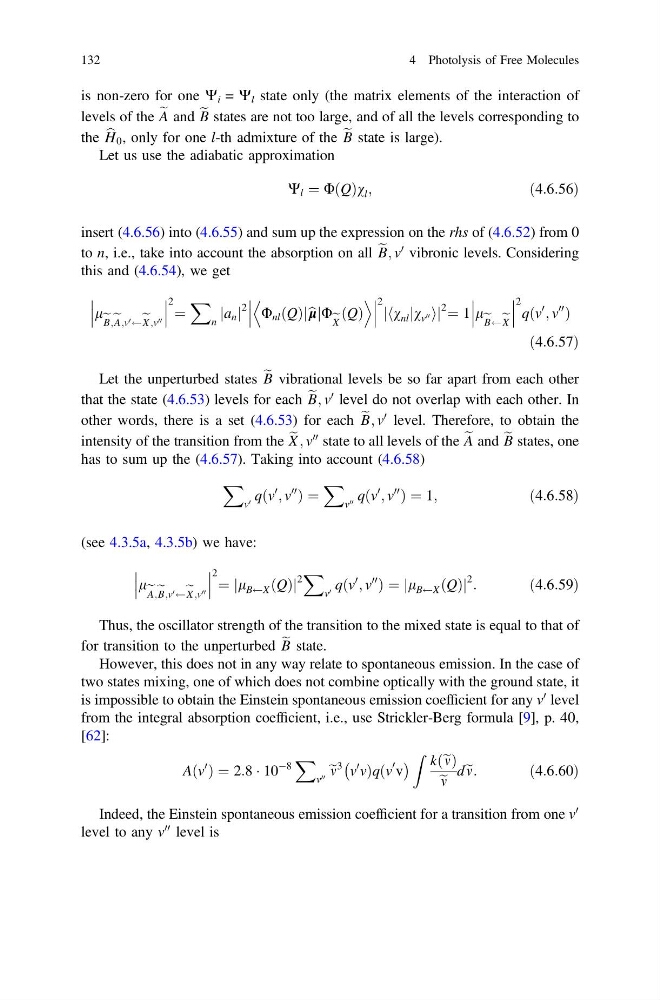
is non-zero for one W i = W l state only (the matrix elements of the interaction of
levels of the e
A and e
B states are not too large, and of all the levels corresponding to
the b
H 0 , only for one l-th admixture of the e
B state is large).
Let us use the adiabatic approximation
W l ¼ U Q
ð Þv l ;
ð4:6:56Þ
insert (4.6.56) into (4.6.55) and sum up the expression on the rhs of (4.6.52) from 0
to n, i.e., take into account the absorption on all e
B; v
0 vibronic levels. Considering
this and (4.6.54), we get
l e B; e A;v 0 e X ;v 00
2 ¼
X
n
a n
j j
2 U nl Q
ð Þ b l
j jU e X
Q
ð Þ
D
E
2 v nl jv v 00
h
i
j
j
2 ¼ 1 l e B e X
2 q v
0
; v
00
ð
Þ
ð4:6:57Þ
Let the unperturbed states e
B vibrational levels be so far apart from each other
that the state (4.6.53) levels for each e
B; v
0 level do not overlap with each other. In
other words, there is a set (4.6.53) for each e
B; v
0 level. Therefore, to obtain the
intensity of the transition from the e
X ; v
00 state to all levels of the e
A and e
B states, one
has to sum up the (4.6.57). Taking into account (4.6.58)
X
v 0 q v
0
; v
00
ð
Þ¼
X
v 00 q v
0
; v
00
ð
Þ¼1;
ð4:6:58Þ
(see 4.3.5a, 4.3.5b) we have:
l e A; e B;v 0 e X ;v 00
2 ¼ l B X Q
ð Þ
j
j
2
X
v 0 q v
0
; v
00
ð
Þ¼ l B X Q
ð Þ
j
j
2 :
ð4:6:59Þ
Thus, the oscillator strength of the transition to the mixed state is equal to that of
for transition to the unperturbed e
B state.
However, this does not in any way relate to spontaneous emission. In the case of
two states mixing, one of which does not combine optically with the ground state, it
is impossible to obtain the Einstein spontaneous emission coefficient for any v
0 level
from the integral absorption coefficient, i.e., use Strickler-Berg formula [9], p. 40,
[62]:
A v
0
ð Þ ¼ 2:8 Á 10
À8
X
v 00 e m
3
v
0
vÞqðv
0 v
À
Á
Z k e m
ð Þ
e m
de m:
ð4:6:60Þ
Indeed, the Einstein spontaneous emission coefficient for a transition from one v
0
level to any v
00 level is
132
4 Photolysis of Free Molecules
levels of the e
A and e
B states are not too large, and of all the levels corresponding to
the b
H 0 , only for one l-th admixture of the e
B state is large).
Let us use the adiabatic approximation
W l ¼ U Q
ð Þv l ;
ð4:6:56Þ
insert (4.6.56) into (4.6.55) and sum up the expression on the rhs of (4.6.52) from 0
to n, i.e., take into account the absorption on all e
B; v
0 vibronic levels. Considering
this and (4.6.54), we get
l e B; e A;v 0 e X ;v 00
2 ¼
X
n
a n
j j
2 U nl Q
ð Þ b l
j jU e X
Q
ð Þ
D
E
2 v nl jv v 00
h
i
j
j
2 ¼ 1 l e B e X
2 q v
0
; v
00
ð
Þ
ð4:6:57Þ
Let the unperturbed states e
B vibrational levels be so far apart from each other
that the state (4.6.53) levels for each e
B; v
0 level do not overlap with each other. In
other words, there is a set (4.6.53) for each e
B; v
0 level. Therefore, to obtain the
intensity of the transition from the e
X ; v
00 state to all levels of the e
A and e
B states, one
has to sum up the (4.6.57). Taking into account (4.6.58)
X
v 0 q v
0
; v
00
ð
Þ¼
X
v 00 q v
0
; v
00
ð
Þ¼1;
ð4:6:58Þ
(see 4.3.5a, 4.3.5b) we have:
l e A; e B;v 0 e X ;v 00
2 ¼ l B X Q
ð Þ
j
j
2
X
v 0 q v
0
; v
00
ð
Þ¼ l B X Q
ð Þ
j
j
2 :
ð4:6:59Þ
Thus, the oscillator strength of the transition to the mixed state is equal to that of
for transition to the unperturbed e
B state.
However, this does not in any way relate to spontaneous emission. In the case of
two states mixing, one of which does not combine optically with the ground state, it
is impossible to obtain the Einstein spontaneous emission coefficient for any v
0 level
from the integral absorption coefficient, i.e., use Strickler-Berg formula [9], p. 40,
[62]:
A v
0
ð Þ ¼ 2:8 Á 10
À8
X
v 00 e m
3
v
0
vÞqðv
0 v
À
Á
Z k e m
ð Þ
e m
de m:
ð4:6:60Þ
Indeed, the Einstein spontaneous emission coefficient for a transition from one v
0
level to any v
00 level is
132
4 Photolysis of Free Molecules