

4.6.2.1 Vibronic Perturbations
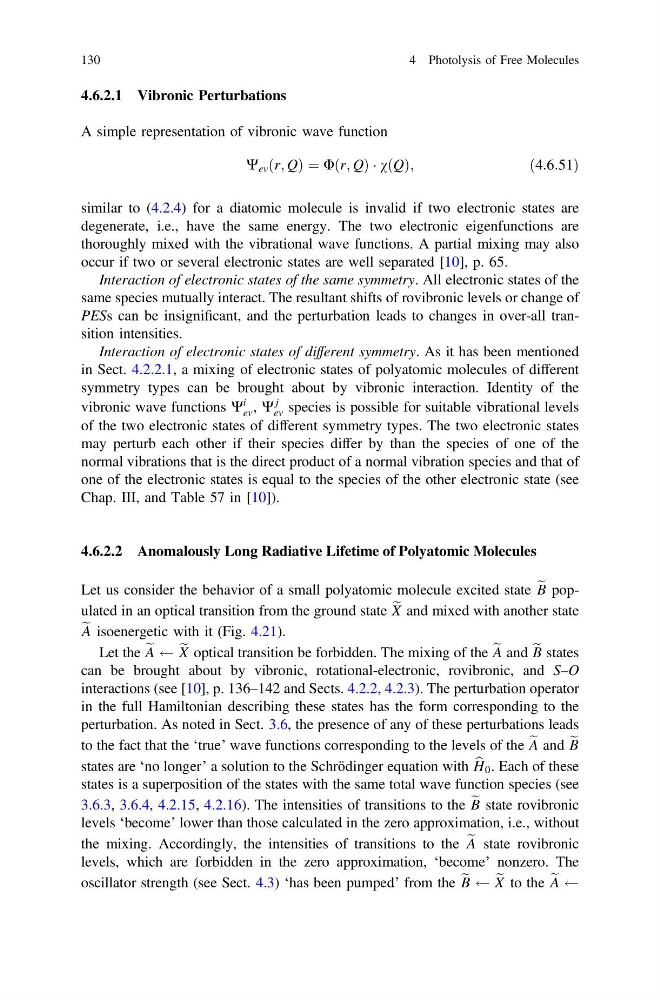
A simple representation of vibronic wave function
W ev r; Q
ð
Þ ¼ U r; Q
ð
ÞÁv Q
ð Þ;
ð4:6:51Þ
similar to (4.2.4) for a diatomic molecule is invalid if two electronic states are
degenerate, i.e., have the same energy. The two electronic eigenfunctions are
thoroughly mixed with the vibrational wave functions. A partial mixing may also
occur if two or several electronic states are well separated [10], p. 65.
Interaction of electronic states of the same symmetry. All electronic states of the
same species mutually interact. The resultant shifts of rovibronic levels or change of
PESs can be insignificant, and the perturbation leads to changes in over-all transition intensities.
Interaction of electronic states of different symmetry. As it has been mentioned
in Sect. 4.2.2.1, a mixing of electronic states of polyatomic molecules of different
symmetry types can be brought about by vibronic interaction. Identity of the
vibronic wave functions W
i
ev , W
j
ev species is possible for suitable vibrational levels
of the two electronic states of different symmetry types. The two electronic states
may perturb each other if their species differ by than the species of one of the
normal vibrations that is the direct product of a normal vibration species and that of
one of the electronic states is equal to the species of the other electronic state (see
Chap. III, and Table 57 in [10]).
4.6.2.2 Anomalously Long Radiative Lifetime of Polyatomic Molecules
Let us consider the behavior of a small polyatomic molecule excited state e
B populated in an optical transition from the ground state e
X and mixed with another state
e
A isoenergetic with it (Fig. 4.21).
Let the e
A
e
X optical transition be forbidden. The mixing of the e
A and e
B states
can be brought about by vibronic, rotational-electronic, rovibronic, and S–O
interactions (see [10], p. 136–142 and Sects. 4.2.2, 4.2.3). The perturbation operator
in the full Hamiltonian describing these states has the form corresponding to the
perturbation. As noted in Sect. 3.6, the presence of any of these perturbations leads
to the fact that the ‘true’ wave functions corresponding to the levels of the e
A and e
B
states are ‘no longer’ a solution to the Schrödinger equation with b
H 0 . Each of these
states is a superposition of the states with the same total wave function species (see
3.6.3, 3.6.4, 4.2.15, 4.2.16). The intensities of transitions to the e
B state rovibronic
levels ‘become’ lower than those calculated in the zero approximation, i.e., without
the mixing. Accordingly, the intensities of transitions to the e
A state rovibronic
levels, which are forbidden in the zero approximation, ‘become’ nonzero. The
oscillator strength (see Sect. 4.3) ‘has been pumped’ from the e
B
e
X to the e
A
130
4 Photolysis of Free Molecules
A simple representation of vibronic wave function
W ev r; Q
ð
Þ ¼ U r; Q
ð
ÞÁv Q
ð Þ;
ð4:6:51Þ
similar to (4.2.4) for a diatomic molecule is invalid if two electronic states are
degenerate, i.e., have the same energy. The two electronic eigenfunctions are
thoroughly mixed with the vibrational wave functions. A partial mixing may also
occur if two or several electronic states are well separated [10], p. 65.
Interaction of electronic states of the same symmetry. All electronic states of the
same species mutually interact. The resultant shifts of rovibronic levels or change of
PESs can be insignificant, and the perturbation leads to changes in over-all transition intensities.
Interaction of electronic states of different symmetry. As it has been mentioned
in Sect. 4.2.2.1, a mixing of electronic states of polyatomic molecules of different
symmetry types can be brought about by vibronic interaction. Identity of the
vibronic wave functions W
i
ev , W
j
ev species is possible for suitable vibrational levels
of the two electronic states of different symmetry types. The two electronic states
may perturb each other if their species differ by than the species of one of the
normal vibrations that is the direct product of a normal vibration species and that of
one of the electronic states is equal to the species of the other electronic state (see
Chap. III, and Table 57 in [10]).
4.6.2.2 Anomalously Long Radiative Lifetime of Polyatomic Molecules
Let us consider the behavior of a small polyatomic molecule excited state e
B populated in an optical transition from the ground state e
X and mixed with another state
e
A isoenergetic with it (Fig. 4.21).
Let the e
A
e
X optical transition be forbidden. The mixing of the e
A and e
B states
can be brought about by vibronic, rotational-electronic, rovibronic, and S–O
interactions (see [10], p. 136–142 and Sects. 4.2.2, 4.2.3). The perturbation operator
in the full Hamiltonian describing these states has the form corresponding to the
perturbation. As noted in Sect. 3.6, the presence of any of these perturbations leads
to the fact that the ‘true’ wave functions corresponding to the levels of the e
A and e
B
states are ‘no longer’ a solution to the Schrödinger equation with b
H 0 . Each of these
states is a superposition of the states with the same total wave function species (see
3.6.3, 3.6.4, 4.2.15, 4.2.16). The intensities of transitions to the e
B state rovibronic
levels ‘become’ lower than those calculated in the zero approximation, i.e., without
the mixing. Accordingly, the intensities of transitions to the e
A state rovibronic
levels, which are forbidden in the zero approximation, ‘become’ nonzero. The
oscillator strength (see Sect. 4.3) ‘has been pumped’ from the e
B
e
X to the e
A
130
4 Photolysis of Free Molecules