

4.6.2 Perturbations Between Bound States of Polyatomic
Molecules. Anomalously Long Radiative Lifetime
of Polyatomic Molecules
As in diatomic molecules, electronic states of a polyatomic molecule lying fairly
close may perturb each other. If the spin-orbit interaction between the states is
negligible, both states have to possess the same orbital species and the same
multiplicity, to be perturbed. If it is not the case, perturbations can occur between
the states of different orbital species, but species of two electronic states must not
differ not more than species of one of the normal vibrations [10], p. 66. For
example, in the C 2v point group a
1
A 1 state can be perturbed by a
3
A 2 state, but one
1
A 1 component of the
3
A 2 state can mix with the former ((A 2 + B 1 + B 2 ) ⨯
A 2 = A 1 + B 2 + B 1 ). If
3
A 1 and
2
A 2 states are perturbed, two, B 2 + B 1 , components
of the former are perturbed by the B 2 + B 1 components of the later (see Tables 56,
57 in [10]). Electronic states can also be perturbed due to vibronic and Coriolis
interactions; the latter leads to coupling between rotation and vibration.
Perturbations in polyatomic molecule are described in detail in [10, 61]. Therefore,
the author will review them very briefly.
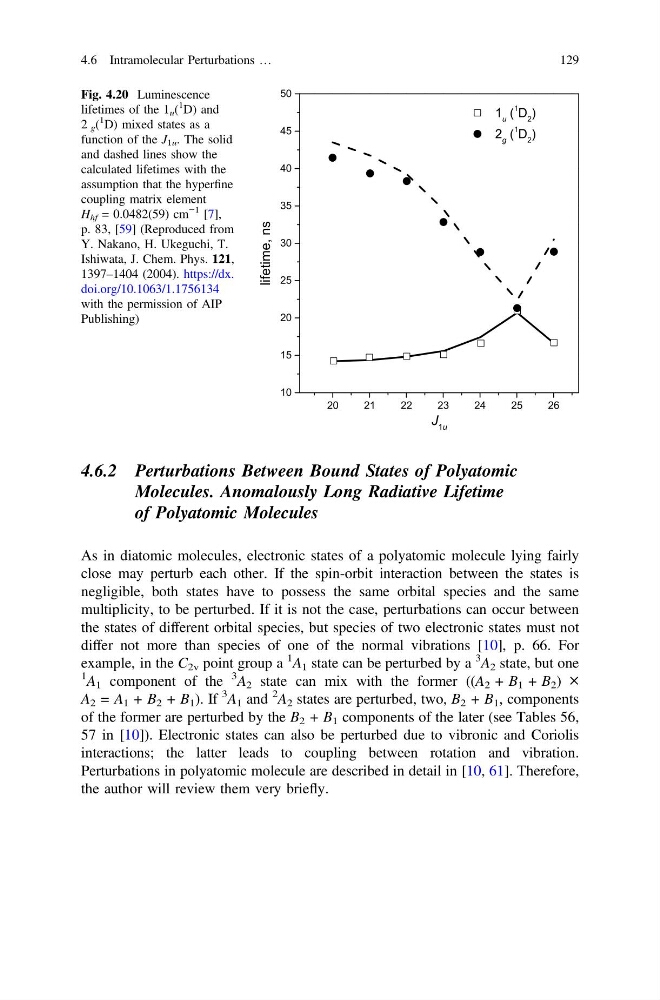
Fig. 4.20 Luminescence
lifetimes of the 1 u (
1
D) and
2 g (
1
D) mixed states as a
function of the J 1u . The solid
and dashed lines show the
calculated lifetimes with the
assumption that the hyperfine
coupling matrix element
H hf = 0.0482(59) cm
−1 [7],
p. 83, [59] (Reproduced from
Y. Nakano, H. Ukeguchi, T.
Ishiwata, J. Chem. Phys. 121,
1397–1404 (2004). https://dx.
doi.org/10.1063/1.1756134
with the permission of AIP
Publishing)
4.6 Intramolecular Perturbations …
129
Molecules. Anomalously Long Radiative Lifetime
of Polyatomic Molecules
As in diatomic molecules, electronic states of a polyatomic molecule lying fairly
close may perturb each other. If the spin-orbit interaction between the states is
negligible, both states have to possess the same orbital species and the same
multiplicity, to be perturbed. If it is not the case, perturbations can occur between
the states of different orbital species, but species of two electronic states must not
differ not more than species of one of the normal vibrations [10], p. 66. For
example, in the C 2v point group a
1
A 1 state can be perturbed by a
3
A 2 state, but one
1
A 1 component of the
3
A 2 state can mix with the former ((A 2 + B 1 + B 2 ) ⨯
A 2 = A 1 + B 2 + B 1 ). If
3
A 1 and
2
A 2 states are perturbed, two, B 2 + B 1 , components
of the former are perturbed by the B 2 + B 1 components of the later (see Tables 56,
57 in [10]). Electronic states can also be perturbed due to vibronic and Coriolis
interactions; the latter leads to coupling between rotation and vibration.
Perturbations in polyatomic molecule are described in detail in [10, 61]. Therefore,
the author will review them very briefly.
Fig. 4.20 Luminescence
lifetimes of the 1 u (
1
D) and
2 g (
1
D) mixed states as a
function of the J 1u . The solid
and dashed lines show the
calculated lifetimes with the
assumption that the hyperfine
coupling matrix element
H hf = 0.0482(59) cm
−1 [7],
p. 83, [59] (Reproduced from
Y. Nakano, H. Ukeguchi, T.
Ishiwata, J. Chem. Phys. 121,
1397–1404 (2004). https://dx.
doi.org/10.1063/1.1756134
with the permission of AIP
Publishing)
4.6 Intramolecular Perturbations …
129