

In the case of the 2 g (
1 D) *1 u (
1 D) coupling, interaction matrix elements were
determined by solving the equations in the two-state model. Laser bandwidth was
also insufficient to resolve the splitting of the near-resonant rovibrational levels of
the 2 g (
1 D) and 1 u (
1
D) IP states [59], and the authors employed another method.
The line shapes were deconvoluted by two lines with the Lorentzian form to derive
their transition frequencies for determining the energies of coupled rovibrational
levels. The electronic interaction matrix element was determined as H
el
hf = 0.0482
(59) cm
−1 , similar to that for D * b and E * c.
Due to the mixing of the zero-order states, which have different radiative lifetimes (s and s
0 for states W and W
0 , respectively), the radiative lifetimes for the
perturbed 1
j i and 2
j i states are determined as follows:
s
À1
1 ¼ s
À1
cos
2 h þ s
0À1
sin
2 h
ð4:6:49Þ
s
À1
2 ¼ s
À1
sin
2
h þ s
0À1
cos
2
h
ð4:6:50Þ
Direct measurements of the radiative lifetimes allow estimating the mixing
angle, which is determined in (4.6.35) and hence, the matrix elements of the
hyperfine interaction. Figure 4.20) demonstrates the reasonability of this method.
Luminescence lifetimes observed for the 1 u (
1
D) and 2 g(
1
D) mixing states strongly
depends on the rotational quantum number near the avoiding crossing
J 1u = 25 * J 2g = 24 range. The upper energy component has a lifetime longer
than that of the lower one after avoiding crossing and vice versa.
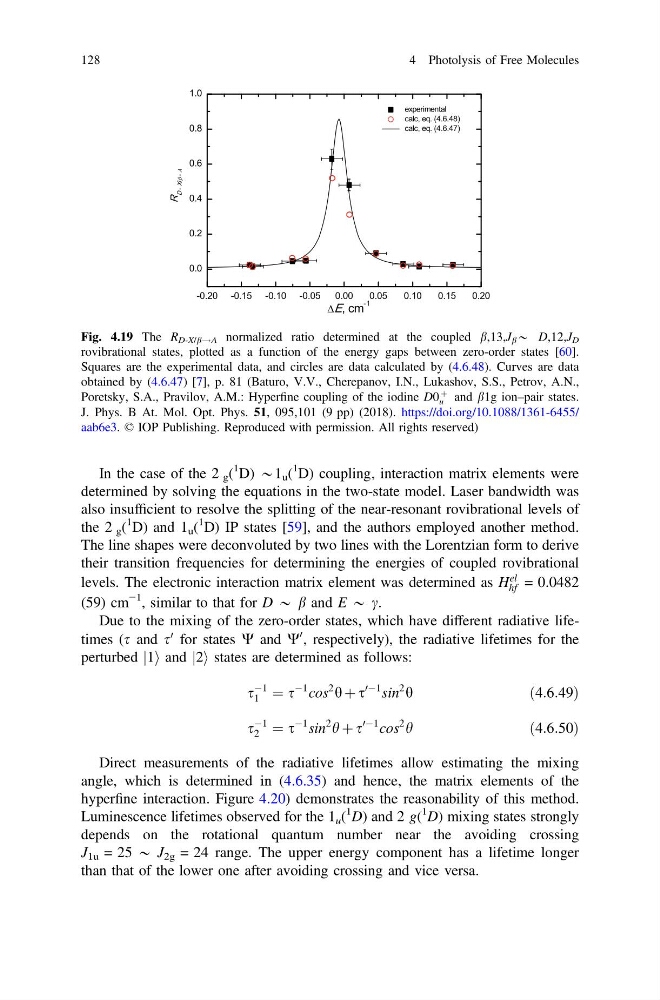
Fig. 4.19 The R D-X/b!A normalized ratio determined at the coupled b,13,J b * D,12,J D
rovibrational states, plotted as a function of the energy gaps between zero-order states [60].
Squares are the experimental data, and circles are data calculated by (4.6.48). Curves are data
obtained by (4.6.47) [7], p. 81 (Baturo, V.V., Cherepanov, I.N., Lukashov, S.S., Petrov, A.N.,
Poretsky, S.A., Pravilov, A.M.: Hyperfine coupling of the iodine D0
þ
u and b1g ion–pair states.
J. Phys. B At. Mol. Opt. Phys. 51, 095,101 (9 pp) (2018). https://doi.org/10.1088/1361-6455/
aab6e3. © IOP Publishing. Reproduced with permission. All rights reserved)
128
4 Photolysis of Free Molecules
1 D) *1 u (
1 D) coupling, interaction matrix elements were
determined by solving the equations in the two-state model. Laser bandwidth was
also insufficient to resolve the splitting of the near-resonant rovibrational levels of
the 2 g (
1 D) and 1 u (
1
D) IP states [59], and the authors employed another method.
The line shapes were deconvoluted by two lines with the Lorentzian form to derive
their transition frequencies for determining the energies of coupled rovibrational
levels. The electronic interaction matrix element was determined as H
el
hf = 0.0482
(59) cm
−1 , similar to that for D * b and E * c.
Due to the mixing of the zero-order states, which have different radiative lifetimes (s and s
0 for states W and W
0 , respectively), the radiative lifetimes for the
perturbed 1
j i and 2
j i states are determined as follows:
s
À1
1 ¼ s
À1
cos
2 h þ s
0À1
sin
2 h
ð4:6:49Þ
s
À1
2 ¼ s
À1
sin
2
h þ s
0À1
cos
2
h
ð4:6:50Þ
Direct measurements of the radiative lifetimes allow estimating the mixing
angle, which is determined in (4.6.35) and hence, the matrix elements of the
hyperfine interaction. Figure 4.20) demonstrates the reasonability of this method.
Luminescence lifetimes observed for the 1 u (
1
D) and 2 g(
1
D) mixing states strongly
depends on the rotational quantum number near the avoiding crossing
J 1u = 25 * J 2g = 24 range. The upper energy component has a lifetime longer
than that of the lower one after avoiding crossing and vice versa.
Fig. 4.19 The R D-X/b!A normalized ratio determined at the coupled b,13,J b * D,12,J D
rovibrational states, plotted as a function of the energy gaps between zero-order states [60].
Squares are the experimental data, and circles are data calculated by (4.6.48). Curves are data
obtained by (4.6.47) [7], p. 81 (Baturo, V.V., Cherepanov, I.N., Lukashov, S.S., Petrov, A.N.,
Poretsky, S.A., Pravilov, A.M.: Hyperfine coupling of the iodine D0
þ
u and b1g ion–pair states.
J. Phys. B At. Mol. Opt. Phys. 51, 095,101 (9 pp) (2018). https://doi.org/10.1088/1361-6455/
aab6e3. © IOP Publishing. Reproduced with permission. All rights reserved)
128
4 Photolysis of Free Molecules