

spin states of W. The total number of the nuclear spin states of W
0 with odd I and W
with even I is g W
0 ¼ 21 and g W ¼ 15, respectively. One can construct 15 bright
states from 21 spin states of W
0 that interact with 15 spin states of W, and 6 dark
states which do not interact with W. The population of the dark states of W
0 does not
lead to the optical transition from W resulting in K ¼
g W
g W 0
¼
15
21 . In the opposite case, if
the u negative or g positive term of W
0 is populated in the optical transition, the
number of nuclear spin states of W
0 is less than the number of nuclear spin states of
W. In this case, each spin state of W
0 interacts with W, and therefore the population of
every W
0 hyperfine level leads to the optical transition from W, which result in K = 1.
Normalized ratio of luminescence intensities
R
0
W=W
0 ¼ R W=W
0 =K
ð4:6:46Þ
can be approximated by a simple Lorentz function. If the W
0 state is populated
optically, the ratio of luminescence intensities R W
0 =W should be used:
R W
0 =W J W
ð Þ ¼
1
1 þ
DE 2
2H 2
hf
Á
s W
s W
0
Á K J W
ð Þ
ð4:6:47Þ
Such normalized ratio of luminescence intensities from near-resonant rovibrational levels of the D,12 and b,13 states as a function of energy gap DE is shown in
Fig. 4.19. Fitting of the experimental data by (4.6.47) gives values of the electronic
interaction matrix element H
el
hf = 0.049(3) cm
−1 . The mixing of the close-lying
rovibrational levels of the b,v b = 47 and D,v D = 48 states have been observed by
the population of the b state [60]. The matrix element value is equal H
el
hf = 0.063(7)
cm
−1 and increases slightly with the vibrational quantum number of the states.
The matrix element of interaction between the E,3,J and c,1,J vibrational states
has found to be similar value H
el
hf = 0.084 cm
−1 in analogous experiments.
Resolution of utilized lasers was insufficient to estimate the matrix element by
(4.6.47, 4.6.48) for the E,19,J and c,18,J coupled states [52]. However, it was
shown that near-resonant rovibrational levels are J E = 81 and J c = 80 and the
electronic interaction matrix element can be estimated of about 0.02 cm
−1 , significantly less than that of the E,3 * c,1 interaction.
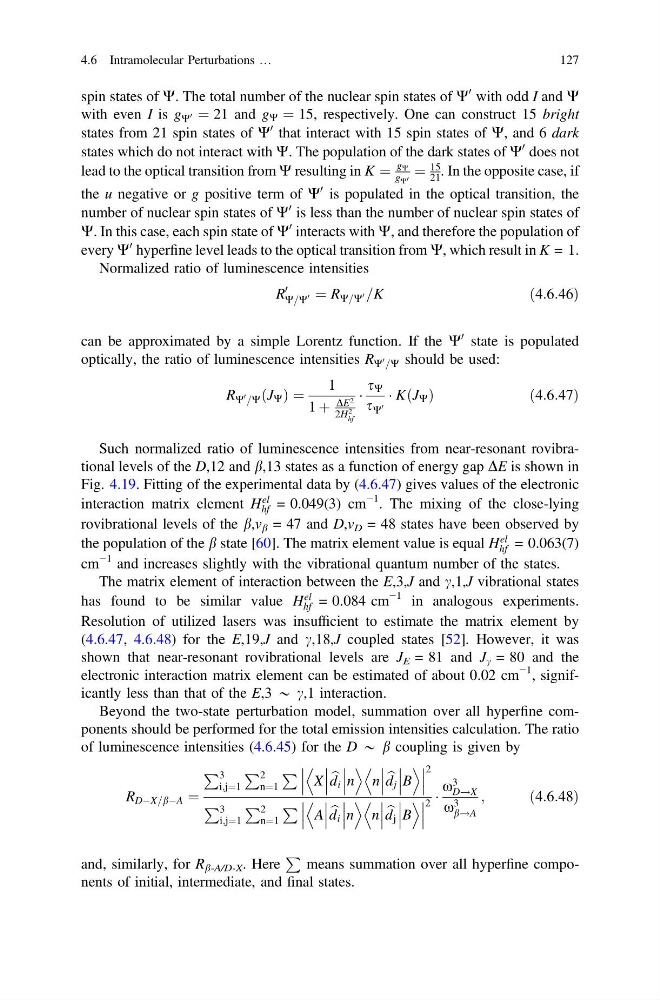
Beyond the two-state perturbation model, summation over all hyperfine components should be performed for the total emission intensities calculation. The ratio
of luminescence intensities (4.6.45) for the D * b coupling is given by
R DÀX=bÀA ¼
P 3
i;j¼1
P 2
n¼1
P X b
d i
n
D
E
n b
d j
B
D
E
2
P 3
i;j¼1
P 2
n¼1
P A b
d i
n
D
E
n b
d j
B
D
E
2
Á
x
3
D!X
x
3
b!A
;
ð4:6:48Þ
and, similarly, for R b-A/D-X . Here
P
means summation over all hyperfine components of initial, intermediate, and final states.
4.6 Intramolecular Perturbations …
127
0 with odd I and W
with even I is g W
0 ¼ 21 and g W ¼ 15, respectively. One can construct 15 bright
states from 21 spin states of W
0 that interact with 15 spin states of W, and 6 dark
states which do not interact with W. The population of the dark states of W
0 does not
lead to the optical transition from W resulting in K ¼
g W
g W 0
¼
15
21 . In the opposite case, if
the u negative or g positive term of W
0 is populated in the optical transition, the
number of nuclear spin states of W
0 is less than the number of nuclear spin states of
W. In this case, each spin state of W
0 interacts with W, and therefore the population of
every W
0 hyperfine level leads to the optical transition from W, which result in K = 1.
Normalized ratio of luminescence intensities
R
0
W=W
0 ¼ R W=W
0 =K
ð4:6:46Þ
can be approximated by a simple Lorentz function. If the W
0 state is populated
optically, the ratio of luminescence intensities R W
0 =W should be used:
R W
0 =W J W
ð Þ ¼
1
1 þ
DE 2
2H 2
hf
Á
s W
s W
0
Á K J W
ð Þ
ð4:6:47Þ
Such normalized ratio of luminescence intensities from near-resonant rovibrational levels of the D,12 and b,13 states as a function of energy gap DE is shown in
Fig. 4.19. Fitting of the experimental data by (4.6.47) gives values of the electronic
interaction matrix element H
el
hf = 0.049(3) cm
−1 . The mixing of the close-lying
rovibrational levels of the b,v b = 47 and D,v D = 48 states have been observed by
the population of the b state [60]. The matrix element value is equal H
el
hf = 0.063(7)
cm
−1 and increases slightly with the vibrational quantum number of the states.
The matrix element of interaction between the E,3,J and c,1,J vibrational states
has found to be similar value H
el
hf = 0.084 cm
−1 in analogous experiments.
Resolution of utilized lasers was insufficient to estimate the matrix element by
(4.6.47, 4.6.48) for the E,19,J and c,18,J coupled states [52]. However, it was
shown that near-resonant rovibrational levels are J E = 81 and J c = 80 and the
electronic interaction matrix element can be estimated of about 0.02 cm
−1 , significantly less than that of the E,3 * c,1 interaction.
Beyond the two-state perturbation model, summation over all hyperfine components should be performed for the total emission intensities calculation. The ratio
of luminescence intensities (4.6.45) for the D * b coupling is given by
R DÀX=bÀA ¼
P 3
i;j¼1
P 2
n¼1
P X b
d i
n
D
E
n b
d j
B
D
E
2
P 3
i;j¼1
P 2
n¼1
P A b
d i
n
D
E
n b
d j
B
D
E
2
Á
x
3
D!X
x
3
b!A
;
ð4:6:48Þ
and, similarly, for R b-A/D-X . Here
P
means summation over all hyperfine components of initial, intermediate, and final states.
4.6 Intramolecular Perturbations …
127