

Both 1
j i and 2
j i states have admixtures of the W and W
0 states and contribute to
the luminescence (see Sect. 4.6.1.5). However, it is possible to extract admixture
coefficients and determine interaction matrix elements using the ratio of the total
luminescence of the W and W
0 components. In the framework of the two-state
model (see above) the total luminescence intensity of the W ! i and W
0
! k bands
from both 1
j i and 2
j i are:
I W $ cos
4 h þ sin
4 h
À
Á 3 X
i
W b l W!i
j
ji
h
i
2 ;
ð4:6:42Þ
I W
0 $ 2 cos
2 hsin
2 h m
3
X
j
W
0
b l W
0 !k
j
jk
h
i
2
ð4:6:43Þ
The total emission intensity ratio for the transitions, in the optical population of
the W
0 state case, is:
I W
I W
0
R W=W
0 ¼
2 cos
2 sin
2
cos 4 þ sin
4
R
m
3
l
2
W!i d
R
m 3 l 2
W
0 !j
d
¼
2 tan
2
1 þ tan 4
P
i A W!i
P
j A W
0 !j
:
ð4:6:44Þ
According to (4.6.33), it can be written as:
R W=W
0 J W
ð Þ ¼
1
1 þ
DE 2
2H 2
hf
Á
s W
0
s W
Á K J W
ð Þ
ð4:6:45Þ
Here, an additional factor K, if W and W
0 have different electronic parities x, has
to be introduced. Indeed, let us suppose that the u positive or g negative term of W
0 is
populated in the optical transition. For the u positive and g negative terms the I = 1,
3, 5 are odd (see 4.6.32). On the other hand, any u * g hyperfine coupling implies
an odd DI (see Sect. 4.6.1.4). Therefore W
0 is coupled with the I = 0, 2, 4 nuclear
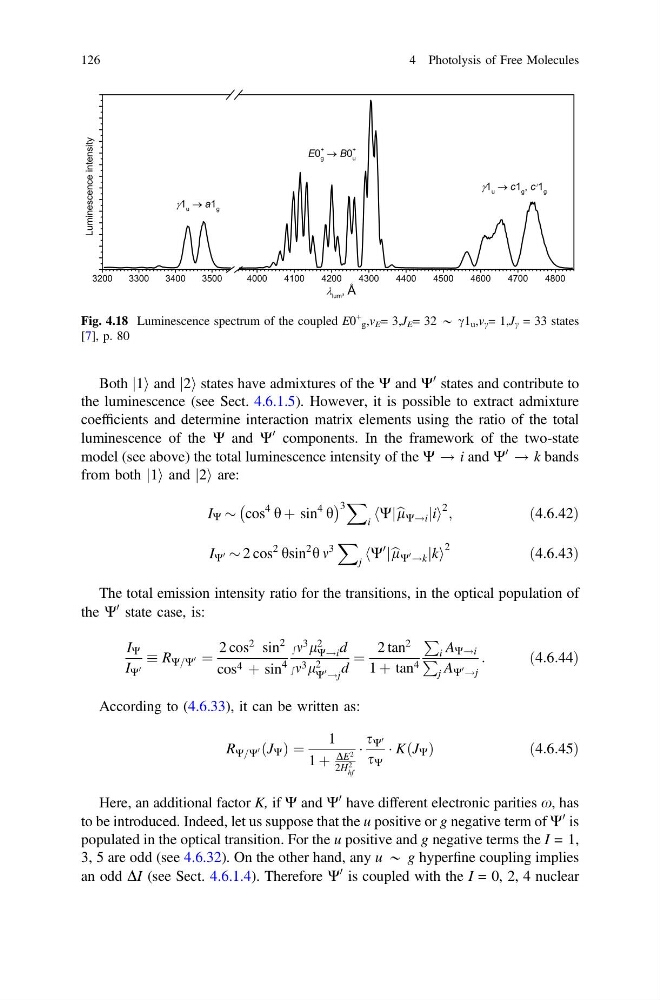
Fig. 4.18 Luminescence spectrum of the coupled E0
+
g ,v E = 3,J E = 32 * c1 u ,v c = 1,J c = 33 states
[7], p. 80
126
4 Photolysis of Free Molecules
j i and 2
j i states have admixtures of the W and W
0 states and contribute to
the luminescence (see Sect. 4.6.1.5). However, it is possible to extract admixture
coefficients and determine interaction matrix elements using the ratio of the total
luminescence of the W and W
0 components. In the framework of the two-state
model (see above) the total luminescence intensity of the W ! i and W
0
! k bands
from both 1
j i and 2
j i are:
I W $ cos
4 h þ sin
4 h
À
Á 3 X
i
W b l W!i
j
ji
h
i
2 ;
ð4:6:42Þ
I W
0 $ 2 cos
2 hsin
2 h m
3
X
j
W
0
b l W
0 !k
j
jk
h
i
2
ð4:6:43Þ
The total emission intensity ratio for the transitions, in the optical population of
the W
0 state case, is:
I W
I W
0
R W=W
0 ¼
2 cos
2 sin
2
cos 4 þ sin
4
R
m
3
l
2
W!i d
R
m 3 l 2
W
0 !j
d
¼
2 tan
2
1 þ tan 4
P
i A W!i
P
j A W
0 !j
:
ð4:6:44Þ
According to (4.6.33), it can be written as:
R W=W
0 J W
ð Þ ¼
1
1 þ
DE 2
2H 2
hf
Á
s W
0
s W
Á K J W
ð Þ
ð4:6:45Þ
Here, an additional factor K, if W and W
0 have different electronic parities x, has
to be introduced. Indeed, let us suppose that the u positive or g negative term of W
0 is
populated in the optical transition. For the u positive and g negative terms the I = 1,
3, 5 are odd (see 4.6.32). On the other hand, any u * g hyperfine coupling implies
an odd DI (see Sect. 4.6.1.4). Therefore W
0 is coupled with the I = 0, 2, 4 nuclear
Fig. 4.18 Luminescence spectrum of the coupled E0
+
g ,v E = 3,J E = 32 * c1 u ,v c = 1,J c = 33 states
[7], p. 80
126
4 Photolysis of Free Molecules