

g states from a single rovibrational level. Luminescence spectra of the F ! X,
G ! A,C and g ! B’ transitions (see Figs. 4.4 and 4.10), which arise from each
perturbed (bb) state were measured to determine HFI and heterogeneous interaction
matrix elements in the framework of the two-state model described above.
Hyperfine electronic matrix elements determined for the 0
þ
g * 1 u and
0
þ
g * 0
À
u couplings were estimated as 0.3(1) cm
−1 and 0.5(2) cm
−1 , respectively.
The coupling of the 0
þ
g and 0
À
u (bb) states can occur by another, indirect mechanism via the 1 u intermediate state in the second-order perturbation approach. The
0
À
u state couples with the 1 u ,v 1 ,J 1 one by the heterogeneous interaction according to
the DJ = 1 selection rule. The 1 u ,v 1 ,J 1 state is mixed with the 0
þ
g ,v 0 ,J 0 one by HFI
with the |DJ|
2 selection rule. However, the observed 0
þ
g ,0,49 and 0
À
u ,1,48/50
coupling states lie significantly lower than the 1 u , v 1 = 0 level (DE > 90 cm
−1 ), so
the 0
þ
g and 0
À
u states are coupled directly.
4.6.1.7 Hyperfine Interactions Between Iodine Molecule Ion-Pair
States
All coupling effects induced by the HFI are weak and can be observed for a few
rovibrational levels of some IP states despite the dense rovibrational structure of the
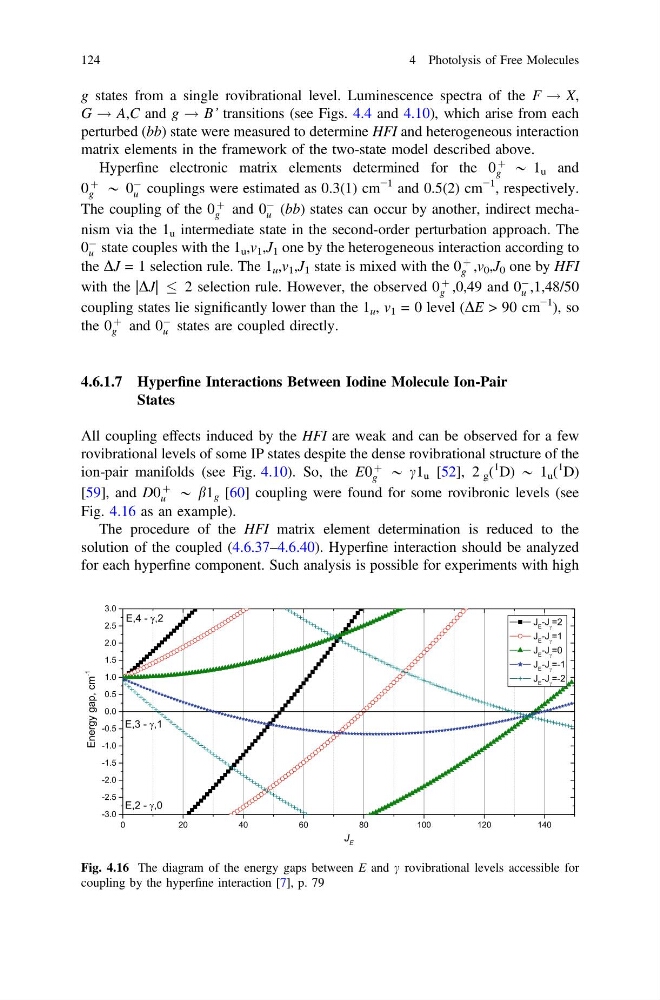
ion-pair manifolds (see Fig. 4.10). So, the E0
þ
g * c1 u [52], 2 g (
1 D) * 1 u (
1 D)
[59], and D0
þ
u * b1 g [60] coupling were found for some rovibronic levels (see
Fig. 4.16 as an example).
The procedure of the HFI matrix element determination is reduced to the
solution of the coupled (4.6.37–4.6.40). Hyperfine interaction should be analyzed
for each hyperfine component. Such analysis is possible for experiments with high
Fig. 4.16 The diagram of the energy gaps between E and c rovibrational levels accessible for
coupling by the hyperfine interaction [7], p. 79
124
4 Photolysis of Free Molecules
G ! A,C and g ! B’ transitions (see Figs. 4.4 and 4.10), which arise from each
perturbed (bb) state were measured to determine HFI and heterogeneous interaction
matrix elements in the framework of the two-state model described above.
Hyperfine electronic matrix elements determined for the 0
þ
g * 1 u and
0
þ
g * 0
À
u couplings were estimated as 0.3(1) cm
−1 and 0.5(2) cm
−1 , respectively.
The coupling of the 0
þ
g and 0
À
u (bb) states can occur by another, indirect mechanism via the 1 u intermediate state in the second-order perturbation approach. The
0
À
u state couples with the 1 u ,v 1 ,J 1 one by the heterogeneous interaction according to
the DJ = 1 selection rule. The 1 u ,v 1 ,J 1 state is mixed with the 0
þ
g ,v 0 ,J 0 one by HFI
with the |DJ|
2 selection rule. However, the observed 0
þ
g ,0,49 and 0
À
u ,1,48/50
coupling states lie significantly lower than the 1 u , v 1 = 0 level (DE > 90 cm
−1 ), so
the 0
þ
g and 0
À
u states are coupled directly.
4.6.1.7 Hyperfine Interactions Between Iodine Molecule Ion-Pair
States
All coupling effects induced by the HFI are weak and can be observed for a few
rovibrational levels of some IP states despite the dense rovibrational structure of the
ion-pair manifolds (see Fig. 4.10). So, the E0
þ
g * c1 u [52], 2 g (
1 D) * 1 u (
1 D)
[59], and D0
þ
u * b1 g [60] coupling were found for some rovibronic levels (see
Fig. 4.16 as an example).
The procedure of the HFI matrix element determination is reduced to the
solution of the coupled (4.6.37–4.6.40). Hyperfine interaction should be analyzed
for each hyperfine component. Such analysis is possible for experiments with high
Fig. 4.16 The diagram of the energy gaps between E and c rovibrational levels accessible for
coupling by the hyperfine interaction [7], p. 79
124
4 Photolysis of Free Molecules