

Three weakly bound 0
þ
g , 1 u and 0
À
u states correlating with the third (bb) dissociation limit have very similar potential curves and dense rovibrational structures
(see Fig. 4.4). The bulk of accidental resonances between rovibrational levels
makes this system an interesting model object for different perturbations studies.
Indeed, as shown in [57, 59], this system can be considered a strongly coupled
cluster of three electronic states.
Three-step three-color excitation scheme via the B0
þ
u and 0
þ
g (bb) states
I 2 IP
hm 2 0
þ
g ; 0
À
u ; 1 u bb
ð Þ
hm
f
i B; v B J B
hm 1 X; v X J X
ð4:6:41Þ
was successfully realized for investigating the I 2 (bb) coupled states in the series of
works [57, 58]. Despite the dense system of the rovibrational levels, a limited
number of rovibrational levels of (bb) states could be populated in experiments if
accidental resonances in the 0
þ
g ; 0
À
u , 1 u (bb) ← B,v B ,J B transitions occur.
The 0
þ
g * 1 u and 0
þ
g * 0
À
u are coupled by HFI, whereas the 0
À
u and 1 u states
are coupled by heterogeneous interaction (see Sect. 4.6.1.3 and [42]). The second
step of the multistep excitation scheme is available due to the 0
þ
g
← B0
þ
u transition and results in population of the ungerade IP states. Two other interacting
states, 1 u and 0
À
u , mixed with 0
þ
g one, and transitions to the gerade IP states
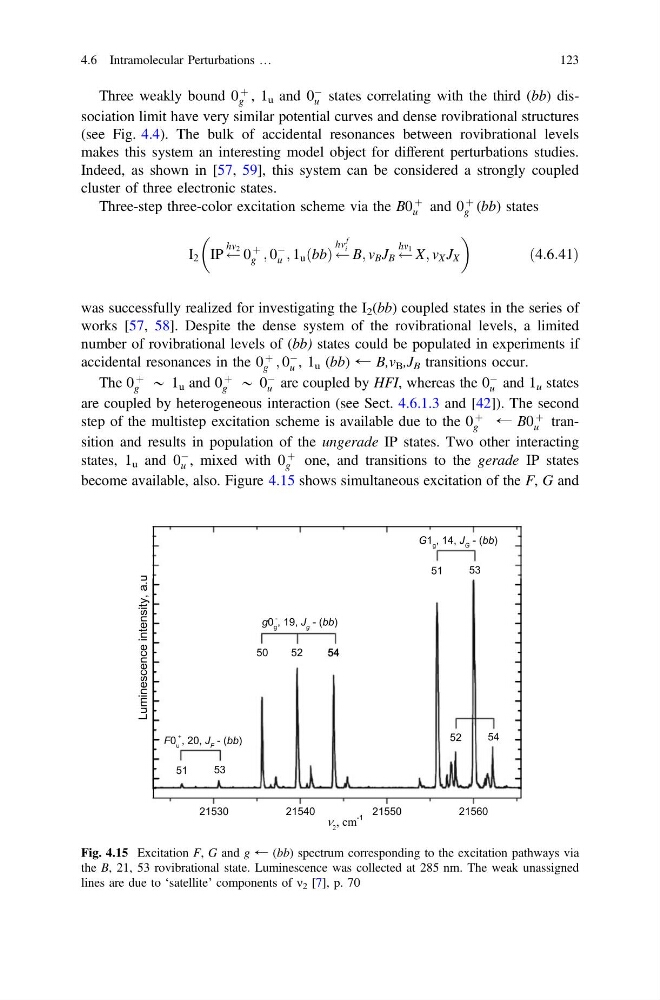
become available, also. Figure 4.15 shows simultaneous excitation of the F, G and
Fig. 4.15 Excitation F, G and g ← (bb) spectrum corresponding to the excitation pathways via
the B, 21, 53 rovibrational state. Luminescence was collected at 285 nm. The weak unassigned
lines are due to ‘satellite’ components of m 2 [7], p. 70
4.6 Intramolecular Perturbations …
123
þ
g , 1 u and 0
À
u states correlating with the third (bb) dissociation limit have very similar potential curves and dense rovibrational structures
(see Fig. 4.4). The bulk of accidental resonances between rovibrational levels
makes this system an interesting model object for different perturbations studies.
Indeed, as shown in [57, 59], this system can be considered a strongly coupled
cluster of three electronic states.
Three-step three-color excitation scheme via the B0
þ
u and 0
þ
g (bb) states
I 2 IP
hm 2 0
þ
g ; 0
À
u ; 1 u bb
ð Þ
hm
f
i B; v B J B
hm 1 X; v X J X
ð4:6:41Þ
was successfully realized for investigating the I 2 (bb) coupled states in the series of
works [57, 58]. Despite the dense system of the rovibrational levels, a limited
number of rovibrational levels of (bb) states could be populated in experiments if
accidental resonances in the 0
þ
g ; 0
À
u , 1 u (bb) ← B,v B ,J B transitions occur.
The 0
þ
g * 1 u and 0
þ
g * 0
À
u are coupled by HFI, whereas the 0
À
u and 1 u states
are coupled by heterogeneous interaction (see Sect. 4.6.1.3 and [42]). The second
step of the multistep excitation scheme is available due to the 0
þ
g
← B0
þ
u transition and results in population of the ungerade IP states. Two other interacting
states, 1 u and 0
À
u , mixed with 0
þ
g one, and transitions to the gerade IP states
become available, also. Figure 4.15 shows simultaneous excitation of the F, G and
Fig. 4.15 Excitation F, G and g ← (bb) spectrum corresponding to the excitation pathways via
the B, 21, 53 rovibrational state. Luminescence was collected at 285 nm. The weak unassigned
lines are due to ‘satellite’ components of m 2 [7], p. 70
4.6 Intramolecular Perturbations …
123