

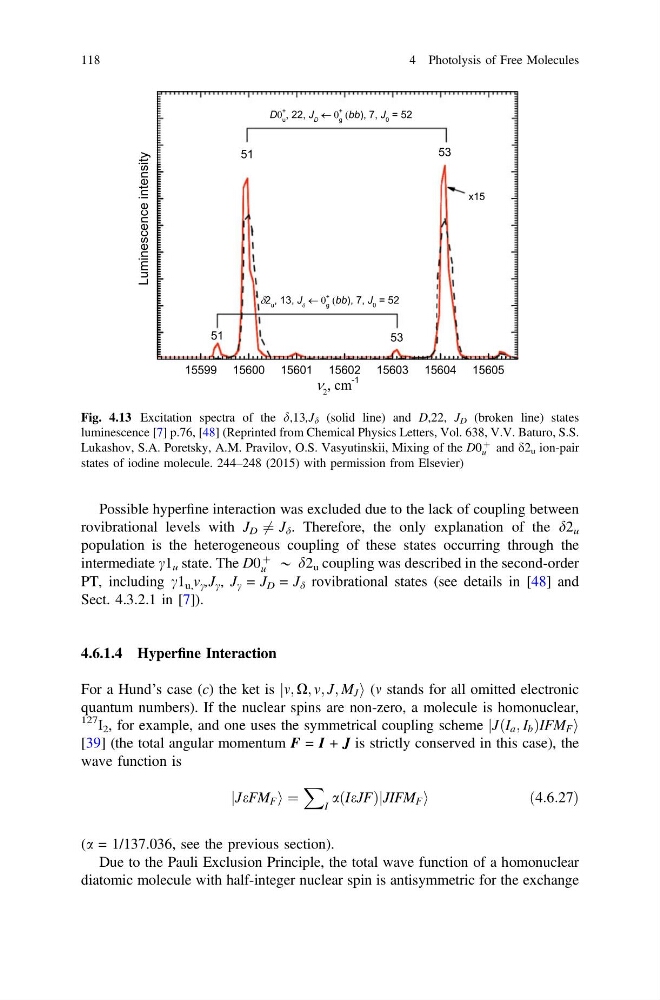
Possible hyperfine interaction was excluded due to the lack of coupling between
rovibrational levels with J D 6 ¼ J d . Therefore, the only explanation of the d2 u
population is the heterogeneous coupling of these states occurring through the
intermediate c1 u state. The D0
þ
u * d2 u coupling was described in the second-order
PT, including c1 u, v c ,J c , J c = J D = J d rovibrational states (see details in [48] and
Sect. 4.3.2.1 in [7]).
4.6.1.4 Hyperfine Interaction
For a Hund’s case (c) the ket is m; X; v; J; M J
j
i(m stands for all omitted electronic
quantum numbers). If the nuclear spins are non-zero, a molecule is homonuclear,
127 I 2 , for example, and one uses the symmetrical coupling scheme J I a ; I b
ð
ÞIFM F
j
i
[39] (the total angular momentum F = I + J is strictly conserved in this case), the
wave function is
JeFM F
j
i¼
X
I
a IeJF
ð
ÞJIFM F
j
i
ð4:6:27Þ
(a = 1/137.036, see the previous section).
Due to the Pauli Exclusion Principle, the total wave function of a homonuclear
diatomic molecule with half-integer nuclear spin is antisymmetric for the exchange
Fig. 4.13 Excitation spectra of the d,13,J d (solid line) and D,22, J D (broken line) states
luminescence [7] p.76, [48] (Reprinted from Chemical Physics Letters, Vol. 638, V.V. Baturo, S.S.
Lukashov, S.A. Poretsky, A.M. Pravilov, O.S. Vasyutinskii, Mixing of the D0
þ
u and d2 u ion-pair
states of iodine molecule. 244–248 (2015) with permission from Elsevier)
118
4 Photolysis of Free Molecules
rovibrational levels with J D 6 ¼ J d . Therefore, the only explanation of the d2 u
population is the heterogeneous coupling of these states occurring through the
intermediate c1 u state. The D0
þ
u * d2 u coupling was described in the second-order
PT, including c1 u, v c ,J c , J c = J D = J d rovibrational states (see details in [48] and
Sect. 4.3.2.1 in [7]).
4.6.1.4 Hyperfine Interaction
For a Hund’s case (c) the ket is m; X; v; J; M J
j
i(m stands for all omitted electronic
quantum numbers). If the nuclear spins are non-zero, a molecule is homonuclear,
127 I 2 , for example, and one uses the symmetrical coupling scheme J I a ; I b
ð
ÞIFM F
j
i
[39] (the total angular momentum F = I + J is strictly conserved in this case), the
wave function is
JeFM F
j
i¼
X
I
a IeJF
ð
ÞJIFM F
j
i
ð4:6:27Þ
(a = 1/137.036, see the previous section).
Due to the Pauli Exclusion Principle, the total wave function of a homonuclear
diatomic molecule with half-integer nuclear spin is antisymmetric for the exchange
Fig. 4.13 Excitation spectra of the d,13,J d (solid line) and D,22, J D (broken line) states
luminescence [7] p.76, [48] (Reprinted from Chemical Physics Letters, Vol. 638, V.V. Baturo, S.S.
Lukashov, S.A. Poretsky, A.M. Pravilov, O.S. Vasyutinskii, Mixing of the D0
þ
u and d2 u ion-pair
states of iodine molecule. 244–248 (2015) with permission from Elsevier)
118
4 Photolysis of Free Molecules