

of the nuclei. In a state of even (gerade) electronic symmetry, such as the
127 I 2 (X 0
þ
g Þ, only states of odd total nuclear spin (I = 1, 3, 5) can combine with
odd-J states, and states of even nuclear spin (I = 0, 2, 4) can combine only with
even-J states. The total number of hyperfine states with the nuclear spin I is 2I + 1.
For the 0
þ
g states of the
127 I 2 molecule, rotational levels with odd J correspond to
I = 1, 3, 5 (ortho-state) and split into 21 components; rotational levels with even
J correspond to I = 0, 2, 4 (para-state) and split into 15 components. For an odd
(ungerade) electronic state such as the 0
þ
u state, the I, J combination rules are
reversed [49]. For the states with X > 0, one should take into account X-doubling.
The relationship between the total angular momentum J and the total nuclear
spin momentum I follows from the (4.6.5, 4.6.6, 4.6.28):
À1
ð Þ
I ¼ pe
ð4:6:28Þ
(p = + 1 and –1 for the g and u states, respectively [7], p. 39, [50].
Equation (4.6.28) means that:
For the u negative e ¼ À1; p ¼ À1
ð
Þ and g positive e ¼ þ 1; p ¼ þ 1
ð
Þ terms;
the total spin I is even:
For the u positive e ¼ À1; p ¼ þ 1
ð
Þ and g negative e ¼ þ 1; p ¼ À1
ð
Þ terms;
the total spin I is odd:
8
> > <
> > :
ð4:6:29Þ
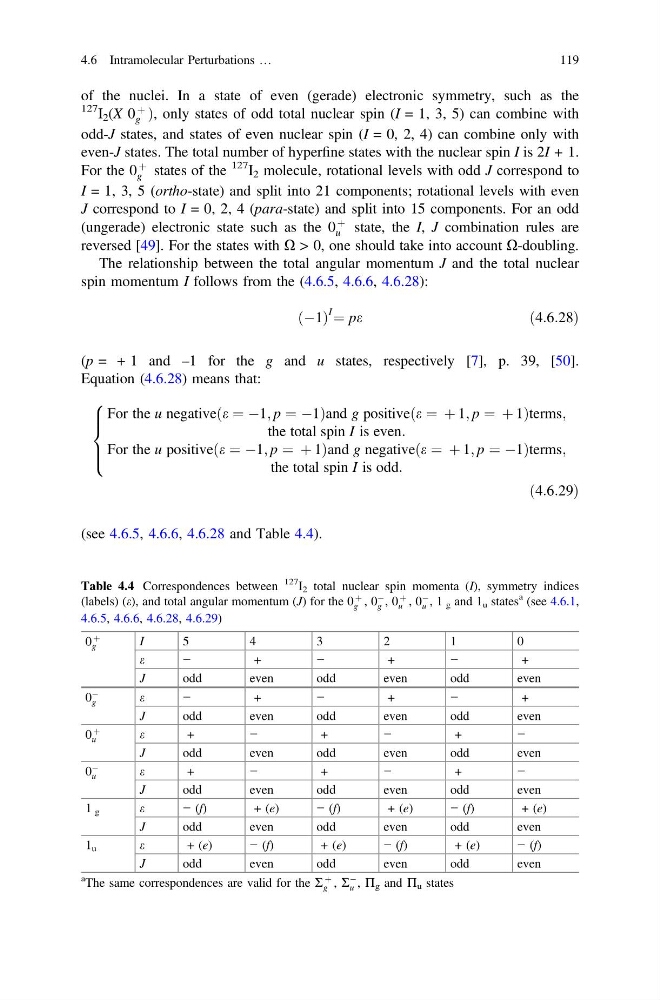
(see 4.6.5, 4.6.6, 4.6.28 and Table 4.4).
Table 4.4 Correspondences between
127 I 2 total nuclear spin momenta (I), symmetry indices
(labels) (e), and total angular momentum (J) for the 0
þ
g , 0
À
g , 0
þ
u , 0
À
u , 1 g and 1 u states
a (see 4.6.1,
4.6.5, 4.6.6, 4.6.28, 4.6.29)
0
þ
g
I
5
4
3
2
1
0
e
−
+
−
+
−
+
J
odd
even
odd
even
odd
even
0
À
g
e
−
+
−
+
−
+
J
odd
even
odd
even
odd
even
0
þ
u
e
+
−
+
−
+
−
J
odd
even
odd
even
odd
even
0
À
u
e
+
−
+
−
+
−
J
odd
even
odd
even
odd
even
1 g
e
− (f)
+( e)
− (f)
+( e)
− (f)
+( e)
J
odd
even
odd
even
odd
even
1 u
e
+ (e)
− (f)
+( e)
− (f)
+( e)
− (f)
J
odd
even
odd
even
odd
even
a The same correspondences are valid for the R
þ
g , R
À
u , P g and P u states
4.6 Intramolecular Perturbations …
119
127 I 2 (X 0
þ
g Þ, only states of odd total nuclear spin (I = 1, 3, 5) can combine with
odd-J states, and states of even nuclear spin (I = 0, 2, 4) can combine only with
even-J states. The total number of hyperfine states with the nuclear spin I is 2I + 1.
For the 0
þ
g states of the
127 I 2 molecule, rotational levels with odd J correspond to
I = 1, 3, 5 (ortho-state) and split into 21 components; rotational levels with even
J correspond to I = 0, 2, 4 (para-state) and split into 15 components. For an odd
(ungerade) electronic state such as the 0
þ
u state, the I, J combination rules are
reversed [49]. For the states with X > 0, one should take into account X-doubling.
The relationship between the total angular momentum J and the total nuclear
spin momentum I follows from the (4.6.5, 4.6.6, 4.6.28):
À1
ð Þ
I ¼ pe
ð4:6:28Þ
(p = + 1 and –1 for the g and u states, respectively [7], p. 39, [50].
Equation (4.6.28) means that:
For the u negative e ¼ À1; p ¼ À1
ð
Þ and g positive e ¼ þ 1; p ¼ þ 1
ð
Þ terms;
the total spin I is even:
For the u positive e ¼ À1; p ¼ þ 1
ð
Þ and g negative e ¼ þ 1; p ¼ À1
ð
Þ terms;
the total spin I is odd:
8
> > <
> > :
ð4:6:29Þ
(see 4.6.5, 4.6.6, 4.6.28 and Table 4.4).
Table 4.4 Correspondences between
127 I 2 total nuclear spin momenta (I), symmetry indices
(labels) (e), and total angular momentum (J) for the 0
þ
g , 0
À
g , 0
þ
u , 0
À
u , 1 g and 1 u states
a (see 4.6.1,
4.6.5, 4.6.6, 4.6.28, 4.6.29)
0
þ
g
I
5
4
3
2
1
0
e
−
+
−
+
−
+
J
odd
even
odd
even
odd
even
0
À
g
e
−
+
−
+
−
+
J
odd
even
odd
even
odd
even
0
þ
u
e
+
−
+
−
+
−
J
odd
even
odd
even
odd
even
0
À
u
e
+
−
+
−
+
−
J
odd
even
odd
even
odd
even
1 g
e
− (f)
+( e)
− (f)
+( e)
− (f)
+( e)
J
odd
even
odd
even
odd
even
1 u
e
+ (e)
− (f)
+( e)
− (f)
+( e)
− (f)
J
odd
even
odd
even
odd
even
a The same correspondences are valid for the R
þ
g , R
À
u , P g and P u states
4.6 Intramolecular Perturbations …
119