

state, describing in the second-order perturbation theory (see below). This effect is
much less than that of for the c1 u state and was not observed.
However, another effect of interaction, namely, mixing of the c1 u and d2 u
wavefunctions was observed. Due to the admixture of the c1 u rovibrational levels to
the d2 u ones, the latter can also be populated from the A1 u intermediate state in
two-step transition [44]. The extra lines in the excitation spectra of the c ! A
luminescence were observed due to ‘intensity borrowing’ from the c state and
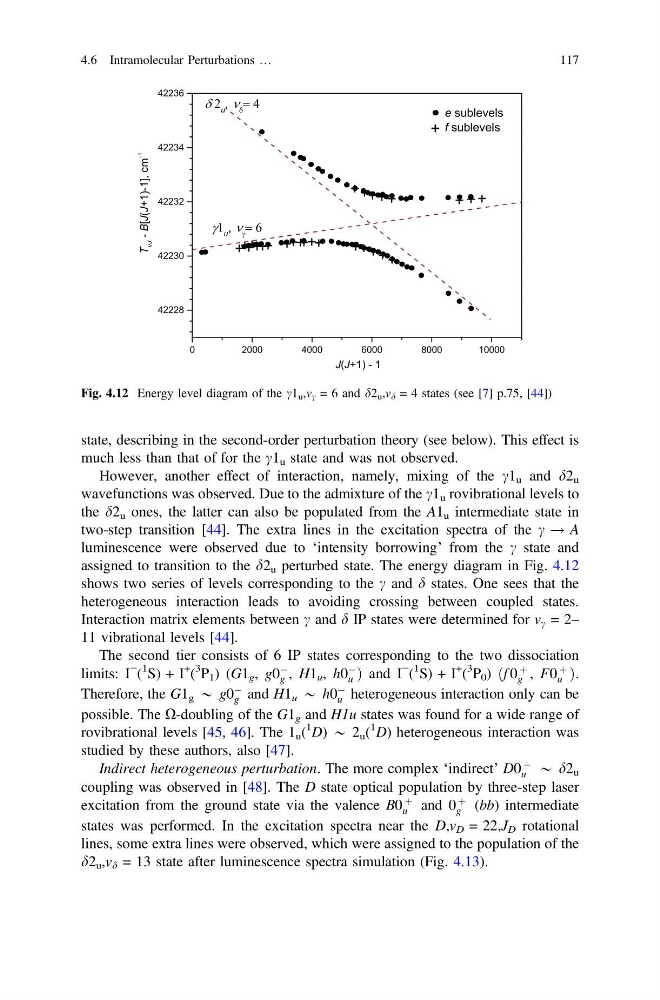
assigned to transition to the d2 u perturbed state. The energy diagram in Fig. 4.12
shows two series of levels corresponding to the c and d states. One sees that the
heterogeneous interaction leads to avoiding crossing between coupled states.
Interaction matrix elements between c and d IP states were determined for v c = 2–
11 vibrational levels [44].
The second tier consists of 6 IP states corresponding to the two dissociation
limits: I
−
(
1 S) + I
+
(
3 P 1 ) (G1 g , g0
À
g , H1 u , h0
À
u Þ and I
− (
1 S) + I
+
(
3 P 0 ) ðf 0
þ
g , F0
þ
u Þ.
Therefore, the G1 g * g0
À
g and H1 u * h0
À
u heterogeneous interaction only can be
possible. The X-doubling of the G1 g and H1u states was found for a wide range of
rovibrational levels [45, 46]. The 1 u (
1
D) * 2 u (
1
D) heterogeneous interaction was
studied by these authors, also [47].
Indirect heterogeneous perturbation. The more complex ‘indirect’ D0
þ
u * d2 u
coupling was observed in [48]. The D state optical population by three-step laser
excitation from the ground state via the valence B0
þ
u and 0
þ
g (bb) intermediate
states was performed. In the excitation spectra near the D,v D = 22,J D rotational
lines, some extra lines were observed, which were assigned to the population of the
d2 u ,v d = 13 state after luminescence spectra simulation (Fig. 4.13).
Fig. 4.12 Energy level diagram of the c1 u ,v c = 6 and d2 u ,v d = 4 states (see [7] p.75, [44])
4.6 Intramolecular Perturbations …
117
much less than that of for the c1 u state and was not observed.
However, another effect of interaction, namely, mixing of the c1 u and d2 u
wavefunctions was observed. Due to the admixture of the c1 u rovibrational levels to
the d2 u ones, the latter can also be populated from the A1 u intermediate state in
two-step transition [44]. The extra lines in the excitation spectra of the c ! A
luminescence were observed due to ‘intensity borrowing’ from the c state and
assigned to transition to the d2 u perturbed state. The energy diagram in Fig. 4.12
shows two series of levels corresponding to the c and d states. One sees that the
heterogeneous interaction leads to avoiding crossing between coupled states.
Interaction matrix elements between c and d IP states were determined for v c = 2–
11 vibrational levels [44].
The second tier consists of 6 IP states corresponding to the two dissociation
limits: I
−
(
1 S) + I
+
(
3 P 1 ) (G1 g , g0
À
g , H1 u , h0
À
u Þ and I
− (
1 S) + I
+
(
3 P 0 ) ðf 0
þ
g , F0
þ
u Þ.
Therefore, the G1 g * g0
À
g and H1 u * h0
À
u heterogeneous interaction only can be
possible. The X-doubling of the G1 g and H1u states was found for a wide range of
rovibrational levels [45, 46]. The 1 u (
1
D) * 2 u (
1
D) heterogeneous interaction was
studied by these authors, also [47].
Indirect heterogeneous perturbation. The more complex ‘indirect’ D0
þ
u * d2 u
coupling was observed in [48]. The D state optical population by three-step laser
excitation from the ground state via the valence B0
þ
u and 0
þ
g (bb) intermediate
states was performed. In the excitation spectra near the D,v D = 22,J D rotational
lines, some extra lines were observed, which were assigned to the population of the
d2 u ,v d = 13 state after luminescence spectra simulation (Fig. 4.13).
Fig. 4.12 Energy level diagram of the c1 u ,v c = 6 and d2 u ,v d = 4 states (see [7] p.75, [44])
4.6 Intramolecular Perturbations …
117