

DX = ± 1 selection rule. The E0
þ
g * b1 g [43] and c1 u * d2 u [44] coupling have
been observed and studied.
J. Perrot et al. determined the empirical formula of the b1 g e/f splitting [43] as
follows:
DE b v; J
ð Þ ¼ À 7:11 10
À6
þ 1:68 10
À7
v þ 1=2
ð
ÞÀ5:35 10
À9
v þ 1=2
ð
Þ
2
h
i
J J þ 1
ð
Þþ2:91 10 À11 J 2 J þ 1
ð
Þ
2
ð4:6:25Þ
Assuming that the interaction between E0
þ
g and b1 g states is responsible for the
splitting of rovibrational levels, the second order of the perturbation theory can be
applied [7], p. 73:
DE b v b ; J
À
Á ¼ À 6:8 10
À7
þ 3:3 10
À9
v b þ
1
2
!
J J þ 1
ð
Þ E0
þ
g J
Æ
e
b1 g
D
E
2
ð4:6:26Þ
The comparison of (4.6.25 and 4.6.26) gives the electronic matrix element that is
in good agreement with the predictions made in the pure precession model [43].
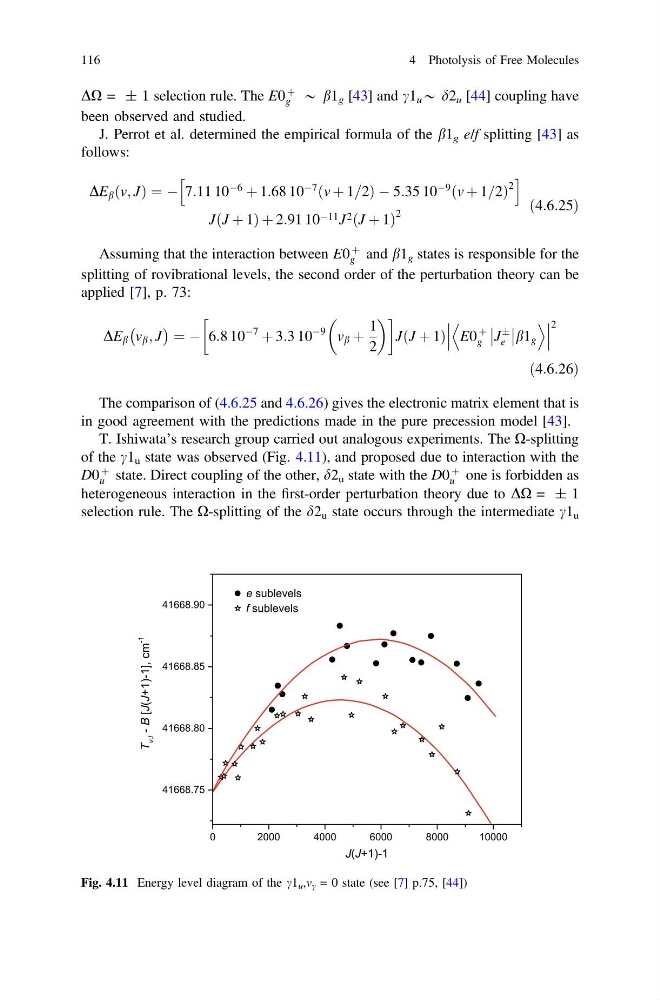
T. Ishiwata’s research group carried out analogous experiments. The X-splitting
of the c1 u state was observed (Fig. 4.11), and proposed due to interaction with the
D0
þ
u state. Direct coupling of the other, d2 u state with the D0
þ
u one is forbidden as
heterogeneous interaction in the first-order perturbation theory due to DX = ± 1
selection rule. The X-splitting of the d2 u state occurs through the intermediate c1 u
Fig. 4.11 Energy level diagram of the c1 u ,v c = 0 state (see [7] p.75, [44])
116
4 Photolysis of Free Molecules
þ
g * b1 g [43] and c1 u * d2 u [44] coupling have
been observed and studied.
J. Perrot et al. determined the empirical formula of the b1 g e/f splitting [43] as
follows:
DE b v; J
ð Þ ¼ À 7:11 10
À6
þ 1:68 10
À7
v þ 1=2
ð
ÞÀ5:35 10
À9
v þ 1=2
ð
Þ
2
h
i
J J þ 1
ð
Þþ2:91 10 À11 J 2 J þ 1
ð
Þ
2
ð4:6:25Þ
Assuming that the interaction between E0
þ
g and b1 g states is responsible for the
splitting of rovibrational levels, the second order of the perturbation theory can be
applied [7], p. 73:
DE b v b ; J
À
Á ¼ À 6:8 10
À7
þ 3:3 10
À9
v b þ
1
2
!
J J þ 1
ð
Þ E0
þ
g J
Æ
e
b1 g
D
E
2
ð4:6:26Þ
The comparison of (4.6.25 and 4.6.26) gives the electronic matrix element that is
in good agreement with the predictions made in the pure precession model [43].
T. Ishiwata’s research group carried out analogous experiments. The X-splitting
of the c1 u state was observed (Fig. 4.11), and proposed due to interaction with the
D0
þ
u state. Direct coupling of the other, d2 u state with the D0
þ
u one is forbidden as
heterogeneous interaction in the first-order perturbation theory due to DX = ± 1
selection rule. The X-splitting of the d2 u state occurs through the intermediate c1 u
Fig. 4.11 Energy level diagram of the c1 u ,v c = 0 state (see [7] p.75, [44])
116
4 Photolysis of Free Molecules