

Electrostatic perturbation. In light molecules, homogeneous perturbations due
to electrostatic interaction are often very strong, 400 cm
−1 < H
12
el < 10
4 cm
−1 (see
Table 3.5 in [31]).
Most frequently, these interactions occur between Rydberg and valence states
[31], p. 307 as well as Rydberg and ion pair state in dihalogens [7], p. 82. In the
latter cases, interactions are weaker.
Spin–orbit perturbation. Spin-orbit perturbation (interaction) causes the mixing
of electronic states according to selection rules (4.6.17) and splitting of the
fine-structure components, corresponding to different X values. Spin–orbit interaction and splitting between the states belonging to the same configuration are
described in Sect. 4.2.3.
Rotational perturbations. The spin-electronic homogeneous perturbation is
much weaker than the S–O one (see above). Two other types of rotational perturbation mentioned above (heterogeneous interactions) cause K- and X-doubling.
They have been studied in the iodine molecule in details (see Sect. 4.3 in [7]).
In principle, the B
0 0
À
u $ B
00 1 u , a1 g $ 0
þ
g , B0
þ
u $ 1 u ab
ð Þ, and 0
À
u $ 1 u bb
ð Þ
heterogeneous interactions in the iodine molecule valence states can occur (see
Fig. 4.4). To the best of our knowledge, the 0
À
u $ 1 u bb
ð Þ one has been observed,
only [42] (see Sects. 4.1 and 4.3.1.2 in [7], also).
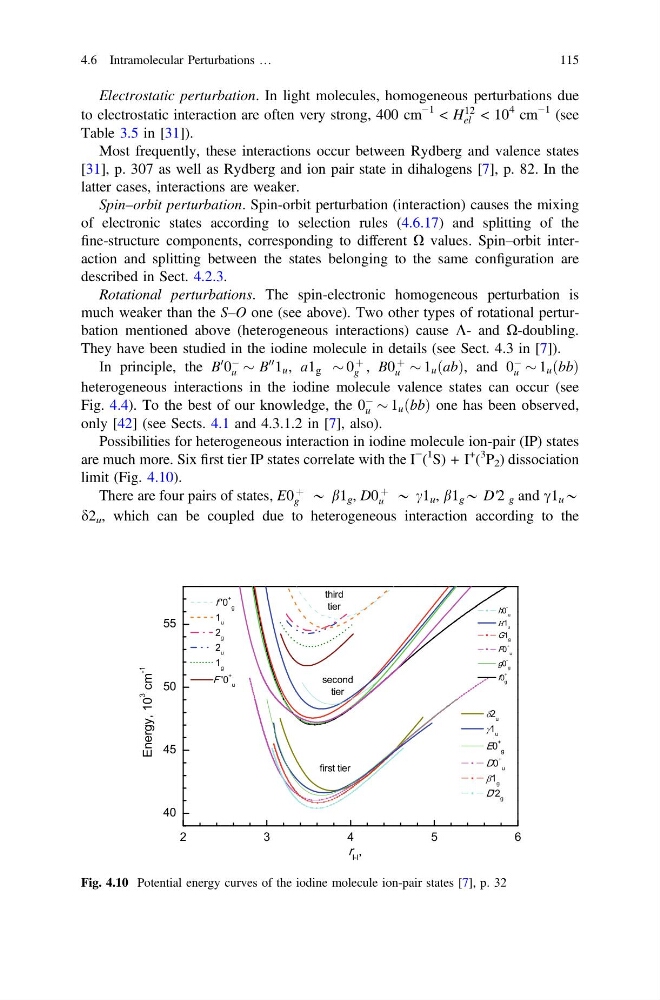
Possibilities for heterogeneous interaction in iodine molecule ion-pair (IP) states
are much more. Six first tier IP states correlate with the I
− (
1 S) + I
+
(
3 P 2 ) dissociation
limit (Fig. 4.10).
There are four pairs of states, E0
þ
g * b1 g , D0
þ
u * c1 u , b1 g * D'2 g and c1 u *
d2 u , which can be coupled due to heterogeneous interaction according to the
Fig. 4.10 Potential energy curves of the iodine molecule ion-pair states [7], p. 32
4.6 Intramolecular Perturbations …
115
to electrostatic interaction are often very strong, 400 cm
−1 < H
12
el < 10
4 cm
−1 (see
Table 3.5 in [31]).
Most frequently, these interactions occur between Rydberg and valence states
[31], p. 307 as well as Rydberg and ion pair state in dihalogens [7], p. 82. In the
latter cases, interactions are weaker.
Spin–orbit perturbation. Spin-orbit perturbation (interaction) causes the mixing
of electronic states according to selection rules (4.6.17) and splitting of the
fine-structure components, corresponding to different X values. Spin–orbit interaction and splitting between the states belonging to the same configuration are
described in Sect. 4.2.3.
Rotational perturbations. The spin-electronic homogeneous perturbation is
much weaker than the S–O one (see above). Two other types of rotational perturbation mentioned above (heterogeneous interactions) cause K- and X-doubling.
They have been studied in the iodine molecule in details (see Sect. 4.3 in [7]).
In principle, the B
0 0
À
u $ B
00 1 u , a1 g $ 0
þ
g , B0
þ
u $ 1 u ab
ð Þ, and 0
À
u $ 1 u bb
ð Þ
heterogeneous interactions in the iodine molecule valence states can occur (see
Fig. 4.4). To the best of our knowledge, the 0
À
u $ 1 u bb
ð Þ one has been observed,
only [42] (see Sects. 4.1 and 4.3.1.2 in [7], also).
Possibilities for heterogeneous interaction in iodine molecule ion-pair (IP) states
are much more. Six first tier IP states correlate with the I
− (
1 S) + I
+
(
3 P 2 ) dissociation
limit (Fig. 4.10).
There are four pairs of states, E0
þ
g * b1 g , D0
þ
u * c1 u , b1 g * D'2 g and c1 u *
d2 u , which can be coupled due to heterogeneous interaction according to the
Fig. 4.10 Potential energy curves of the iodine molecule ion-pair states [7], p. 32
4.6 Intramolecular Perturbations …
115